Oil shipping, insurance costs spike as Hormuz tensions test UAE trade routes
Iran-US conflict disrupts key maritime corridor with higher freight rates, idle vessels
Dubai: Oil freight rates are surging and maritime traffic is stalling around the Strait of Hormuz, putting the UAE at the center of a rapidly escalating disruption to global energy and trade flows.
Stay updated: Get the latest faster by downloading the Gulf News app - it's completely free. Click here for Apple or here for Android. You can also find it us on the Huawei AppGallery.
Shipowners are demanding sharply higher fees to move crude out of the Gulf after U.S. and Israeli strikes on Iran triggered retaliatory action and heightened security risks in the narrow waterway that carries roughly a fifth of the world’s oil.
South Korea’s Sinokor is seeking about 700 Worldscale points to transport Middle East crude to China on very large crude carriers, according to shipbrokers. Two brokers said that level would translate to roughly $20 a barrel for cargoes discharged in eastern China, compared with an average of about $2.50 last year.
Freight rates spiral
A tanker controlled by Greece’s Dynacom Tankers Management was provisionally leased at 525 Worldscale, equivalent to daily earnings of about $350,000, reported Bloomberg. The Baltic Exchange said it is consulting panelists on how to respond to conditions in Hormuz as it determines benchmark freight assessments.
The Strait of Hormuz, which links the Arabian Gulf to the Indian Ocean between Iran and Oman, is almost 100 miles long and just 21 miles wide at its narrowest point. Shipping lanes in each direction are about two miles wide. In 2023, flows through the waterway averaged 20.9 million barrels per day, according to the U.S. Energy Information Administration.
UAE at crosscurrents
The UAE, one of OPEC’s largest producers, relies heavily on Hormuz for crude exports and as a conduit for refined products and liquefied natural gas moving through its ports.
At least 150 tankers, including crude and LNG vessels, dropped anchor in Gulf waters beyond the strait following the strikes, according to ship-tracking data cited by Reuters. Dozens more were stationary on the other side of the chokepoint. Many were clustered within the exclusive economic zones of Gulf states including the UAE and Kuwait, according to MarineTraffic data.
The U.S. Navy-led Joint Maritime Information Center said no formal suspension of traffic had been communicated by recognized maritime authorities, but warned mariners to expect “increased naval presence, enhanced force protection postures, potential VHF hailing, congestion near anchorage areas outside the Strait, and insurance market volatility.”
Insurance shock
Insurers have moved quickly. War risk underwriters submitted cancellation notices for vessels transiting the Gulf and Strait of Hormuz, brokers told the Financial Times, with premiums expected to rise by as much as 50%.
Insurance costs for ships sailing through the Gulf had been about 0.25% of a vessel’s replacement value, according to Marsh. For a $100 million ship, that implies an increase from $250,000 to $375,000 per voyage if rates climb by half.
“If Israel and U.S. are continuing to strike Iran, it’s more likely that Iran will start trying to leverage their control via the manipulation of shipping in the region,” Dylan Mortimer, marine hull UK war leader at broker Marsh, told the FT, adding that underwriters were also pricing in the risk of vessel seizure attempts.
Ports, trade at risk
The UAE has some capacity to bypass Hormuz. The Habshan-Fujairah pipeline can transport up to 1.5 million barrels per day from Abu Dhabi’s oil fields to the port of Fujairah on the Gulf of Oman, outside the strait. Even so, most regional exports, including crude from Iraq, Kuwait and Qatar, must pass through Hormuz.
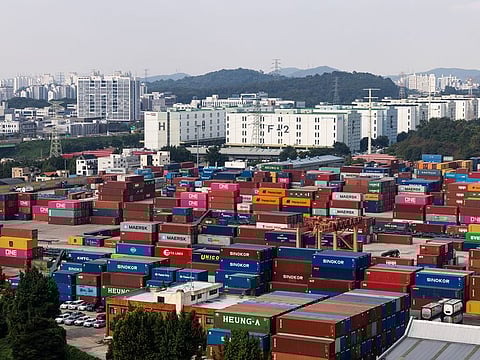
The waterway is also critical for the UAE’s role as a regional trade hub. Ports such as Jebel Ali and Khor Fakkan function as transshipment centers linking Asia, Europe and Africa. Disruption threatens container flows as well as energy shipments.
Denmark’s A.P. Moller-Maersk said it would suspend vessel crossings in the Strait of Hormuz until further notice and warned of delays to services calling Arabian Gulf ports. Germany’s Hapag-Lloyd said it had suspended transits through Hormuz, citing crew safety. France’s CMA CGM instructed vessels in the Gulf to proceed to shelter and rerouted ships around the Cape of Good Hope. MSC ordered vessels operating in the region to designated safe areas.
Container costs climb
Maersk also paused future trans-Suez sailings through the Bab el-Mandeb Strait, a key link between the Red Sea and the Gulf of Aden that accounts for an estimated 12% of seaborne oil trade and 8% of LNG trade in the first half of 2023.
Peter Sand, chief analyst at Xeneta, said higher container shipping rates should be factored in for the Middle East region for as long as the conflict persists, adding there is “no real alternative” to ocean freight.
“The risk of geopolitics has shown its ugly face with higher frequency and more severity over the past years than ever before,” Sand told CNBC, adding that the industry was grappling with constant contingency planning as new developments unfold.
Market fallout
Energy analysts say even short-lived disruption can ripple across markets.
A full closure of Hormuz for more than a few days could push oil prices above $100 a barrel, according to Wood Mackenzie. Brent crude averaged $67 year-to-date as of March 2, after briefly topping $80 that day.
Amrita Sen, founder and director of market intelligence at Energy Aspects, said a complete shutdown of the strait was unlikely given the prospect of a swift military response. But isolated attacks on tankers could still deter shipping.
“While we are not saying the strait is going to get closed, what the U.S. will not be able to do is control these one-off attacks on tankers and that is enough to make the market extremely cautious about sending vessels in,” Sen said.
For the UAE, the stakes extend beyond crude exports. The region accounts for about 15% of global aluminum exports and nearly a third of global fertilizer trade, much of which transits Hormuz. The Al Khaleej Sugar refinery in Dubai handles roughly 3% of global sugar production, with part of its exports moving through the strait.
Any prolonged disruption risks higher energy prices, elevated freight and insurance costs, and renewed inflationary pressure worldwide — with the UAE’s ports, pipelines and trade corridors positioned at the heart of the fallout.
– With inputs from Agencies