How DP World’s Fujairah terminals will give Jebel Ali cargo an alternative route
East coast gateway to handle nearly half of re-exports now moving via Jebel Ali: Moody’s
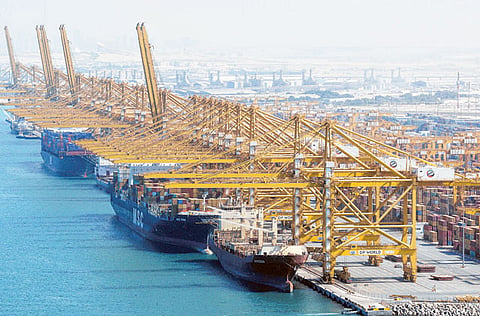
Dubai: The UAE’s planned new terminals in Fujairah will create another route for essential imports, protect re-export trade and reduce the economy’s dependence on a single maritime gateway, according to Moody’s Ratings.
Get updated faster and for FREE: Download the Gulf News app now - simply click here.
“The new terminals will provide free zone tenants with an alternative route for importing and re-exporting goods, mitigating potential disruptions from a closure of the Strait of Hormuz,” Moody’s said in a research note published on Friday.
“They will also strengthen UAE supply chains by providing an alternative entry point for essential cargo, including construction materials used in the real estate sector.”
Why does location matter?
Jebel Ali lies inside the Strait of Hormuz, while Fujairah faces the Gulf of Oman and provides direct access to the Indian Ocean. This gives the UAE another maritime gateway if shipping through the strait faces prolonged disruption.
The strategic importance of the expansion has increased following interruptions to shipping through the Strait of Hormuz since March 2026, which have adversely affected cargo volumes and earnings at Jebel Ali, Moody’s said.
“Located outside the Gulf, Fujairah offers direct access to the Indian Ocean, making it a strategically important gateway for liner shipping,” Alphaliner said in an analysis cited by shipping publication The Loadstar.
The east coast location means vessels carrying goods to the UAE could call at Fujairah without first travelling through the strait. The cargo could then move overland to businesses, logistics centres and consumers elsewhere in the country.
How new route will work
The terminals will connect with Jebel Ali Port and Jebel Ali Free Zone through DP World’s inland logistics network. Cargo owners will be able to move goods between the UAE’s east and west coasts and onwards to domestic or overseas markets.
The infrastructure will complement rather than replace Jebel Ali. It will extend the port’s logistics and free-zone ecosystem to Fujairah, giving businesses more flexibility in how they import, distribute and re-export goods.
For residents and companies, the connection would provide another route for goods entering the country. It could also reduce the risk of cargo shifting permanently to competing regional ports during prolonged disruption.
Yuvraj Narayan, Group Chief Executive Officer of DP World, said the project would add capacity as Jebel Ali operates at high utilisation. “Fujairah strengthens what Jebel Ali already delivers — a single, global integrated platform for moving goods across global supply chains and within the UAE and beyond,” Narayan said.
“With Jebel Ali operating at high utilisation, this development provides the additional capacity to support long-term growth. For cargo owners, it means greater flexibility, more choice and stronger supply chain resilience.”
UAE re-export trade security
DP World expects the development to increase its annual container-handling capacity in the UAE by about 13%, from 19.4 million twenty-foot equivalent units, or TEUs, to almost 22 million TEUs.
Moody’s described the increase as relatively modest but estimated that the additional capacity could accommodate close to half of the re-export volumes currently handled through Jebel Ali.
Re-export cargo is more vulnerable to relocation than goods destined for the UAE domestic market. Companies using the country as a hub to serve other markets can shift shipments to competing ports if established routes face persistent disruption.
“The new terminals therefore enhance DP World’s ability to retain these volumes and preserve the competitiveness of its UAE logistics ecosystem,” Moody’s said.
Retaining that trade could support activity across ports, free zones, warehouses, road transport, freight forwarding, customs clearance and distribution services. Moody’s did not estimate the project’s wider contribution to economic output, trade or employment.
Al Rugaylat will have annual capacity for up to 2.5 million TEUs, 1.7 million tonnes of general cargo and 190,000 car equivalent units. The deep-water facility will be capable of handling the latest generation of Ultra Large Container Vessels.
Dibba will add capacity for as much as 3.6 million tonnes of general cargo a year, expanding the UAE’s ability to handle non-containerised shipments.
Investment, jobs in Fujairah
The project will bring additional port and logistics activity to Fujairah, which already serves as a maritime and energy centre because of its position outside the Strait of Hormuz.
Sheikh Saleh Bin Mohamed Al Sharqi, Chairman of the Fujairah Ports Authority, said the terminals would bring investment and additional operating capacity to the emirate.
“The Al Rugaylat and Dibba terminals will bring world-class operating capability, expanded capacity and new investment to the emirate,” he said.
“We look forward to working with DP World to deliver a project that will benefit customers, communities and the UAE’s wider economy.”
DP World said the development of Fujairah’s ports and logistics zone would support investment, employment and long-term economic opportunities. It did not disclose the investment value or provide a forecast for job creation.
More cargo moving between the two coasts will increase the use of inland transport and logistics services. Moody’s said this could modestly dilute DP World’s margins compared with its higher-margin port operations.
The rating agency said the wider network benefits would reduce the concentration risk associated with one maritime gateway and improve connectivity across the UAE.
3-year construction plan
Moody’s described the agreement as credit positive for DP World, which has a Baa2 rating with a stable outlook. “We view the agreement as credit positive for DP World because it enhances the resilience of its ports network and supports its revenue base stability,” the agency said.
The development will require capital expenditure, but Moody’s does not expect it to materially increase DP World’s forecast spending of $3 billion in 2026.
DP World had $4.6 billion in unrestricted cash at the end of 2025, about $1.6 billion in available committed credit facilities and around $1 billion of further term-loan capacity.
Moody’s said these funding sources gave the company substantial room to finance the development and absorb potential execution risks while maintaining credit measures consistent with its current rating.
The project’s scale and 50-year concession also highlight the high barriers to entering the GCC ports sector, according to the agency. Jebel Ali’s size, integrated logistics services and diverse cargo base continue to support its competitive position.
Construction will proceed in phases and is expected to take about 24 to 30 months from commencement. Moody’s referred to a construction period of approximately three years and said the project’s credit benefits would materialise over time.