EGA profit falls 10% to $1.57 billion as regional conflict hits aluminium sales
Al Taweelah smelter recovery is progressing, with full production targeted in Q1 2027
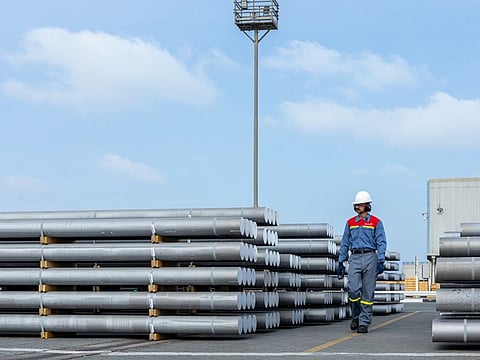
Abu Dhabi: Emirates Global Aluminium (EGA) reported a 10 per cent decline in adjusted earnings for the first nine months of 2026, as the regional conflict disrupted production at its Al Taweelah facilities and constrained aluminium exports from the UAE.
The Abu Dhabi-based producer recorded adjusted earnings before interest, tax, depreciation and amortisation (EBITDA) of $1.572 billion (Dh5.77 billion) for the nine months to September, compared with $1.738 billion (Dh6.38 billion) in the same period last year.
Total aluminium sales volumes fell 36 per cent to 1.327 million tonnes, from 2.083 million tonnes a year earlier. The decline reflected lower metal availability following the shutdown of Al Taweelah and logistical constraints affecting outbound shipments.
Higher realised aluminium prices, a greater share of higher-value products and cost controls helped cushion the impact of lower volumes.
EGA's adjusted EBITDA margin increased to 30 per cent from 28 per cent, while value-added products accounted for 88 per cent of sales, up from 83 per cent.
The company said its performance had been affected by the March 28 incident at Khalifa Economic Zone Abu Dhabi, which led to an emergency shutdown of all Al Taweelah facilities.
After accounting for the $53 million impact on EBITDA linked to the incident, reported EBITDA stood at $1.519 billion (Dh5.58 billion).
"In the first nine months of 2026, EGA has been tested like never before. These results demonstrate our deep operational expertise, our people's resilience and adaptability, and the fundamental strength of our business," said Abdulnasser Bin Kalban, chief executive of EGA.
Profit declines
EGA's adjusted net profit fell 9 per cent to $744 million (Dh2.73 billion), compared with $817 million (Dh3 billion) in the first nine months of 2025.
Reported net profit was lower at $547 million (Dh2.01 billion), after the company recognised a net impact of $197 million (Dh725 million) related to the incident.
Revenue declined to $5.282 billion (Dh19.4 billion), from $6.279 billion (Dh23.06 billion) a year earlier. Lower sales volumes more than offset the benefit of higher realised aluminium prices and an improved product mix.
Al Taweelah recovery
EGA has restarted 766 of the 1,262 reduction cells at its Al Taweelah smelter, representing 61 per cent of the total. The company expects to complete the restart during the first quarter of 2027.
The emergency shutdown on March 28 affected all Al Taweelah facilities, while EGA's Jebel Ali operations and international recycling plants continued operating.
The Al Taweelah alumina refinery produced 899,000 tonnes in the first nine months, compared with 1.747 million tonnes a year earlier.
Following its restart in early July, the refinery initially operated at around 50 per cent capacity before increasing to approximately 70 per cent in early September. EGA said the pace of further expansion would depend on supply chain considerations and its alumina sourcing strategy.
The company estimates that restoring Al Taweelah production will require capital expenditure of approximately $400 million (Dh1.5 billion), with most spending expected in 2026 and the remainder in 2027.
Exports rerouted
The disruption also affected EGA's ability to ship aluminium from the UAE.
After temporarily suspending new outbound shipments in March because of logistical constraints linked to the regional conflict, EGA established alternative export routes through ports outside the Strait of Hormuz.
In September, the company signed an agreement with Gulftainer to expand its export capacity through the UAE's East Coast.
Under the agreement, EGA plans to route up to 250,000 tonnes of aluminium through the East Coast in the first year, increasing to as much as 300,000 tonnes in the second year.
The company has also diversified inbound routes through alternative regional ports and transport corridors to secure raw materials for its smelter and refinery.
It renewed its long-term bauxite supply agreement with Compagnie des Bauxites de Guinée (CBG), securing supplies of up to 4.9 million tonnes annually until 2044. The first shipment under the renewed agreement, comprising approximately 66,000 tonnes, arrived in October.
Aluminium prices
Higher global aluminium prices helped support EGA's earnings despite the decline in sales volumes.
The average London Metal Exchange aluminium price rose to $3,328 per tonne in the first nine months of 2026, compared with $2,566 per tonne in the same period last year.
Regional premiums also increased. The average European premium more than doubled to around $429 per tonne from $192 per tonne, while the Japanese premium rose to approximately $294 per tonne from $135 per tonne.
In the US, the average premium climbed to around $2,409 per tonne, compared with approximately $1,100 per tonne a year earlier.
EGA said higher realised prices and a greater proportion of value-added products helped offset lower production and shipments.
Cash position
EGA's cash flow from operations declined to $613 million (Dh2.25 billion), compared with $1.422 billion (Dh5.22 billion) in the first nine months of 2025.
The company attributed the reduction to lower adjusted EBITDA and higher working capital requirements, including increased finished metal inventories and the accumulation of raw materials to protect supply chains.
EGA expects some of this working capital to be released as Al Taweelah production and export capacity recover. The company reported total liquidity of $2.93 billion (Dh10.76 billion) as of September 30. This included $1.93 billion (Dh7.07 billion) in cash and term deposits and an undrawn revolving credit facility of $1 billion (Dh3.67 billion).
Net debt to adjusted EBITDA stood at 1.5 times. Total debt increased to $4.9 billion (Dh18.1 billion), compared with $3.5 billion (Dh12.7 billion) a year earlier.
Chief financial officer Pål Kildemo said the company had taken steps to protect its financial position.
"Najah 2.0 and our dedicated cash preservation programme together delivered $213 million of value in the first nine months, and we are strengthening Najah further to embed lasting improvements in cost and performance," he said.
The Najah 2.0 programme delivered $153 million in improvements against its 2024 baseline, while a separate cash preservation programme generated $60 million in savings. EGA is targeting $440 million in annual improvements by 2030.
Kildemo said the company's liquidity position would allow it to complete the Al Taweelah restoration while continuing to pursue strategic investments.
Recycling expansion
EGA is also expanding its international recycling business. In September, the company completed the acquisition of an 80 per cent stake in Italian aluminium recycler Eco Green.
The acquisition takes EGA's recycling capacity to more than 400,000 tonnes annually across the UAE, Europe and the US. A further 200,000 tonnes of capacity is under development in Europe and the US.
EGA sold 71,000 tonnes of its RevivAL recycled aluminium in the first nine months of 2026, compared with 68,000 tonnes a year earlier.
Sales of low-carbon primary aluminium under its CelestiAL and MinimAL brands stood at 68,000 tonnes, compared with 76,000 tonnes in the same period of 2025.


