Global oil prices next hinge on security of Iran’s Kharg Island
Iran export hub handles most crude shipments, making markets highly sensitive to risk
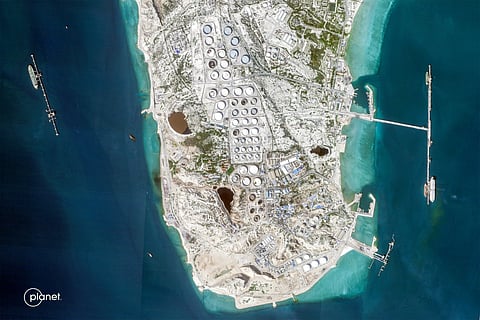
Dubai: Global oil markets are now closely watching Iran’s Kharg Island, a key export hub whose disruption could quickly drive crude prices higher by tightening global supply.
The small island in the Arabian Gulf handles around nine out of every ten barrels of Iranian crude exports, making it one of the most strategically important oil terminals in the global energy system.
Iran currently exports roughly 1.5 million barrels per day through the facility — a volume larger than the total output of many members of the Organization of the Petroleum Exporting Countries (OPEC). Any disruption to the terminal could therefore remove significant supply from international markets and amplify volatility in oil prices.
Stay updated: Get the latest faster by downloading the Gulf News app - it's completely free. Click here for Apple or here for Android. You can also find it on the Huawei AppGallery.
Critical node in supply
Located about 15 miles (24 kilometres) off Iran’s mainland, Kharg Island has served as the country’s main crude export terminal since the 1960s, when it was developed by Amoco before being nationalised after Iran’s 1979 Islamic Revolution.
Crude produced across Iran’s oil fields is transported via subsea pipelines to the island, where it is stored in large tanks before being loaded onto tankers bound for international buyers.
The site has storage capacity of about 30 million barrels, roughly one-third of the capacity of the major U.S. oil storage hub in Cushing, Oklahoma.
Kharg Island can berth eight tankers simultaneously and load more cargo through ship-to-ship transfers. Iranian officials say the terminal can load more than 6 million barrels per day, rising to as much as 10 million barrels under peak conditions.
Because of this scale, traders closely track activity at the terminal to gauge the flow of Iranian crude into global markets.
Export flows monitored
The majority of crude shipped from Kharg Island is destined for China, making the terminal a key link in the supply chain between Middle Eastern producers and Asian energy consumers.
Governments and traders also monitor the terminal to assess how sanctions affect Iran’s oil exports.
Even modest disruptions in loading schedules or export volumes can move prices as traders adjust expectations for global supply.
Iran increased oil loadings at Kharg Island before hostilities in the region intensified, and tankers continued filling there after tensions escalated.
Satellite tracking showed two very large crude carriers moored at the terminal on March 7, with several additional tankers anchored nearby.
Supply risks go beyond
Oil shipments leaving Kharg Island must pass through the Strait of Hormuz, the narrow maritime corridor between Iran and Oman that carries about one-fifth of the world’s oil supply.
Shipping traffic through the strait has fallen sharply since regional tensions escalated, further tightening the supply outlook.
Even if exports continue loading at Kharg Island, disruptions in tanker traffic through Hormuz could still restrict how much oil reaches international markets.
Market consequences
Any disruption to Kharg Island would likely remove most Iranian exports from global markets for weeks or months.
That loss of supply would come at a time when global inventories are already tight, increasing the risk of sharp price spikes.
Oil traders say such a disruption could quickly push crude prices higher worldwide, feeding inflation pressures in major economies including the United States and Europe.
Because Kharg Island plays such a central role in Iran’s energy exports, the terminal has long been seen as one of the most sensitive pressure points in global oil supply chains.
- With inputs from Agencies


