Anatomy of oil shocks: What historical data shows about key geopolitical moments
Black gold: How oil price has proven extraordinarily sensitive to global disruptions
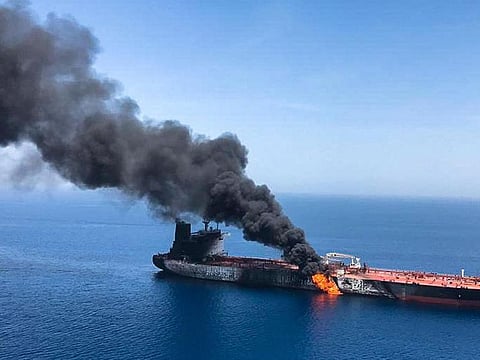
Oil has long been dubbed "black gold", but its price has proven extraordinarily sensitive to global disruptions.
Geopolitical events — such as wars, embargoes, revolutions and territorial invasions — have repeatedly triggered sharp spikes in crude oil prices.
They often lead to broader economic fallout like recessions, inflation surges, and shifts in global power dynamics.


These shocks aren't random.
When supply gets gutted or disrupted in key oil-producing regions, key export routes (like the Strait of Hormuz), and demand fluctuations amplify international tensions.
Recent numbers rattle global energy markets: Approximately 90 ships, including oil tankers, passed through the Strait of Hormuz between March 1 and March 15, 2026, as per maritime tracking sites.
These vessels include Iranian-affiliated ships, along with others heading to Asia, often navigating the area under increased tension and selective passage.
This marks a significant drop from the usual 100–135 daily transits before the conflict, according to CNBC.
Drawing from historical data and analyses, below is a chronological overview of key oil price shocks since 1973.
1973: The first oil shock – Arab-Israeli War and OPEC embargo
The modern era of oil shocks began amid the Yom Kippur War in October 1973, when Egypt and Syria attacked Israel. In retaliation against Western support for Israel, Arab members of the Organisation of Petroleum Exporting Countries (OPEC) imposed an oil embargo on the US, Europe, Japan, and others.
This cut global supply by about 5%, quadrupling prices from around $3 per barrel to $12 by early 1974.
The US faced gas shortages, rationing, and a recession. It was amplified by prior monetary tightening.
This event marked OPEC's rise as a geopolitical force. It shifted control from Western oil companies to producer nations.
It also set a precedent: supply-side shocks from Middle Eastern conflicts could cripple economies worldwide.
1979: The second oil shock – Iranian Revolution
Geopolitical turmoil struck again with the 1979 Iranian Revolution, which overthrew the Shah and halted Iran's oil exports (then about 5 million barrels per day).
Prices more than doubled from $14 to over $30 per barrel by 1980, exacerbated by the Iran-Iraq War's outbreak later that year.
Unlike 1973, this wasn't a deliberate embargo but a production collapse amid internal chaos. The US economy entered another recession, with inflation spiking and uncertainty fueling speculative trading, as per the EIA.
This shock highlighted oil's vulnerability to regime changes in key producers, and it coincided with US Federal Reserve policy shifts under Paul Volcker, worsening the downturn.
1990-1991: Gulf War – Iraq's invasion of Kuwait
In August 1990, Iraq under Saddam Hussein invaded Kuwait, seizing control of significant oil fields and prompting UN sanctions.
Oil prices surged from $15 to $42 per barrel by October as exports from both countries (about 4.3 million barrels daily) halted, according to Science Direct.
The US-led coalition's swift military response ("Operation Desert Storm") restored supplies, with Saudi Arabia ramping up output to offset losses.
Prices stabilized quickly, but the event caused a brief US recession. The Leverage Shares chart pegs this as a +75% spike over two months, underscoring how rapid military interventions can limit long-term damage compared to prolonged conflicts.
Late 1990s: Asia crisis cecovery and OPEC cuts
The 1997-1998 Asian Financial Crisis initially depressed oil demand, crashing prices to $11 per barrel by December 1998. But recovery came via OPEC production cuts and surging demand, particularly from Asia. Prices rebounded to $33 by September 2000—a +205% rise over 1 year and 9 months, per the chart.
This wasn't a pure war shock but was influenced by geopolitical maneuvering within OPEC, including Saudi-led quota reductions.
It demonstrated how economic recoveries in emerging markets could amplify price swings, setting the stage for the next "supercycle".
2000s: Commodity 'supercycle' – Iraq War and China demand boom
The early 2000s saw a massive +592% surge over 6 years and 7 months, from $21 in January 2002 to $145 in July 2008. Geopolitics played a key role with the 2003 US invasion of Iraq, which disrupted output amid fears of wider Middle East instability. However, the spike was supercharged by non-geopolitical factors like explosive demand from China's industrialization.
The chart labels this the "2000s Supercycle: Iraq War - China Demand," illustrating a blend of supply fears and demand pressures. The rally ended with the 2008 Global Financial Crisis (GFC), which tanked prices to $32 by year's end as global activity contracted.
2009-2011: Post-GFC rally – QE and Arab Spring
Post-GFC, oil prices rallied +235% over 2 years and 2 months, from $41 in February 2009 to $114 in April 2011. Quantitative easing (QE) stimulus boosted demand, but geopolitics ignited the surge via the 2011 Arab Spring uprisings.
Revolts in Libya, a major producer, slashed output by 1.5 million barrels daily, while tensions spread to other OPEC nations, as per Business Insider.
The chart attributes this to "Post-GFC Rally: QE Stimulus - Arab Spring," showing how monetary policy and regional unrest can compound.
Prices later eased as Libyan production recovered, but the event reinforced oil's role in amplifying social and political instability.
2020-2022: COVID-Ukraine 'dual shock'
The most dramatic recent spike was +934% over 1 year and 10 months, from a historic negative $37 (briefly in April 2020 due to storage overflows amid COVID lockdowns) to $120 by March 2022.
The pandemic crushed demand, but Russia's 2022 invasion of Ukraine triggered supply fears, with sanctions cutting Russian exports (about 8 million barrels daily).
The chart calls this "COVID-Ukraine: Neg Price - War Supply Shock," capturing the whiplash from demand collapse to wartime shortages. It fueled global inflation and recessions in some economies, with Europe hit hardest by energy dependence on Russia.
2026: US-Israel-Iran conflict – Hormuz threat
As of March 2026, oil prices have spiked +95% over two months amid the US-Israel-Iran war, from $55 in December 2025 to $108 by February 2026.
Tensions escalated with Iran's threats to the Strait of Hormuz—a chokepoint for 20% of global oil—and direct military exchanges.
The Leverage Shares chart labels this "US-Israel Iran War: Feb 28 2026 - Hormuz Threat," noting it's ongoing. Markets are pricing in supply risks, though increased US shale output and OPEC+ spare capacity have tempered the rise so far.
This fits the historical pattern: immediate reactions to chokepoint threats, with potential for further escalation.
Patterns
Analyses of these shocks reveal patterns: supply disruptions from Middle East conflicts often cause the sharpest spikes, while demand-driven recoveries (like post-Asia or GFC) prolong rallies.
Not all geopolitical events spike prices — some, like the 1980 Iran-Iraq War start, had muted effects as they are offset by other producers.
But duration matters most.
Persistent shocks (e.g., 1970s) lead to inflation and recessions, while short ones (e.g., 1990) have limited impact, as per Business Insider.
Currencies of oil exporters (like USD and CAD) often strengthen during shocks, while importers suffer.
Looking ahead, with energy transitions accelerating toward renewables, future shocks may be less severe, but dependence on volatile regions persists.
While the 2026 Iran-US-Israel conflict echoes past patterns, it reminds global consumers: oil remains a geopolitical linchpin.


