Why US military might can’t end Iran war despite Trump’s strikes and blockade
Iran doesn’t need to defeat US — it only needs to remain dangerous enough to prolong war
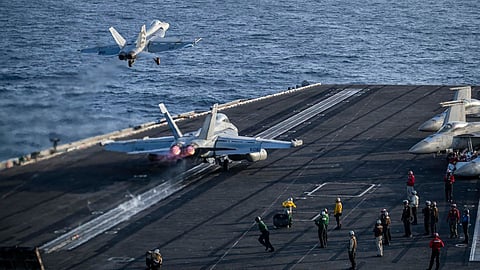
Dubai: On almost every conventional measure of military power, the contest between the United States and Iran should be hopelessly unequal.
The US can send advanced aircraft deep into Iranian territory, destroy radar and missile sites, blockade ports and deploy some of the world’s most sophisticated warships, surveillance systems and air defences.
Iran has lost senior leaders, much of its navy has been destroyed and its ability to monitor and threaten shipping through the Strait of Hormuz has been repeatedly degraded.
Yet six months after the war began, Iran is still fighting — and Washington is still striking some of the same types of targets it attacked before.
Why?
Because Iran does not have to defeat the United States militarily to frustrate it.
It only has to survive, rebuild enough of its capabilities to keep threatening shipping and US interests, and make Washington pay an increasingly high price for achieving its objectives.
That is the asymmetric problem at the heart of America’s Iran war.
A weaker Iran can still hurt
Michael Froman, president of the Council on Foreign Relations, told The New York Times that Iran was fundamentally weaker than it was several years ago and that the US military had achieved many of its objectives.
But he pointed to the challenge posed by asymmetric warfare: Even a much smaller power with far fewer capabilities can deploy them strategically enough to frustrate a vastly stronger adversary.
Iran has demonstrated exactly that around Hormuz.
Tehran does not have to completely close the strait. Nor does it have to sink large numbers of commercial vessels.
It needs only to preserve enough uncertainty over the safety of the waterway to make shipping companies, insurers and energy traders nervous.
A drone approaching a tanker, an anti-ship missile launch or the possibility of mines in shipping lanes can raise insurance and charter costs and make companies reconsider voyages through one of the world’s most important energy corridors.
That gives Iran leverage far beyond the conventional strength of its remaining military.
The ‘whack-a-mole’ problem
Tuesday demonstrated both America’s overwhelming firepower and the difficulty of converting it into a permanent solution.
US forces struck nearly 60 Iranian military targets around Hormuz, including air-defence sites, radar systems, maritime assets, communications facilities and mine-laying capabilities, while simultaneously escorting 40 commercial vessels carrying 18 million barrels of oil through the strait, CNN reported, citing two US officials familiar with the operation.
American forces also fought off Iranian drones and neutralised anti-ship cruise missiles during the escort operation, according to CNN.
But destroying those capabilities once does not necessarily eliminate them.
Axios has reported that US military officials became concerned that Iran was rebuilding radar, air-defence and anti-ship missile capabilities around the strait, potentially requiring Washington to conduct periodic strikes to keep the threat suppressed.
US officials have described the process as “mowing the grass” or playing “whack-a-mole” — destroying Iranian capabilities, watching Tehran reconstruct some of them and then striking again.
It raises an uncomfortable question: How many times does America have to destroy the same kind of target?
America is winning battles
None of this means Iran is winning the war.
Far from it.
The US has inflicted enormous military damage, and Washington now believes Iran’s ability to use Hormuz as leverage is diminishing.
Traffic through the strait has risen sharply. More than 17 million barrels of oil reportedly passed through on Monday, approaching the roughly 20 million barrels a day that moved through before the war.
At the same time, Washington is trying to ensure that other countries’ oil gets through Hormuz while Iran’s does not.
Iranian crude exports have collapsed under the US naval blockade, while the Trump administration is intensifying financial sanctions designed to cut Tehran’s remaining economic lifelines.
Treasury Secretary Scott Bessent’s “economic D-Day” campaign adds another layer of pressure, targeting the financial networks and trading relationships that allow Iran to continue earning money despite sanctions.
Militarily and economically, Tehran is being squeezed.
But how long can America keep doing this?
The asymmetry works in another direction too.
Iran can threaten shipping with relatively inexpensive drones, missiles and mines. Countering those threats requires the United States to maintain an enormous and technologically sophisticated military presence.
And that burden is beginning to accumulate.
The Wall Street Journal has reported that US deployments to the Middle East are being extended into 2027, as Washington maintains roughly 50,000 personnel alongside warships, fighter aircraft, air-defence systems and other forces required by the conflict.
The prolonged deployment is putting pressure on personnel, equipment and maintenance schedules, according to the Journal.
That matters because Iran’s strategy does not necessarily depend on winning quickly.
It may depend on lasting longer.
Survival can become a strategy
For Tehran, simply remaining dangerous can deny Trump the clean victory he once suggested would come quickly.
Iran can rebuild some relatively inexpensive systems, threaten vulnerable shipping routes, retaliate against US or regional targets and hope that the economic, military and political costs eventually weaken Washington’s appetite for a prolonged conflict.
The United States faces a much higher bar.
To claim a durable victory, it needs not merely to destroy Iranian military assets but to prevent Tehran from rebuilding them, keep Hormuz reliably open, protect regional allies, squeeze Iran economically and ultimately translate all that pressure into a political outcome.
The New York Times noted another sign of the difficulty this week: Trump has returned to urging Iranians to “rise up”, six months after making similar calls at the beginning of the war, while negotiations remain stalled and there is still no clear end to the conflict.
That explains the paradox six months into the war.
America possesses overwhelmingly greater military power and has inflicted extraordinary damage on Iran.
But Iran does not have to become stronger than America to keep the war going.
It merely has to remain dangerous enough that America cannot finish it.


