Turkish premier says navy will escort aid ships to Gaza
Ankara will be violating international law, Israeli official argues
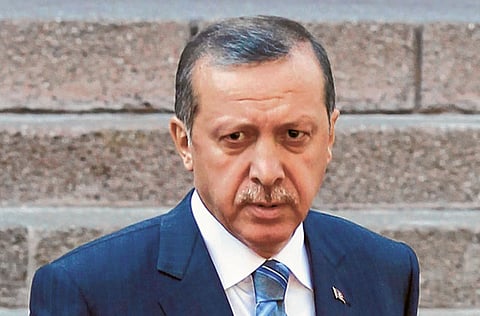
Ankara: Turkish Prime Minister Recep Tayyip Erdogan stepped up his belligerent rhetoric against Israel, saying that the country's warships will escort Turkish Gaza-bound aid ships in the future to prevent a repeat of last year's Israeli raid on a flotilla that killed nine people.
Erdogan's comments to Al Jazeera television broadcast on Thursday marked the first time Turkey said it will send warships to help attempts to break Israel's blockade of Gaza. Ankara had already said it would increase navy patrols in the eastern Mediterranean in response to Israel's refusal to apologise for the raid.
"At the moment, there is no doubt that the Turkish military ships' primary duty is to protect [Turkish] ships," Anatolia news agency quoted Erdogan as telling Al Jazeera.
"We will be making humanitarian aid. This aid will no longer be subjected to any kind of attack as the Mavi Marmara was."
Serious threat
A top Israeli minister yesterday described Erdogan's comments as a "grave and serious" threat. "These remarks are grave and serious," senior cabinet minister Dan Meridor told army radio, while indicating that Israel had "no wish to add to the polemic."
"It is better to stay quiet and wait — we have no interest in aggravating the situation by replying to such [verbal] attacks," said Meridor, who is also minister of intelligence and atomic affairs.
A senior Israeli official, speaking to AFP on condition of anonymity, called Erdogan's remarks "a very grave provocation," although he said it was unlikely that he would actually make good on his threats.
"It is very difficult to imagine that Turkey would go so far as to take such action, given its commitments to Nato," he said.
Meridor also said that Ankara "would be violating international law" if it tried to break the naval blockade by force, which a UN report into the flotilla incident declared to be legal. But Alon Liel, a former Israeli ambassador to Turkey and expert on the relationship between the two countries, said Erdogan's warnings should not be taken lightly.
"This warning should be taken more seriously than a hypothetical expression of support for any Gaza-bound flotilla, taking into account Turkish interests in the region," Liel told AFP. "Such an action would involve additional complications with Cyprus and Greece," he said.
The most recent crisis between Israel and Turkey was sparked last week following the release of the long-awaited UN report into the flotilla incident.
The report's authors concluded that Israel's naval blockade was valid under international law and that its forces had the legal right to stop Gaza-bound ships in international waters, which deeply angered both Turkey and the Palestinians. But it also said Israeli troops had used "excessive and unreasonable" force in stopping the boats, and described the loss of life as unacceptable.
Hours after the report was published, Ankara expelled the Israeli ambassador and suspended all military ties and on Tuesday it cut defence-related trade with Israel.
Lawyer submits list of flotilla raiders
A lawyer for a Turkish Islamic group yesterday said he had submitted to prosecutors a list of Israeli soldiers involved in a deadly raid on a flotilla sent by the group to break the Gaza blockade.
"We have presented a list of Israeli soldiers who gave the order for and who were involved in the attack on the Turkish flotilla to the Istanbul prosecutor's office," Ramazan Ariturk, the lawyer for the Humanitarian Relief Foundation (IHH) which organised the ill-fated flotilla, told AFP. "Currently we are waiting for the prosecutor's office to issue an order for arrest," he said.
Eight Turks and one Turkish-American were killed when Israeli commandos boarded the flag ship of the six-boat flotilla on May 31 last year, to stop it from breaking Israel's blockade on Gaza.
A UN report accused Israel of acting with "excessive force" in the operation. But it endorsed the legality of Israel's naval blockade of Gaza, which the Jewish state says is necessary to prevent the Islamist movement Hamas, which rules the coastal enclave, from obtaining weapons.


