Syria refugee numbers continue to swell
More than 131,000 displaced Syrians take shelter at Zaatari refugee camp in Jordan
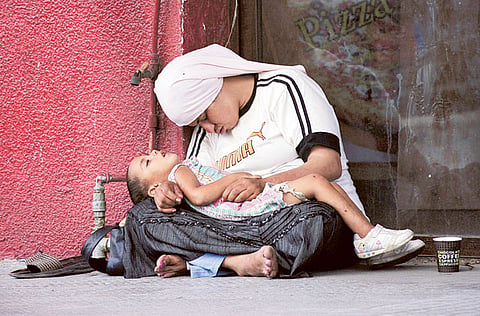
Dubai: The magnitude of the destruction and displacement that Syrians face in their civil war can perhaps aptly be demonstrated through the Zaatari refugee camp whose population has swelled uncontrollably in the one year it has been operational.
Having been established on July 28, 2012, the camp now houses more than 131,000 Syrian refugees fleeing violence in their country. It is one of the largest of the Syrian refugee camps, and has become one of Jordan’s biggest population centres.
Jordan houses some of the many refugee camps in the region for Syrians escaping the war in their country. Other countries with significant refugee numbers are Lebanon, Turkey and Iraq. In Syria, innocent lives have paid a high price for what in the start was only a protest against President Bashar Al Assad’s regime, that has now become a regional arena for international score settling with foreign players from both the regime’s supporters and those of the opposition playing a growing part in the conflict.
Both the West and Russia are providing military equipment and advice to both sides in the Syrian conflict, but not a solution for peace in Syria.
As a consequence, the conflict has caused 1.8 million Syrians to flee to neighbouring countries and about 100,000 deaths, mostly civilians, since the war began. It is the longest and most violent of the Arab Spring revolutions.
According to the United Nations, it is estimated that the number of Syrian refugees across the region may reach 3.45 million by the end of 2013, if a solution is not forthcoming.
The governments of neighbouring Jordan, Lebanon, Iraq, Turkey and Egypt have allowed, to varying degrees, Syrian refugees access to their territories. But it is unclear how long the generosity will last.
Egypt started in the beginning of July to impose visa requirements and security clearance for Syrians. Authorities in Turkey and Jordan have been carefully managing their borders with Syria, mainly due to national security concerns. Lebanon is the only country whose borders remain completely open with more than 600,000 registered refugees, the highest number of refugees in the region.
Inside Syria, 6.8 million people require urgent humanitarian assistance, half of whom are children, as the UN reports. The increase of refugees in the neighbourhood is creating intense social, economic and political pressure, and all these facts together may put the stability of the region at risk, as governments and observers have warned.
The impact the conflict is having on children is measured using six grave violations committed against children during armed conflicts. These include: killing or maiming, recruitment and use, abduction, sexual violence, attacks on schools and hospitals and denial of humanitarian access, not to mention the education they have been denied. Schools in Syria have been bombed, used as military barracks, prisons or simply closed because of lack of security. Thousands of children, inside Syria and in neighbouring countries, have been out of school for months, or even years, according to the UN.
The UN has shed light on the mistreatment and torture faced by children at the hands of both Syrian regime authorities and opposition groups. “I have received reports that in detention, children are mistreated and tortured, or detained in degrading conditions. Families are without news of their relatives”, said Leila Zerrougui, secretary-general for children and armed conflict at the UN.
The mistreatment is not limited to physical abuse as the war leaves children traumatised by the violence and atrocities they witness. A refugee camp counsellor in Jordan recalls the story of a girl who had witnessed the death of her parents: “The child stayed apart from the others and could hardly stop crying. The refugee children are nervous, anxious and often frightened when they get to the camp... I have to say I have been shocked and horrified by the stories that I’ve heard. You never want to hear a child talk about watching their friend killed or their father tortured in front of them or their brother shot through the leg,” Justin Forsyth, chief executive of Save the Children told The Associated Press.


