Salafist vote could prove decisive
Al Nour backs progressive Islamist after disqualification of preferred candidate
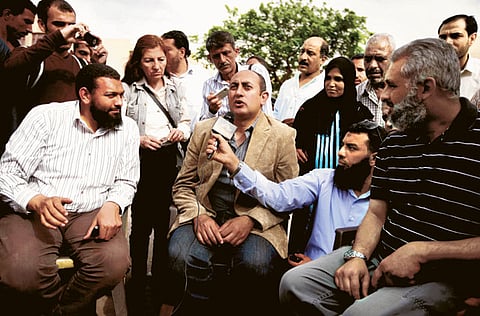
Cairo: After Egyptian president Hosni Mubarak was ousted last year, ultraconservative Muslims known as Salafists emerged from the shadows and quickly became a surprising political force. No longer afraid of being detained and tortured for their strict interpretation of Islam, more pious men grew out their beards and more women felt comfortable covering their faces with the black veils favoured by Salafists, even at government jobs.
In the winter, Salafists won about 25 per cent of the seats in Egypt's new parliament. But though they are far more visible now than they were under Mubarak's secular but autocratic rule, Salafists are once again feeling marginalised as they struggle to translate their new strength into a unified political voice just a few weeks before Egyptians elect a new president.
Their preferred candidate, ultraconservative preacher Hazem Abu Esmail, was disqualified this month over the issue of his late mother's nationality, leaving the voting bloc up for grabs and in disarray.
Last week, the largest Salafist political party, Al Nour, and its founding organisation, Dawa Salafiya, backed the progressive Islamist Abdul Moneim Abul Fotouh.
The move could reunify the vote behind an unlikely figure. The progressive Islamist has a much looser interpretation of Islamic law compared with the Salafists. But he is not beholden to the leadership of the Muslim Brotherhood, the country's most powerful Islamist group, and could be a key ally, analysts said.
"The decision could encourage other Salafist groups to back Abul Fotouh and create a future alliance with him. We have to see," said Khalil Al Anani, an expert on Islamist movements at Britain-based Durham University.
He added if other Salafist groups follow, it could consolidate the ultraconservative political movement.
But Salafists still face significant challenges. Al Nour party appears to be unravelling, with a number of members resigning in recent weeks, some even giving up on politics to return to preaching.
Moderates uneasy
At the same time, many Salafists have said they are boycotting the vote over Abu Esmail's disqualification. The Jurisprudence Commission for Rights and Reforms, a panel of top, mostly Salafist scholars and clerics, backed the Brotherhood candidate, Mohammad Morsi, last week, making it unclear whether the Nour party's decision would seal the rank-and-file Salafist vote for Abul Fotouh.
"Salafists are now one of the new power centres in Egypt, and their decision will shape Egypt's polity for years to come," Al Anani said.
The puritanical Muslims' potentially decisive role has made more moderate Egyptian Muslims and the minority Coptic Christians uneasy.
Salafist leaders have advocated for expanding the application of Islamic law to sectors such as banking, which would, for instance, outlaw charging interest on loans. Some have suggested head scarves for women ought to be mandatory and that workplaces should be segregated.
In parliament, Salafist lawmakers were ridiculed for suggesting that English be banned from schools. Those calls have generated fear among liberal Egyptians, who worry that the country could become as conservative as Saudi Arabia, where women are not allowed to drive, and boosted support in some quarters for two other presidential candidates: former foreign minister Amr Mousa and former prime minister Ahmad Shafiq.That backlash has prompted some Salafists to conclude that a concerted effort is afoot to marginalise them again. Many are moving toward Abul Fotouh, who they see as a person who could unify Egyptians across the political spectrum, from religious conservatives to liberals and leftists.
Independent views
"We need all the Islamist votes to mobilise behind one Islamist candidate to block the path for attempts to reproduce the old regime with different faces," said Nizar Gorab, an Abul Fotouh supporter who recently resigned from Al Nour because of disagreements with it and its founding organisation.
"The strongest political movement right now is the Islamist movement. Antagonising and marginalising us will have no effect."
Many Salafists might be closer to the Brotherhood ideologically, analysts said, but they see Abul Fotouh as a more independent and revolutionary candidate who is more likely than a Brotherhood statesman to promote their interests.
Mossad Farghali, 35, owns a religious bookshop on Aziz B'illah street in north-east Cairo, a hub for Salafist book and clothing stores. But he went to work at a pharmaceutical company during the previous administration and returned to the bookshop only after Mubarak's removal. The state security forces that had been on every corner were gone, and the accusations the mosque he attended was a hub for terrorism had stopped.
But Farghali said Abu Esmail's disqualification this month, after his calls for a broader role for Islamic law in Egypt and intense criticism of the military rulers, made him feel his community was again under attack. He added that people who focus on veils rather than the piety and justice that could come from the same Islamic laws are misguided.
The bookstore owner said he is now leaning toward Abul Fotouh in the May 23-24 presidential vote because he is an Islamist and seems honest, despite being more liberal than Farghali is.
But just down the road, other Salafist shop owners vowed to boycott the vote.
"After what happened to Shaikh Hazem [Abu Esmail], I've decided not to participate," said Walid Askan, 37. "We were tricked. There is no one that represents true Islamic law now, and it's clear that the outcome has already been decided."
In a nearby neighborhood, Hesham Abdul Azim and his wife, Marwa Mustafa, have spent months discussing the right choice for the future of their family and their country.
Abdul Azim wants an Islamist leader but not a Salafist president, who may alienate less conservative Egyptians.


