Report: US weighs ‘short, powerful’ strikes on Iran regime targets as crisis sends oil prices to highest level since 2022
US CentCom readies 'high‑impact' Iran strike plan amid stalled Gulf diplomacy — Axios
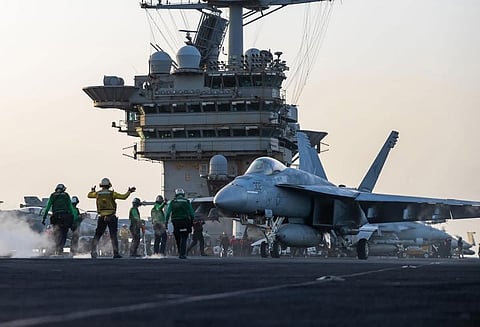
The US Central Command (CentCom) has prepared a military plan for a “short and powerful” wave of military strikes on Iran, Axios reported as Washington seeks to break a diplomatic deadlock with Tehran over the war in the Gulf and Iran’s nuclear program.
BBC reported on Thursday that the "plan" is being presented to US President Donald Trump as a high‑impact option short of a full‑scale invasion.
Trump has not authorised the plan, instead maintaining a naval blockade and economic pressure, which he publicly declared as being "more effective than bombs"
As the US weighs its next move, the Hormuz crisis has sent oil prices soaring.
'High-impact option'
The Axios report cited three “anonymous” sources as saying the proposed "wave" of strikes would likely include Iranian infrastructure targets.
Another plan reportedly focuses on taking control of part of the Strait of Hormuz so it can be reopened for commercial shipping, Axios reported.
In doing so, it may involve ground‑based operations.
What the plan entails
According to Axios and BBC, CentCom's "concept" calls for a limited but intense series of strikes, likely targeting Iranian infrastructure such as oil export facilities, military bases, command nodes, and regional militia‑support networks.
The goal: to inflict noticeable damage quickly rather than wage prolonged bombardment, in the hope of forcing Tehran back to negotiations under more favourable terms for the United States.
Diplomacy, blockade
The strike plan comes as peace talks remain stalled and the US has effectively rejected Iran’s proposed three‑stage plan for de‑escalation, including partial reopening of the Strait of Hormuz.
Trump has stated publicly that he views the ongoing naval blockade and economic‑strangulation strategy as “more effective than bombing” for now, keeping Iran under pressure while preserving the option of a sharp military punch if diplomacy fails.
Heightened US military logistics movement
Aviation trackers have cited the increased military cargo flights from mainland US to facilities in Europe and the Middle East, potentially to beef up offensive and defensive assets.
Meanwhile, Bloomberg reported that CentCom had requested the Pentagon to deploy the Army's "Dark Eagle" hypersonic missile to the Middle East for possible use against the Iranian regime.
The Dark Eagle is the US Army's first deployed hypersonic weapon. Officially designated the Long-Range Hypersonic Weapon (LRHW), it carries a glide body that travels at speeds above Mach 5, with a range exceeding 1,725 miles.
It is designed to strike high-value, time-sensitive targets that current weapons can't reach in time or can't penetrate, including hardened underground facilities, deeply-buried command bunkers, as well as mobile missile launchers that move before conventional weapons can hit them.
The system was officially declared "operational" only in 2025, reportedly with only a few of such weapons in existence.
CentCom and the Hormuz crisis
The new “short and powerful” strike scenario is being briefed by CENTCOM Commander Admiral Brad Cooper and mirrors earlier Pentagon planning for a “final blow” in the Iran war, though the current proposal is framed as a more targeted, limited‑duration operation.
Analysts note that the existence of a detailed CentCom plan does not mean strikes are imminent, but it signals that the Trump administration is deliberately raising the threat of renewed combat to gain leverage over Tehran.
The choice of the phrase “short and powerful” underscores an intent to deliver a shock effect — potentially including Iranian infrastructure and IRGC assets — without committing to a long‑term escalation that could trigger wider regional conflict or draw in other powers.
Axios’s reporting shows that CentCom has prepared a tailored strike option meant to pressure Iran into concessions, while the White House continues to balance the threat of force with the current naval‑blockade strategy around the Strait of Hormuz.
Oil prices spike
Energy prices have climbed in recent days as peace talks appear to have stalled, with the Strait of Hormuz waterway remaining effectively closed.
Brent crude surged Thursday (April 30) nearly 7% to over $126 a barrel in early Asian trade, the highest level since Russia’s invasion of Ukraine.
The current Brent futures contract for June delivery is due to expire on Thursday; West Texas Intermediate crude also rose, up 2.68% to $109.75, as of 3:30 pm Thursday in East Asia.


