Recognition hurts Israel: Abbas
Palestinian leader says move will help push parties back to negotiating table
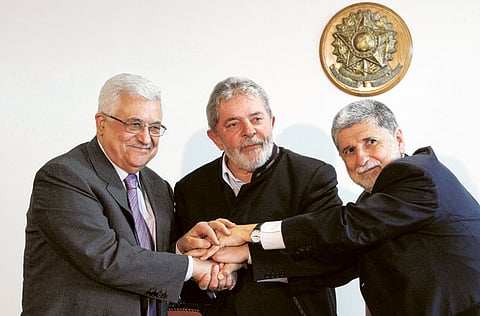
Brasilia: Palestinian leader Mahmoud Abbas said on Friday that a recent wave of nations recognising a Palestinian state based upon 1967 borders is pressuring Israel and the US to return to negotiations and reach a peace deal.
Abbas, in Brazil to lay the cornerstone of a Palestinian Embassy and attend the inauguration of President-elect Dilma Rousseff, told The Associated Press in an interview that recent recognition of a Palestinian state by several Latin American nations would help push the US and Israel into new talks.
"These recognitions of a Palestinian state will help us to convince the Israelis on the necessity to reach a two-state solution," said Abbas.
Colonies
The current round of peace negotiations collapsed in late September, just weeks after they were launched, when Israel ended a slowdown on colonies in West Bank areas it captured in 1967, land where the Palestinians plan to build their state. By December, the US abandoned trying to persuade Israel to halt the colonies.
The Palestinians refuse to negotiate while Israel builds homes for Jews in the West Bank and occupied east Jerusalem.
Abbas said he expects other Latin American and European nations to soon join Brazil, Argentina and Bolivia in recognising a Palestinian state.
Uruguayan officials have said they'll likely recognise the state soon. Cuba and Venezuela did so long ago.
Eventually, Abbas said, "It will only be Israel and maybe the United States who do not recognise the Palestinian state — and this will put pressure on them."
The Israeli government has reacted testily to the recognitions, saying that inaugurating an embassy for a nonexistent state — and Palestinians efforts for recognition of that state — is not the best way to achieve peace.
Azani said that the Palestinians "must remember that at the end of the day peace is done with your neighbour and not in faraway continents or with the United Nations."
Last week, Palestinian officials said they plan to ask the UN Security Council to declare Israeli colonies illegal and demand a halt to their construction.
That would be a key element in a Palestinian campaign to rally international support for independence. Abbas said the colonies were the cause of the stalled talks.
"It's not that we don't want the negotiations. We were extending our hand always to the negotiations with the Israelis," he said.
Despite the deadlocked talks, Abbas said he is "optimistic that 2011 will be the year of peace."
"The Palestinian people have suffered a lot. They need to live free in their own state and they hope this will be achieved in 2011," he said.


