Lebanese know how fast revolutions fade
Irony hard to miss as March 14 tries to rekindle mass appeal
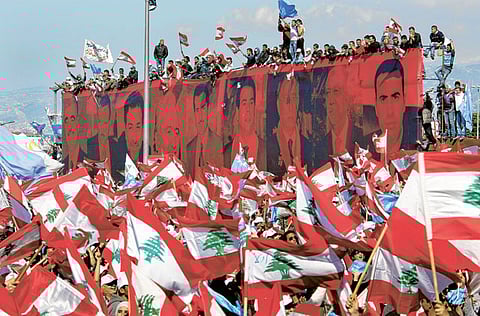
Beirut: Picture the following: hundreds of thousands of demonstrators take to the streets of a leading Arab capital, demanding a change of regime and greater independence. The regime struggles to check the uprising, but fails and collapses.
Egypt? Tunisia? No, this was Lebanon six years ago when on March 14, 2005, some 1 million demonstrators — roughly a quarter of the population — gathered on the streets of Beirut to demand the resignation of the Damascus-backed government and the withdrawal of Syrian troops.
Sparked by the assassination a month earlier of former Lebanese prime minister Rafik Hariri, Lebanon's "independence uprising" against years of domination by neighbouring Syria was unprecedented in the modern Arab world. Syrian troops pulled out in April 2005 and the Western-backed March 14 parliamentary coalition, named after the date of the rally, went on to win elections and form a national unity government.
But subsequent developments in Lebanon should serve as a cautionary tale to those protesters in Tunis and Cairo who believe that the triumphant toppling of regimes signifies the end of the battle. Six years later, the March 14 coalition is weakened by internal splits, bereft of international and regional support, and looks set to remain outside the next government.
On Sunday, in an attempt to rekindle the spirit of the original 2005 rally and to inject new vitality into the coalition's flagging fortunes, the March 14 group held a huge demonstration in Beirut's Martyr's Square. Adopting a new rallying cry, they called for arms wielded by the powerful Hezbollah resistance movement to be placed under the authority of the state.
"We still need to achieve freedom, because there cannot be freedom for a people when its state, constitution, security, economy, future, and decisions are subject to the supremacy of weapons and to those who control the weapons," Sa'ad Hariri, the caretaker prime minister, told cheering crowds assembled in downtown Beirut's Martyrs' Square beside the mausoleum where his father, Rafik, lies buried.
Hariri's government was brought down in January when the ministers representing the Hezbollah-led opposition collectively resigned. Najeeb Mikati, a billionaire businessman, narrowly won the nomination of a majority of parliamentarians to head up a new government.
New government
Mikati's new government, once it is formed, is likely to respect Hezbollah's interests, which include the preservation of its military assets and deflecting pressure from an international tribunal investigating Rafik Hariri's murder.
Most of those attending the Martyr's Square demonstration had been bussed in from all over Lebanon.
In contrast, the Beirut Spring of 2005 was a spontaneous reaction of shock and anger to Rafik Hariri's murder in a bombing widely blamed on Syria.
The US and France quickly capitalised on the anti-Syrian uprising, dubbing it the ‘Cedar Revolution' and offering political backing to the March 14 coalition.
Analysts say that the coalition cannot expect the same level of support today.
"In this sense, the real challenge in front of Hariri is not the success of the Sunday gathering," wrote Emad Marmal, a columnist with Lebanon's As Safir daily, "but to find a convincing answer to the obvious question: What about the next day?"


