Last survivor of first Baath state dies
Al Zu’ayyin was a staunch Arab nationalist who served as Syrian prime minister in turbulent times
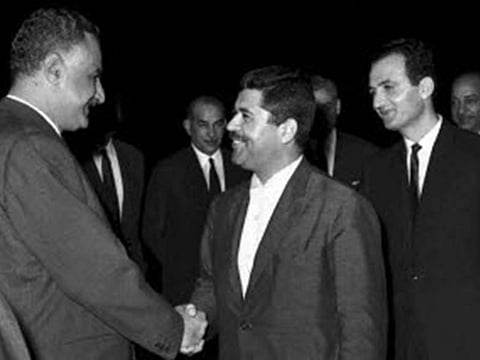
Beirut: Yousuf Al Zu’ayyin, the last survivor of the first Baath state (1963-1970) died on Tuesday in Stockholm. He was 85. The former prime minister of Syria will be buried in Europe, as neither the Syrian government in Damascus nor that of Daesh in his native Al Bukamal, will allow his return to Syria.
Al Zu’ayyin was born in Al Bukamal, a frontier town on the Syrian-Iraqi border that lies on the banks of the Euphrates river. As a young Arab nationalist, he dreamt of the day when Al Bukamal and all of Syria became part of a united Arab world.
Unfortunately, Syria is currently torn to pieces, and Al Bukamal is under the iron grip of Abu Bakr Al Baghdadi.
Al Zu’ayyin studied medicine at Damascus University and became a voluntary medic in the Algerian Revolution (1954-1962), serving alongside the resistance forces of Houari Boumedienne.
Al Zu’ayyin’s experience in Algeria came to shape a bulk of his future vision, especially during the Arab-Israeli War of 1967 when he claimed that Israel, like France in Algeria, could be forced to yield by force.
After a heroic stint with the Algerian Revolution, he returned to Syria in 1957 and joined the Baath Party of Michel Aflaq, then in-control of a majority of seats in the Syrian Parliament.
Al Zu’ayyin was attracted to the party’s socialist views, preaching a classless society, land redistribution, and Arab unity.
A junta of Baath officers staged a coup in March 1963 bringing down Syria’s last civilian government.
Baath Party co-founder Salah Al Bitar became prime minister and appointed Al Zu’ayyin minister of agricultural reform. Al Zu’ayyin was charged with confiscating land belonging to the urban notability of pre-Baath Syria and redistributing it accordingly among farmers.
The landowners, who had been Syria’s ‘who’s who’ since Ottoman times, were brutally harassed and kicked off their plantations — often at the encouragement of the Baath regime.
Impressed by Al Zu’ayyin’s revolutionary Marxism, Head of State Ameen Al Hafez appointed the young doctor-turned politician, at the young age of thirty-four, as prime minister on September 22, 1965.
Al Zu’ayyin made his colleague from the Algerian Revolution, Ebrahim Makhous, the new Minister of Foreign Affairs. He also appointed Sulaiman Al Khosh, another Baathist, as Minister of Education, with orders to nationalise all foreign schools in Syria.
During his tenure, French Laique schools, Catholic schools, Italian hospitals, and British education centres were all ‘Arabised’ and put under watchful eye of the Baath Party.
The Al Zu’ayyin cabinet was short-lived and collapsed when a coup toppled Al Hafez in February 1966. He was subsequently thrown in jail and the Baath Party founders were exiled, with orders never to return.
Al Zu’ayyin did not object and cuddled up to the coup mastermind Salah Jadid, who reappointed him prime minister on March 1, 1966.
He kept Makhous at his job but brought two ruthless officers, Mohammad Rabah Al Tawil as minister of interior and Abdul Karim Al Jundi as minister of agriculture.
The period 1966-1970 set basics of the Syrian police state and terrorised society. Given that Al Zu’ayyin, Makhous, and Syria’s new head of state were all medical doctors, a Lebanese newspaper commented, “Syria is ruled by three doctors. She must be sick.”
Al Zu’ayyin moved ahead with his social redistribution programme, confiscating private factories, businesses, oil companies, and banks.
Considered a fanatical idealist, he tried to refashion society. True to his socialist views, he appeared in France one day for a meeting with president Charles de Gaulle wearing a Mao-style jacket.
He was informed that de Gaulle would not receive him until he dressed formally.
Al Zu’ayyin refused, but when de Gaulle remained adamant, he gave up and wore a western-style suit and tie before entering the Elysee Palace.
Al Zu’ayyin once toyed with the idea of nationalising the fabled Hamidieh Market in the Old City and of shutting down the Grand Umayyad Mosque and transforming it into a state museum.
The project was torpedoed by the mosque’s preacher Abu Al Faraj Al Khatib, the father of current opposition leader Mu’ath Al Khatib.
Al Zu’ayyin ruled Syria during the Arab-Israeli War of 1967 and was accused of poor leadership by Syrians.
Facing mounting criticism from a public who blamed him for their dire economic conditions, Al Zu’ayyin was dismissed on October 28, 1968. Weeks after Hafez Al Assad came to power in November 1970, he was arrested and sent to the infamous Mezzeh prison, where he remained for the next 10 years.
He was released on health grounds in 1981 and took up residency in Hungary.
His death marks the end of a violent and controversial chapter in the modern history of Syria. All pre-Al Assad era premiers are now dead and so are most early generation Baathists.
Most of them like Al Zu’ayyin died in exile, like his colleague and friend Makhous, who passed away in Algeria in September 2013.
Neither local media in Al Bukamal nor state-run one in Damascus carried anything about his passing, which only made the rounds in opposition websites and via social media networks.


