Iran protests: What the 2019 and 2022 uprisings reveal about how this may end
From fuel riots to Mahsa Amini, history frames Tehran’s response — as Trump pressure rises
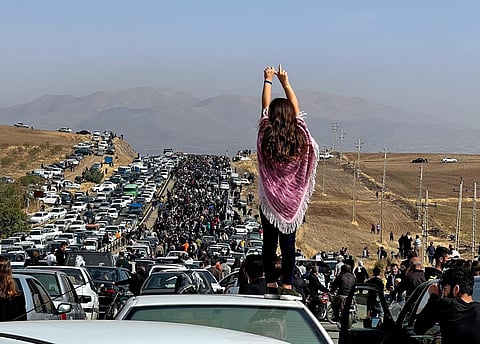
Dubai: As Iran reels from its deadliest unrest in years — with young protesters reportedly shot at close range and families forced into silent burials — a familiar question is resurfacing: how does this end?
This time, the unrest is unfolding under far heavier international pressure than during Iran’s last major protest waves.
US President Donald Trump has announced a 25% tariff on goods from countries with commercial ties to Iran, a move he said was “effective immediately” and “final and conclusive.” The decision comes on top of already severe US sanctions that have battered Iran’s economy, collapsed its currency and driven inflation to painful levels.
Food prices have surged by as much as 70%, according to Iranian data and independent estimates. Food accounts for roughly one-third of Iran’s imports, meaning further trade restrictions risk worsening shortages and pushing costs even higher for ordinary households.
Iran’s economic exposure is also broader than before. China remains Iran’s largest trading partner, followed by Iraq, the United Arab Emirates, Turkey and India — all countries now forced to weigh commercial ties against new US penalties.
The pressure comes as Trump projects a far more assertive posture globally than during Iran’s previous protest waves, following his recent move against Venezuela and renewed willingness to weaponise tariffs as a geopolitical tool.
Against this backdrop, Iran is facing nationwide unrest once again.
It has been here before — in 2019, after a sudden fuel price hike, and in 2022, following the death of Mahsa Amini in morality police custody. Each uprising appeared, at its peak, to challenge the authority of the Islamic Republic. None produced political reform.
Looking back at how those protests ended — and how foreign powers, especially the United States, responded — does not predict the future.
But it does reveal a pattern shaping how Tehran is acting now.
What happened during the 2019 protests — and how did they end?
The November 2019 protests erupted after a sudden fuel price hike imposed by the government. Demonstrations spread rapidly across cities and provincial towns, driven by economic anger rather than ideological slogans.
The state responded swiftly and brutally.
Security forces opened fire on protesters. A near-total internet shutdown cut Iran off from the outside world, preventing coordination and limiting documentation of the violence. Independent estimates later suggested hundreds, possibly more than a thousand people, were killed within days.
The protests ended quickly — not because anger faded, but because participation became immediately lethal.
How did the Mahsa Amini protests of 2022 end?
The death of Mahsa Amini, a 22-year-old woman detained by Iran’s morality police, triggered a deeper and more sustained uprising. Unlike 2019, the protests were driven by demands for dignity, women’s rights and political freedom.
The slogan “Woman, Life, Freedom” spread nationwide. Women publicly defied hijab rules. Students, artists, athletes and professionals joined.
Initially, the state hesitated. The protests endured for months.
Then repression intensified:
Mass arrests
Torture allegations
Death sentences and executions
Targeting of activists, journalists and ethnic minorities
By early 2023, street protests had largely faded.
There was no accountability for Amini’s death.
There was no reform of the morality police.
Political power remained unchanged.
Did the Mahsa Amini movement fail?
Not entirely.
While it failed to force political change, it permanently altered Iranian society. Hijab enforcement weakened in everyday life. Public defiance became more visible. The fear barrier cracked, especially among the young.
The protests ended on the streets, not in society.
What role did the United States play in 2019 and 2022?
During the 2019 protests, Donald Trump was US president. Washington did not threaten military intervention in response to the unrest.
Instead, Trump and senior US officials publicly condemned Iran’s use of force and expressed support for protesters’ rights. Trump said Iranian authorities were killing “thousands”, while the US imposed additional sanctions. But there was no explicit warning of armed intervention tied to the protests themselves.
Similarly, during the Mahsa Amini protests in 2022, the US and its allies issued strong condemnations, sanctioned Iranian officials and backed international investigations — but again stopped short of threatening direct military action.
For Tehran, however, even rhetorical support from Washington reinforced a long-standing narrative: that protests are foreign-influenced threats to national security.
This framing has consistently been used to justify harsher crackdowns.
How is the current protest wave different?
Two differences stand out.
First, the unrest appears driven by structural collapse — economic hardship, political stagnation and accumulated anger — rather than a single trigger.
Second, the state’s response has been faster and deadlier:
Immediate live fire
Reports of close-range shootings
Sweeping internet blackouts
Forced burials and intimidation of families
Unlike in 2019 or 2022, escalation came almost instantly, suggesting the authorities are applying lessons learned from both episodes.
What patterns emerge across all three uprisings?
Across 2019, 2022 and now, the trajectory is strikingly consistent:
Protests spread rapidly and remain leaderless
Youth play a central role
The state frames unrest as an existential threat
Communication is restricted
Force escalates until streets are cleared
Each time, protests end not through negotiation, but through suppression without reform.
What does this history suggest about how the current protests might end?
History does not offer certainty — but it does offer warnings.
If past patterns hold, the state is likely to:
Maintain lethal force early
Prevent the emergence of leadership
Isolate protesters digitally
Target symbolic figures to deter others
For protesters, the risks are immediate and severe. Yet history also shows that repression has not erased dissent — only postponed it.
The bottom line
Iran’s protest movements have ended differently in pace — swiftly in 2019, slowly in 2022 — but identically in outcome: the state survives, society absorbs the cost.
Each wave leaves behind deeper grievances and a generation less afraid than before.
Whether the current unrest breaks that cycle remains uncertain. What history — domestic and international — suggests is how Iran’s leadership believes protests are best ended: Move faster, shut things down sooner and strike harder.
Why US warnings matter to Tehran
Deep mistrust: US–Iran relations have been hostile since the 1979 Islamic Revolution, with no diplomatic ties for decades
Past protests: In 2019 and 2022, Washington condemned crackdowns and imposed sanctions but did not intervene militarily
Iran’s view: Tehran routinely portrays protests as foreign-backed plots, using US statements to justify harsher repression
Trump factor: Trump’s explicit talk of military options marks a sharper tone than previous US responses
Risk calculation: Iranian leaders fear intervention but also see external threats as a way to rally domestic support


