Hariri tribunal puts nation on knife-edge
Druze leader warns of civil war if Hezbollah is charged with Hariri killing
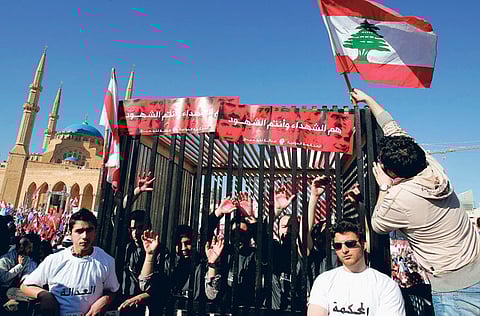
Beirut: Druze leader Walid Junblatt warned that Lebanon would slide into a state of chaos if the United Nations Special Tribunal for Lebanon went ahead and charged members of Hezbollah in the assassination of former prime minister Rafik Hariri.
"Resorting to the use of the UN tribunal through the decision of indictment of Hezbollah members would hit the civil peace and achievements of the Taif Accord, as well [as] drag the resistance and justice seekers into chaos," Junblatt said. He was speaking during a lunch banquet hosted in honour of the Russian Ambassador in his palace in Al Mukhtara.
"We got the court, but now we wish it never existed," Junblatt said in what could be described as a clear rejection of the court.
A few days earlier, leader of the Marada Movement and Hezbollah ally Sulaiman Franjieh stated in no uncertain terms that the possible indictment of Hezbollah in Hariri's murder means nothing but war in Lebanon.
Tense atmosphere
"The atmosphere is so tense that any small spark means that an international decision has been made to take Lebanon to war, which we must be fully aware of," Franjieh said
Recalling the 15-year civil war in Lebanon, Franjieh said the war broke out in 1975 when no one was aware how it started, adding that if the war takes place it will take the shape of a Sunni-Shiite strife.
"What we need to do is to thwart the strife before the court's decision is issued, because once it is taken, I have no idea how we can prevent its consequences," he said.
"If the tribunal decision will cause a strife, why not cancel it?" he asked
The lunch hosted by Junblatt brought together politicians from various Lebanese blocs, including Lebanese Forces, Future bloc, Phalanges Party, Hezbollah, Free Patriotic Movement (FPM), Ba'ath Party, Amal Movement and others, along with many ambassadors.
Miracle hope
They spoke about the crisis and the difficulty of finding a way out of it, which was clearly expressed by a politician who said Lebanon would need a miracle to avoid going to war, and added that the time of miracles is gone.
A Lebanese minister voiced his deep concern over the possible destruction of the remaining Lebanese government institutions.
The minister referred to a worrisome statement by Khalid Al Daher, an MP close to the future bloc, who said: "We have supporters in the Lebanese Army who would not leave us on our own."
The statement came as a clear sign of a possible division in the Lebanese Army, which is the sole national institution enjoying Lebanese consensus.
The 14 March bloc accuses the FPM and Hezbollah of destructing the state institutions, citing the ongoing verbal attack by FPM leader General Michel Aoun on the Information Branch and its head Colonel Wissam Al Hassan.
The Information Branch, which operates under the International Security Forces, was recently criticised by Aoun who asked his supporters not to succumb to the demands of the branch. This was seen by the 14 March bloc as an indirect declaration of political rebellion.
Meanwhile, Hezbollah is accused of systematically destructing the state, which was demonstrated by the airport reception and protection extended to former General Security chief Major General Jameel Al Syed who spent four years without charges in detention in the case of Hariri's assassination.
Clear messages
The act by Hezbollah, which was seen as a violation of the state sovereignty, sent two clear messages to everyone in Lebanon. The first message was that all government institutions would be taken over by Hezbollah if such a decision is issued by the UN court.
The second message was the provision of complete protection to Al Syed because exposing false witnesses who were behind Al Syed's arbitral detention would be the fatal blow to the international court and demonstrate its aim of politicising the issue. Consequently, if Al Syed, who works legally to prosecute false witnesses, failed in this mission, no one would dare raise this issue again.
While everyone was betting that revealing false witnesses would be the only way to face the possible effects of the court's decision, Junblatt urged the Lebanese to formulate a common position to reveal the truth of bogus witnesses and refrain from using the UN court by some countries in the service of their own interests.
Buying arms
With a tense atmosphere prevalent on the streets of Lebanon streets, it has been noticed that people are buying arms, the prices of which have increased in the past three months.
However there is little evidence that arms are being bought by organised groups.
Some see that the prime minister is the key to solving the crisis, as the opposition believes that Sa'ad Hariri can use his influence and defuse the crisis by a clear-cut announcement on false witnesses and stand by what he told the London-based Arabic daily Asharq Al Awsat — that false witnesses have misled the investigation.
If Hariri is convinced that the investigation in his father's assassination was misled by false witnesses, why should he not announce it publicly, Franjieh, a politician close to Syrian President Bashar Al Assad, asked.
"Whether he is convinced or not, he is supposed to voice his opinion frankly by telling media," he added.
Newspaper report
Hariri is required to announce, before the court's decision is issued, his rejection if it directly accuses Hezbollah or its members of the killing of his father, the Lebanese Arabic daily Al Akhbar said in a report published recently.
He must solve the issue himself since he is the son of the slain prime minister, and because the court was mainly established to reveal his killers, the newspaper said.
Meanwhile, politicians close to the prime minister call on Hezbollah to keep quiet and to abide by the country's law since no one knows what the court's decision would be.
Some Mustakbal MPs indicated that if Hezbollah continued to weaken Hariri, this would lead to the emergence of Sunni fundamentalism in Lebanon.
Ironically, Lebanon is racing against time. Hezbollah wants to expose and weaken the government before the decision is issued, considering it if issued as a declaration of war, while Hariri's supporters and allies prefer to await the decision — which may not accuse Hezbollah of killing Rafik Hariri. During this time of cautious anticipation, Lebanon will be on the brink of a war, unless a miracle happens to save the country.
Hussam Kanafani is a journalist based in Beirut.


