Eisenkot says no 'immediate threat from Iran' requiring military action
Former army chief says Iran threat not immediate for Israel
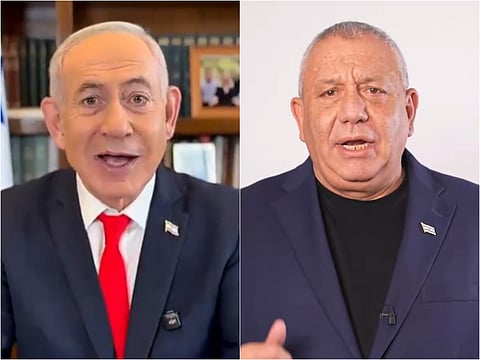
Gadi Eisenkot, the Israeli politician tasked with forming the next government, said Monday that he sees no immediate need for military action against Iran.
The former army chief of staff called Iran the most serious threat to Israel, but said he sees no direct and immediate threat that would require action before a government is formed.
He spoke at a press briefing at the Knesset in Jerusalem.
Get it: Fast, verified news for FREE ... download the Gulf News app — simply click here
He said the gravest danger is the roughly 440 kilograms of enriched uranium that has still not been destroyed or removed, and that Israel should focus on that.
"The Iranian threat is the most serious threat to the State of Israel, but at this moment I do not see a direct and immediate threat to the State of Israel that would require action before a government is formed," the former army chief of staff said during a press briefing at Israel's parliament in Jerusalem.
Netanyahu urged to avoid 'dangerous moves'
He urged Prime Minister Benjamin Netanyahu to avoid "dangerous moves that can wait until a new government."
The comments put Eisenkot at odds with Netanyahu at a sensitive time.
Netanyahu remains in office for now with no formal limits on his powers. Eisenkot's position sets a test for any strike ordered while he holds the mandate.
Eisenkot served as the IDF's 21st chief of staff from 2015 to 2019, and as a minister without portfolio from 2023 to 2024. He now leads the Yashar party.
President Isaac Herzog gave him the first shot at forming a government on Nov. 8. He has a maximum of 42 days, of which 15 had passed as of Monday.
Coalition talks
Likud and Yashar held talks lasting over four hours, covering ultra-Orthodox military service, legal reforms and an October 7 inquiry.
Netanyahu has pushed back on Eisenkot's claim, as the rivals accused each other of minimising the danger for political reasons.
Security briefing
Netanyahu gave Eisenkot a two-hour security briefing on Nov. 23. Channel 13 reported that the IDF position presented was that there is no immediate urgency to strike Iran.
Former Mossad director David Barnea urged military action against Iran "as soon as all conditions allow."
Washington's view
A US official said the president sees "no need" for major combat operations because the economic pressure campaign is devastating Iran, adding to the argument for waiting. Trump is nonetheless considering renewed strikes on Tehran, Fox News reported.
Iran's stance
Tehran says it considers the US naval blockade "a military aggression," will use all available tools against it, and will reopen Hormuz only if Washington accepts its demands.


