Display of rare resilience
Despite being ravaged by looters during the US occupation, the Iraq Museum has bounced back with an exhibition of ancient cuneiform writing in Mesopotamia
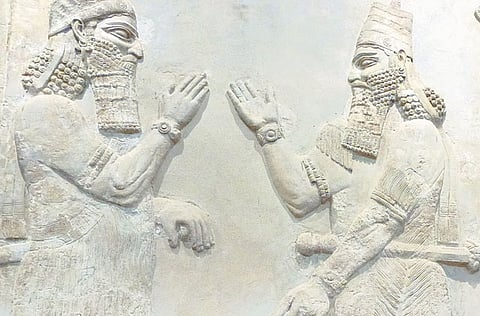
A new exhibit opened at the Iraq Museum on November 17 — one among many signs that Iraq is leaving behind the horrors of war and creating a new normal.
"You know what we have been through; it was very dangerous," says Shaimaa, an archaeologist who has worked at the museum since 1999. "But so many things are happening now that convince us that times are changing for the better."
Among them is the re-emergence of her beloved museum, which was devastated by looting during the war. Indeed, the renovation of the museum — from which 15,400 artefacts were carted away by looters soon after US forces entered Baghdad in 2003 — shows a determined optimism in the nation. As US forces fully withdrew from Iraq this week — after toppling Saddam Hussain and getting locked into nearly nine years of occupation, insurgency and sectarian civil war that cost America 4,500 lives and Iraq hundreds of thousands — even small events are taking on unexpected significance.
Abd Al Zahra Al Talakani, of the Ministry of Tourism and Antiquities, says the cultural scene has blossomed. "It's clear," Talakani says, "that cultural activities are coming back to Baghdad, and by 2013 the city will be announced the capital of Arab culture [by the Arab League]."
Iraqis fear that the country's police and army are not up to the task of maintaining security without the American forces, and also complain about the state of national politics, where the new democratic system has been hamstrung by infighting and gamed by Prime Minister Nouri Al Maliki. But none of this has stopped the Iraq Museum from unveiling a French-sponsored exhibit on ancient cuneiform writing in Mesopotamia. On the opening night, the staff dressed as if for a gala event and hobnobbed with diplomats while French ambassador Denys Gauer and Iraqi Tourism and Antiquities Minister Liwaa Semeism cut the ribbon.
During the US occupation American commanders were criticised for leaving most government institutions such as the Iraq Museum unguarded, making them prime targets for looting. Priceless artefacts from the museum's incomparable 170,000-strong Babylonian, Sumerian and Assyrian collection disappeared, including the remnants of a 5,000-year-old Sumerian alabaster vase and a headless stone statue of a Sumerian king, thought to be 4,400 years old. It was recovered in 2006 in the US.
Iraqi officials say 38,000 items have been returned — most taken from Iraqi dig sites both before and after the US invasion. Some 700 were returned from Syria in 2008, another 540 recovered in the US and brought back last year. Another 632 artefacts that had been shipped to the prime minister's office from the US had "gone missing" for the greater part of a year but were found intact in basement offices. The problem was not only the looting but the lack of security, especially in a facility one block away from Haifa Street, which was controlled by the Al Qaida in Iraq and marked by violence.
The museum first reopened to the public in February 2009. Eight of its 23 halls remained open until mid-2010 but was closed again for complete renovation. The reopening, scheduled for last month, has been delayed at least two months now, as the renovation will include fitting all the halls with new lighting and glass showcases. Until then, the new exhibit will be open to official visits and select students.
But the delayed reopening does not dim chances of progress for Mohsin Hassan Ali, the museum's deputy director, who says "most of the money" to support the work — about $9 million (Dh33 million) — has come from the US government. "With the efforts of the Iraqi people, we have got back much of what was lost, and — God willing — the rest, too, will return," he says.
Foreign support has helped. Besides the cash sent by the US and French sponsorship, the Italians helped renovated the main hall where the cuneiform exhibit is on. But what excites Ali more is the fact that in recent years, not only have many stolen artefacts been returned, but also that Iraqi archaeologists have been at work "adding to the collection, with new artefacts being dug out of the ground".
"I am sure tomorrow will be better," Shaimaa says. "The new generation, God willing, will be more active."


