Daesh suffers reversal in Kurdish north of Iraq
Extremist group seems to have worn out its welcome in Sunni Arab towns
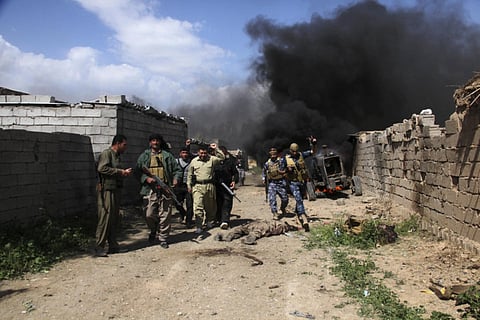
Kharab Al Rut, Iraq: Peering from his trench on a ridgeline fortified with sandbags, the Kurdish commander gazed toward an Daesh-held village next to a swath of territory recently seized from the extremist forces. Smoke wafted into the sky from natural gas burning off a well in a broad basin known as Wadi al Naft, or Valley of Oil, west of Kirkuk, Iraq’s strategic northern energy hub.
“Daesh is weaker now, no doubt,” said Hussain Yazdanpana, who heads an Iranian-Kurdish front-line unit. “We’ve heard that many of their fighters are running away,” said the militiaman, who incongruously wore an American flag pocket patch -- a gift from “Jack,” one of the US military advisors here.
While media attention has focused on Iraqi government advances north from Baghdad on the Daesh-held city of Tikrit, Daesh has also been suffering a series of significant reversals in the Kurdish north.
Unlike in the Tikrit assault -- where Iran is a major partner and the US-led coalition has been absent -- the role of American air power is clearly evident here.
Warplanes roar unseen high in the skies overhead. The ghostly presence of abandoned, bombed-out villages -- such as the flattened hamlet of Kharab al Rut, a onetime Daesh stronghold now reduced to rubble -- attests to the ferocity of the airborne assault.
US military advisors are also on the scene, some outfitted in Kurdish peshmerga uniforms, though “Jack” and others encountered on the front lines declined to be interviewed.
In northern Iraq, Daesh appears increasingly under siege, its territory pinched from the north and south. There are indications that militants in Tikrit and elsewhere are pulling back to Mosul, the so-called Iraqi capital of the group’s self-declared caliphate, in anticipation of a looming all-out assault by Iraqi government and allied forces.
“Absolutely, Daesh is on the run,” Kirkuk Gov. Najm Al Deen Karim said in an interview.
“Even in Hawija they have left in droves, going to Mosul,” he said, referring to a notorious militant stronghold to the southwest.
Judging Daesh’s actual military strength involves considerable conjecture, given the group’s secrecy and a lack of access to the vast regions of Iraq and Syria where its forces are arrayed. Hit-and-run attacks and suicide assaults -- such as a series of coordinated strikes in late January in and around Kirkuk -- still occur with regularity in the north and elsewhere.
But the clear impression in northern Iraq is of a militant force that is on the defensive and retrenching, facing pressure on all approaches to Mosul. The deployment of US-led air power has made its once-signature armored onslaughts a thing of the past.
Even within its so-called caliphate, residents are tiring of the group’s draconian rule, according to interviews with former residents of territory held by the militants. Daesh’s initial welcome in Sunni Arab towns as liberators from the Shiite-led government in Baghdad appears to have worn thin in much of the north.
“They were all right for the first two weeks after they came,” said Firas Abdullah, 21, a former Hawija resident who is among thousands of displaced Sunni Arabs living in tents at a glum camp outside Kirkuk that houses mostly escapees from Daesh rule. “But when they started stopping people from smoking, making the women wear niqab to go out, it just became too much,” said Abdullah.


