Araghchi hits back at Rubio over ICC warning, invokes Pompey's defeat
Iranian diplomat warns against ignoring history in ICC debate with Rubio
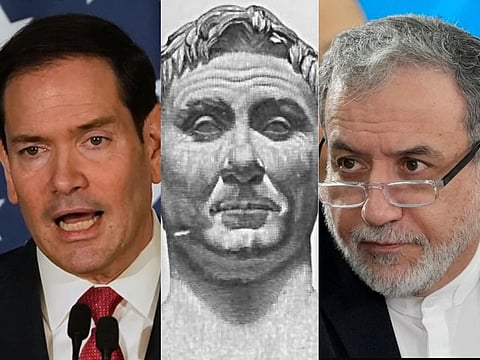
Iranian Foreign Minister Abbas Araghchi has hit back at US Secretary of State Marco Rubio by invoking the downfall of ancient Roman general Pompey, turning a historical reference into a warning against the use of military power to dismiss international law.
In a post on X on Sunday, Araghchi challenged Rubio's reference to Pompey, arguing that the Roman commander's military strength did not ultimately save him from defeat and execution.
“‘Don't quote laws to men with swords’ was uttered by a Roman general whose final campaign ended in crushing defeat, despite numerical superiority. He was beheaded after fleeing the battlefield,” Araghchi wrote.
“Better maxim: ‘Those who cannot remember the past are condemned to repeat it,’” he added.
The exchange followed Rubio's speech on Friday at the Federalist Society's National Lawyers Convention in Washington, where he criticised the International Criminal Court (ICC) and accused international institutions of exploiting international law to pursue political interests.
“If they're foolish enough to try to enforce their paper decrees on Americans, our answer will probably be the same as the Roman general, Pompey,” Rubio said.
“Stop quoting laws to men with swords,” he added, invoking the ancient Roman commander.
The dispute also highlights a broader disagreement over the authority of international institutions, particularly the ICC, which Washington does not recognise as having jurisdiction over US citizens.
The Trump administration has imposed sanctions on the court and its officials.
The ICC has faced US opposition over its investigations involving Afghanistan, where alleged crimes by US personnel were among the matters examined, and its arrest warrants for Israeli leaders.
Pompey the Great
Pompey the Great was one of Rome's most powerful military commanders.
He was defeated by Julius Caesar at the Battle of Pharsalus in 48 BC, during the Roman civil war.
He fled to Egypt, where he was assassinated on the orders of advisers to the young Pharaoh Ptolemy XIII.
His head was presented to Caesar.
Araghchi's historical reference was pointed: Pompey, the Roman commander invoked to illustrate military power overriding legal authority, ultimately suffered defeat and death.
His response effectively turned Rubio's own historical analogy against Washington, framing the exchange as a warning that military superiority does not guarantee lasting victory or immunity from the consequences of history.




Iran 'common factor' behind the Middle East’s major conflicts: Rubio
Rubio has earlier described Iran as the “common factor” behind the Middle East’s major conflicts, calling its regional ambitions an “extraordinary historic danger” that demands urgent attention.
Speaking at the Federalist Society’s National Lawyers Convention in Washington, Rubio pointed to Yemen’s Houthis, Iraq’s Shia militias, the forces that backed former Syrian President Bashar al-Assad, and Lebanon’s Hezbollah as the main expressions of Iranian influence.
“Every problem in the Middle East, every major problem in the Middle East – the Houthis attacking Saudi Arabia, the Shia militias that destabilise Iraq, the fighting elements that supported Assad and the destruction of Syria, Hezbollah in Lebanon – everywhere you turn, there is one common denominator, the Shia clerics of Iran and their expansionist mentality,” he said.
He added: “This is an extraordinary historic danger and one that cannot be ignored.”
His remarks come as the confrontation between Washington, Israel and Tehran continues to widen.
It began on February 28 with US-Israeli strikes on Iranian targets and has since spread across the region, affecting military bases, shipping lanes and energy infrastructure.
Tensions stayed high on Sunday.
Bahrain said its air defences had intercepted multiple aerial attacks launched from Iran, and the Islamic Revolutionary Guard Corps (IRGC) later made claims about its ongoing operations.
Qalibaf rejects 'neither war nor peace'
Separately, Iranian Parliament Speaker Mohammad-Baqer Qalibaf told lawmakers on Sunday that Tehran rejects a prolonged state of “neither war nor peace” with the United States.
He said Iran remains open to talks if Washington meets seven conditions set by Tehran.
“We do not care whether the US chooses the path of negotiations or war. If it accepts our seven reasonable conditions, the door to an agreement will be open,” he said.
He also warned Washington against further miscalculation, saying Iran’s armed forces will determine the geographic limits of any future conflict.
The contrasting statements show how firmly both sides are dug in, even as military tensions continue alongside talk of possible negotiations.


