Aleppo short on weapons, medical supplies
Battle for control of economic hub may shape the fate of the Syrian uprising
Aleppo: Shouting men rushed the wounded rebel fighter, on a stretcher, into a makeshift emergency ward Monday night at dusk after shrapnel from a Syrian government mortar shell tore through his leg.
“You see?” asked Abu Hassan, another rebel from the Free Syrian Army (FSA). “Tell your country to do something, anything!”
Shortly afterwards, another man – a plumber shot in the leg by a Syrian government sniper – was brought in.
Tensions are high in Aleppo, Syria’s second city, where rebel commanders are expecting at any moment a powerful government offensive to reverse the past week’s rebel gains, as happened in Damascus, where regime forces reclaimed the capital from the rebels with firepower and lethal street battles.
The battle for control of Syria’s northern economic hub and largest city will likely shape the fate of the 17-month uprising against President Bashar Al Assad, which has so far claimed 17,000 lives, according to some of the highest estimates. Losing Aleppo to the rebels would demonstrate severe government weakness.
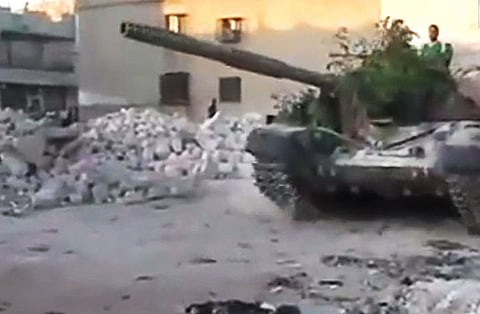
Eighty Syrian government tanks are believed to have arrived at the Aleppo battlefront on the western flanks of the city. On Friday, helicopters circling overhead fired repeated bursts into rebel-held districts for most of the day, causing six deaths. Government snipers claimed two more lives, according to rebels in Aleppo.
“The FSA is ready – we have many explosives and roadside bombs,” says Abu Mhio, an FSA officer in one Aleppo district. Tanks already deployed in Aleppo have not been used, he says – only artillery, from a distance – but their use is “only a matter of time, we don’t know when”.
“The regime can’t enter here. The FSA is very strong and everyone supports the FSA,” says Abu Mhio about rebel-held districts east and west/southwest of the city centre. “People open their houses to us.”
It is not possible to verify rebel claims of broad support in Aleppo. Yet one woman cradling a baby on her shoulder stepped into an FSA office, specifically to ask for an FSA flag – to use as a backdrop for a portrait of the child, she said, and to hang at home.
Friday and all week, families raced to fill trucks with belongings, hoisting refrigerators, televisions and anything that would fit before fleeing to safer villages in northern Syria or across the border to Turkey. Looks of fear marked their faces as they continually scanned the sky to check the location of the shooting helicopters.
Aleppo has been a challenge for rebel forces. It was late to join the uprising, has long supported the regime, and its neighbourhoods are split between opposition and government supporters. But the expected showdown between rebel and regime forces has also brought a fresh influx of rebels into the city.
“Every day some more fighters come from the villages… we just want to defend these places [in Aleppo], so let God bless us,” says a fighter and former government special forces soldier, who asked to be called Abu Omar. “The regime does a lot of shelling at night to make people afraid, to destroy buildings and kill more people – to make people curse the FSA, they say: ‘You come here, and now the bombs come’ – so we try to protect people. But we need weapons, more weapons, from any country.”
Another fighter, Abu Hamza, brandishes his AK-47 assault rifle to make the point: “This gun costs $2,000, and every bullet is $2,” he says. “It’s so expensive.”
What should the world do?
Syrians in this city expressed anger today that so little had been done to help them, citing United Nations Security Council vetoes from Russia and China and declarations from the US and Europeans ruling out military intervention.
American and Turkish intelligence agencies reportedly channel light weapons, communication gear and intelligence data to them, and Gulf countries like Qatar have provided cash and more. One rebel fighter carried a fresh-out-of-the-box 12-gauge shotgun; another wore new fragmentation grenades on his belt.
The shortages have also been felt by a medical system overwhelmed by the number of casualties. Evidence of need is everywhere. On one street, the tail fins of a 120mm mortar shell have buried themselves in the asphalt. Shrapnel smashed the windows of a car nearby and struck at least one person, who left a trail of blood splashes on the sidewalk for a full city block.
“We can’t do anything but sometimes only watch them die,” says Umm Huda, the female doctor who runs this makeshift emergency ward. “There are children, ten or three years old, they have done nothing and you see them die. They are angels.”
She says the lack of international help has been a mixed blessing.
The US “can do a lot of things; they know how to end it”, she says in between treating casualties. At the same time, the Russian and Chinese vetoes of intervention “is a good thing... we want to win, but we want it ourselves, with no help from anybody”.
A leaflet held up at a recent demonstration in Aleppo read: “Hey world, how many kids should be killed before you DO something?”


