A statesman who put the nation first
Leading figure in March 14 coalition dies
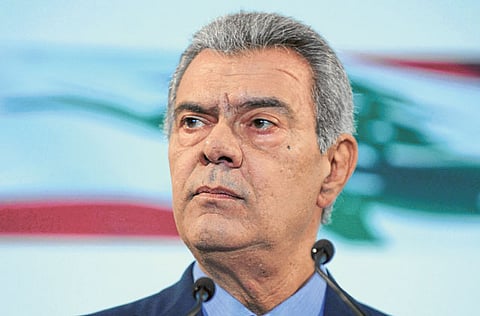
Beirut: Naseeb Lahoud, head of the Democratic Renewal Party and a leading figure in the March 14 coalition, died yesterday after a long illness.
In a divided sectarian society like Lebanon where politics was little more than the distribution of resources among various "clans", Lahoud stood out as a rare statesmen, a politician who believed that the interests of the nation ought to come first.
Although active in what came to be known as the March 14 movement that grouped those who opposed the three-decades old Syrian hegemony over Lebanon, Lahoud placed "Lebanon First" long before the February 14, 2005 assassination of Prime Minister Rafiq Hariri, which coalesced various factions around the "Cedar Revolution" that was born a month later.
His "Vision for the Republic", which was published in a 2007 booklet in anticipation of the 2008 presidential campaign — when he was a serious contender — stressed the 1990 Ta'if Accords, constitutional norms, the creation of effective institutions as well as non-sectarian values, all of which stifled his candidacy for the "fromagistes" (cheese eaters), which was President Fouad Chehab's favourite term for parasite politicians who feigned to love Lebanon.
A former minister of state, member of parliament, and ambassador to the United States, Lahoud hailed from a leading family. His father, Salim, was a well-known politician in his own right, elected to parliament and appointed both Minister of Foreign Affairs as well as Minister of Defence by President Camille Chamoun in the 1960s.
His cousin Emile was both Commander of the Army and President of the Republic (1998-2008), while other family members served in various other capacities.
Studied in Britain
The scion of a leading Maronite family from the Metn region, Lahoud studied civil engineering in Britain and married Ablah Fistuq who gave him Salim and Jumanah.
He established the Lahoud Engineering Co in the early 1970s, which specialised in the construction of large-scale power and heavy industry plants, and was active in Saudi Arabia and several Gulf states.
Because of his contacts in Riyadh, especially with Rafiq Hariri who was then a leading construction principal, Lahoud was well positioned when the kingdom convened the Ta'if conference to help end the Lebanese civil war.
A close confident of King Fahd Bin Abdul Aziz, which ensured regional and international backing, Lahoud returned to Beirut in 1991 to run for parliament.
First elected in 1992, the Metn deputy won successive ballots in 1996 and 2000, although much of what passed for legislative life left him distraught.
Constitutionalist
It may be safe to argue that he almost always opposed successive pro-Syrian governments and even disagreed with Hariri with respect to economic initiatives proposed by the latter.
A strict constitutionalist, he rejected Damascus' shenanigans to toy with the Lebanese Constitution, and voted twice against amendments imposed by Syria to extend the mandates of presidents Elias Hrawi in 1995 and Emile Lahoud in 2004.
Labelled anti-Syrian, Lahoud joined the Qurnit Al Shihwan gathering in 2001 that galvanised a group of prominent Christian figures under the leadership of Maronite Patriarch Cardinal Nasr Allah Butros Sfeir.
He stood out even in that group on account of its sectarian preferences, as he embarked during the same year on his most cherished Democratic Renewal Movement, which he founded with about 250 Lebanese intellectual figures.
The movement represented Lahoud's hopes for a non-sectarian society and while he associated the DRM with the March 14 alliance, his goal was to dramatically change the country's vision of itself.
That was not to be as Lahoud withdrew from political life in 2009 for health reasons.
Dr Joseph A. Kechichian is an American scholar of Armenian descent. He is a commentator and author of several books on Gulf affairs.


