Will Trump attack Yemen’s Houthis? 5 big questions
Riyadh airport attacks raise prospect of US strikes as Red Sea tensions escalate
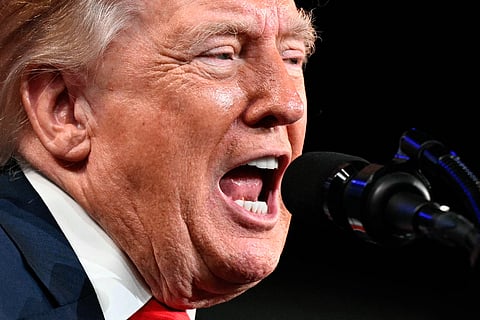
Dubai: Could the United States be preparing to launch another military campaign against Yemen’s Iran-backed Houthis?
President Donald Trump has opened the door to direct American intervention after a fresh attack on Riyadh’s King Khalid International Airport on Saturday, raising fears that the widening conflict in Yemen could draw Washington into another military confrontation.
The latest strike, which injured several people and forced the airport to suspend operations, followed deadly attacks earlier in the week.
With Saudi-led forces already carrying out extensive operations against the Houthis, Trump’s remarks have raised five important questions about what could happen next.
What has Trump said about attacking the Houthis?
Trump has confirmed that Washington is considering joining Saudi-led military strikes but has stopped short of announcing a decision.
“We may. We’re going to look at it,” he told reporters at the White House on Saturday.
He said the administration had just learned of the latest airport attack and would make a decision quickly.
His remarks suggest direct American military action is under consideration, although no timetable or operational details have been announced.
Why is the US considering intervention now?
The immediate trigger is the escalating series of attacks against Saudi Arabia, particularly Riyadh’s international airport.
The Houthis have claimed responsibility for earlier strikes that killed three Saudis, including a pilot. Saturday’s attack caused further injuries and widespread flight disruptions.
The attacks have also targeted other airports, military installations and oil infrastructure.
Saudi Arabia and its allies have intensified operations against the Houthis, with the coalition announcing on Friday that it had destroyed more than 130 targets.
The growing threat to civilian aviation, regional security and energy infrastructure has increased pressure for a stronger military response.
Is the US already involved in the campaign?
Yes, but there is an important distinction between supporting military operations and directly conducting strikes.
According to the Associated Press, American assistance has included intelligence sharing, identifying targets and helping plan the latest offensive against the Houthis.
Direct US airstrikes would represent a further escalation.
Washington also has experience conducting operations against the group. Last year, American forces carried out an eight-week bombing campaign targeting Houthi radar systems, missile launchers and drone facilities following attacks on commercial shipping.
The campaign reduced the group’s ability to threaten shipping but did not eliminate its military capabilities.
Why does the Red Sea matter so much?
The fighting is not confined to Yemen’s internal conflict.
Saudi-backed Yemeni government forces are attempting to reverse Houthi territorial gains near the strategic Bab Al Mandab Strait, one of the world’s most important maritime chokepoints.
The waterway connects the Red Sea to the Gulf of Aden and is crucial for ships travelling between Asia and Europe through the Suez Canal.
Recent Houthi advances have strengthened the group’s ability to monitor shipping movements near the strait.
That has become particularly significant because the Strait of Hormuz, another vital energy corridor, remains affected by the wider conflict with Iran.
Further disruption in the Red Sea could complicate shipping routes, increase transport costs and add pressure to global energy markets.
Could US intervention widen the conflict?
That is one of the biggest concerns.
American strikes could strengthen the Saudi-led campaign by targeting Houthi missile systems, drones, launch sites and other military infrastructure.
However, they could also prompt retaliatory attacks against regional military facilities or commercial shipping.
The Houthis have already warned international airlines against operating in Saudi airspace, while aviation safety authorities have highlighted the dangers posed by missile and drone activity.
Diplomatic efforts have not stopped. Saudi Arabia and Oman discussed the importance of de-escalation on Saturday, underscoring the continuing search for a political solution.
For now, the central question remains unanswered: Will Trump limit Washington’s role to military support, or order American forces back into direct combat against the Houthis?
His next decision could have consequences far beyond Yemen, affecting Saudi security, regional aviation and shipping through two of the world’s most sensitive waterways.


