Al Houthi rebels hand over two Saudi soldiers after truce deal
Provide no information on release of other two held captive
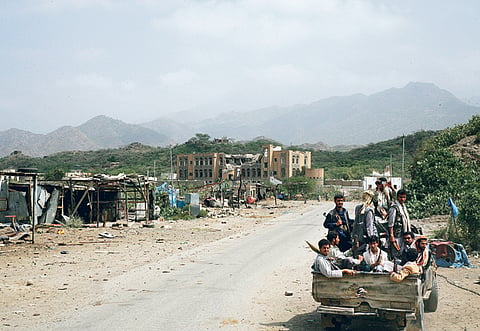
Sana'a: Al Houthi rebels handed over two captive Saudi soldiers to the Yemeni government yesterday, a government official said, but gave no information on when the other two soldiers might be freed.
"The two [soldiers] were handed over to the Yemeni government and are in the hands of the truce committee. They will be handed over to the Saudi side shortly," a government official told reporters.
Yemeni troops should begin to deploy on Saudi Arabia's border from tomorrow, as part of a truce deal with Shiite rebels, a member of a committee overseeing the truce announced.
"We expect that the engineering teams will complete the removal of mines on Friday [today] and that the army will deploy on the border with Saudi Arabia starting from Saturday," he said.
Agreement
Yemen agreed to the truce last week with the Shiite rebels, who have been fighting both Yemeni forces and those of its northern neighbour Saudi Arabia.
Previous truces in the war that has continued sporadically since 2004 have not been held.
Both sides declared a ceasefire on February 12 to end the sixth round of fighting that lasted for more than six months, the longest and the most violent of the six-year-old sporadic war, which claimed thousands of lives, and displaced about 250,000 people.
The international community, which exercised an obvious pressure on Sana'a to end the war, welcomed the decision to end the war so Yemen could focus its energy on an open war with Al Qaida, which exploits unrest for more recruitment. On top of this, Yemen also faces a separatist movement in the South.
"The US supports a unified, stable, democratic and prosperous Yemen," Secretary of State Hillary Rodham Clinton, who was on a middle-eastern trip, said.
The decree of ending the war comes before the international donors meet in Riyadh at the end of this month to support Yemen and help it face its major challenges.
Optimistic
Some observers are optimistic about a permanent end to the war despite the difficulties and breaches, which happen almost every day.
Ahmad Al Sufi, political analyst and chairman of the Yemeni Institute for Democratic Development said the decision of ending the war was strategic for both parties.
End of war
"Two things imposed the end of the war: The government emerged from the London conference with many commitments to solve its problems in Sa'ada, south, and with Al Qaida.
Al Houthi rebels have almost finished all their resources, even the Iranian support stopped, and they were almost defeated," Al Sufi told Gulf News.
"President Saleh who was shrewd enough to declare the end of the war, secured a victory for the state.
"Al Houthi wanted to have a political victory but was almost completely defeated militarily," he said.
President Ali Abdullah Saleh has chosen 20 members of the parliament from all parties and formed four separate committees to supervise the implementation of the six conditions, which includes the rebels retreat from the mountains and handing over the heavy weapons in the next 45 days.
One of these four committees is in charge of supervising the implementation of the conditions at the borders with Saudi Arabia, which wants its five soldiers captured by the rebels to be released as the first and foremost.
The swap of detainees was not included in the declared conditions.
The Saudi authorities repeatedly said they will only deal with Sana'a as the legitimate government and not directly with the rebels.
Hurdles on path to peace
The issue of Saudi captives is sensitive and may obstruct the mediation committees' efforts. The second issue that may be a hurdle to bringing peace to war-torn Sa'ada, is the tribal blood feuds between tribesmen who are divided between the government and the Al Houthi rebels.
For instance, a senior military officer was killed on Tuesday when a group of Al Houthi rebels attacked a checkpoint in Al Jawf province, southeast of Sa'ada, according to local and security sources.
The five Al Houthi gunmen attacked and killed Colonel Ali Darban, 51, while he was on duty at the checkpoint between Al Samoom and Al Zaher, in Al Jawf province.
The officer belonged to the Shulan tribe (loyal to the government) and the attackers belong to Al Ashraf (loyal to the Al Houthi rebels). The two tribes have blood feuds going back 30 years.
The government considered the incident as a breach of ceasefire, while the Al Houthis said it was only a tribal dispute.
The accusations started after Al Houthi rebels tried to assassinate the top security official in Sa'ada city, Mohammad Al Kawsi, hours after the two sides declared truce.
These incidents show how difficult it is for both sides to implement the six conditions of the ceasefire.

