Clinton in Gulf to shore up support on Iran move
US Secretary of State Hillary Clinton shores up support for tougher stance against Iran
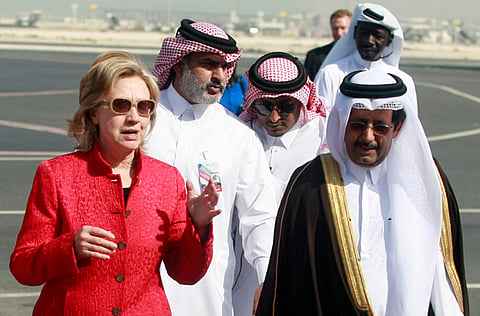
Doha: US Secretary of State Hillary Rodham Clinton began a visit to two Gulf allies on Sunday as part of a broader Obama administration effort to shore up support for taking a tougher stance against Iran's nuclear programme.
Her stops in Qatar and in Saudi Arabia coincide with a string of diplomatic and military contacts in the Middle East, including a visit to Egypt on Sunday by Admiral Mike Mullen, chairman of the Joint Chiefs of Staff. Clinton's top three deputies - James Steinberg, Jacob Lew and William Burns - will be in the region in coming days, and a Clinton aide said Gen. David Petraeus, chief of US Central Command with responsibility for US military operations across the Middle East, would also be in the region.
Their agenda is not focused exclusively Iran. There also is an American push for closer cooperation in Yemen against Al Qaida, a move toward bolstering diplomatic relations with Syria and efforts to get Israeli-Palestinian peace negotiations back on track.
After an overnight flight from Washington, Clinton went directly into a series of high-level meetings in the Qatari capital and delivered an evening speech at the US-Islamic World Forum.
Little choice
Clinton told the US-Islamic World Forum in Doha on Sunday that Iran has left the world little choice but to take harsher action to contain its nuclear programme.
Iran has not lived up to its nuclear obligations, she said.
She also said Iran has rebuffed US and international efforts to engage in serious negotiations on the nuclear issue.
As a result, Clinton said in her speech, the US and others are working on "new measures" to try to persuade Iran to change its course.
"We are now working actively with our regional and international partners, in the context of our dual track approach, to prepare and implement new measures to convince Iran to change its course," Clinton said.
Meeting with Erdogan
She also was holding a one-on-one meeting with Turkish Prime Minister Recep Tayyip Erdogan, who was attending the US-Islamic World Forum, which is jointly organised by the Qatari Foreign Ministry and the US Brookings Institution's Saban Center for Middle East Policy.
Obama addressed the forum by video on Saturday, announcing that he is appointing a special envoy to the Organisation of the Islamic Conference.
In Cairo, Mullen met with Egyptian President Hosni Mubarak and said afterward that Iran is a key challenge to the security of the Middle East. He accused Tehran of spreading its radical influence in Lebanon, Gaza, Yemen and Iraq. And he said the United States will work through the UN Security Council to seek new sanctions on Iran. He said Washington has no specific plans for military action against Iran.
On Monday Clinton is scheduled to travel to Saudi Arabia - first to the capital, Riyadh, and then on Tuesday to the Red Sea city of Jeddah.
It is Clinton's first visit to Qatar and Saudi Arabia as secretary of state.
Saudi Arabia and Qatar, both situated across the Gulf from Iran, are concerned about Iran's nuclear ambitions. They are seen by the Obama administration as an important part of a regional effort to persuade the Iranians that it is in their economic interest to give up their uranium enrichment programme as called for in a series of Security Council resolutions that Iran has ignored.
The State Department's top Middle East policy officer, Jeffrey Feltman, who was accompanying Clinton, told reporters on the flight from Washington that Iran would figure prominently in Clinton's discussions in both Qatar and in Saudi Arabia.
Feltman said the US believes the two Gulf allies, as well as other countries in the region, can help "sharpen the question for Iran" as to whether it is better off continuing to seek higher-enriched uranium that is closer to weapons grade or halt the programme.
"We would expect them (Gulf allies) to use their relationship in ways that can help increase the pressure that Iran feels," Feltman said.

