Q & A: Bahrain's elections
Bahrain is set to go to the polls this week in the third elections since 2002.
Are these the first elections in Bahrain’s modern history?
These are the third elections since 2002. Bahrain had the first municipal elections on May 9, 2002 and the parliamentary elections on Thursday October 24, 2002. At that time, the weekend was on Thursday-Friday.
The number of candidates in the parliamentary elections in 2002 was 190, including eight women. Around 70% of the candidates had at least a university degree.
The number of candidates in the municipal elections in 2002 was 306, including 31 women.
The participation percentage in the municipal elections in 2002 was 51.27% in the first round and 55% in the second round. Women’s participation percentage was 51%.
In 2006, the municipal and parliamentary elections were held on the same day on Saturday 25 November 2006.
Who is voting?
Any Bahraini citizen who is at least 21 years old on October 23 can cast ballots. The citizen must be fully eligible with political and civil rights and live in the constituency from which he will elect the candidate.
In 2002, the number of those who were eligible to vote was 243,449. In 2006, the figure went up to 295,686 (148,358 women and 147,328 men)
In 2010, about 318,000 people are eligible to vote in Bahrain’s parliamentary elections.
Who are the candidates?
Conditions for parliamentary candidates:
- The candidate should be a Bahraini with full civil and political rights.
- Name should be registered in the voters’ list of the constituency where s/he is running.
- Should be at least 30 years old on October 23.
- Should possess excellent command of written and spoken Arabic language.
- Should not have been sentenced in a case of felony, even if he / she was pardoned.
- Should not have been sentenced to jail in misdemeanor crimes for a period more than six months even if s/he was pardoned.
Conditions for municipal candidates:
- Candidate should be Bahraini with full civil and political rights.
- Name should be registered in the voters’ list of the constituency where s/he lives.
- Should be at least 30 years on October 23.
- Should have a good command of Arabic
- Should have the backing of ten voters from his / her constituency.
- Most candidates are independent.
How many political formations are running?
All officially registered societies, except for one, are taking part in the elections. Some are fielding up to 18 candidates (Al Wefaq).
Amal said that it was not taking part amid reports that it wanted to run only if it was assured of at least one seat.
When will the elections be held?
The elections will be held on October 23 in 40 constituencies. However, so far five candidates have secured their seats after their challengers have pulled out, leaving only 35 constituencies in the race.
A second round will be held on October 30 in the constituencies where no candidate received at least 50% of the votes. Only the two top scorers in each undecided constituency move to the second round.
Can foreigners living in Bahrain vote?
Non-Bahrainis who own property in the kingdom can vote in the municipal elections.
How did women do in past elections?
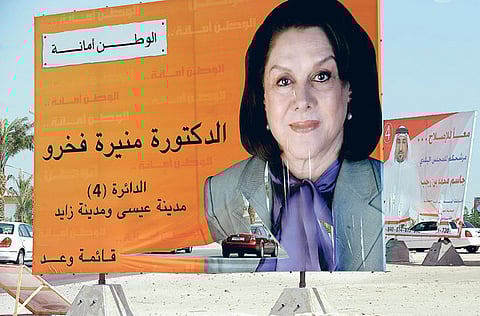
No woman won in 2002, but in 2006, Lateefa Al Gaood made history by becoming the first woman to reach an elected parliament in the Gulf Cooperation Council states. Lateefa who ran unopposed in her constituency in 2006 will also be in the 2010 – 2014 parliament after no-one challenged her. Four other incumbent lawmakers were confirmed after their opponents pulled out.
Who is in charge of the elections?
An executive committee under the umbrella of the ministry of justice and Islamic affairs.
Who can monitor the elections?
Bahrain’s human rights national commission and four local NGOs will be monitoring the elections. The executive committee said that only people who did not belong to a political society or did not have links with any of the candidates could monitor the elections.
Applications by non Bahraini NGOs to monitor the elections were rejected.
When will the results be announced?
The results will be announced gradually at least three hours after the poll centres close at 8 pm. Results will be expected early morning on Sunday 24 October.


