Malampaya Fund scam: Philippine Supreme Court rules Ombudsman can probe officials without waiting for COA audit
SC affirms penalties for Palawan officials in Malampaya Fund irregularities
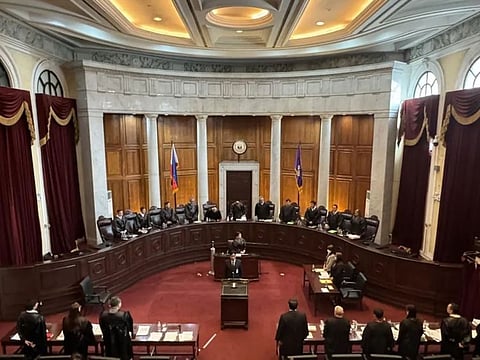
MANILA: The Supreme Court has ruled that the Office of the Ombudsman can independently investigate alleged wrongdoing by government officials even while the Commission on Audit (COA) is examining the same transactions.
This removes any requirement for the Office of the Ombudsman to wait for the state auditor to complete its work.
In a decision written by Associate Justice Maria Filomena D. Singh, the Supreme Court en banc affirmed the administrative liability of Ronelo O. Del Socorro and other former officials of the provincial government of Palawan over irregularities involving projects funded by the Malampaya Fund, according to a court statement on Tuesday (October 20, 2026).
The Office of the Ombudsman is an independent constitutional body that acts as the country's primary anti-corruption watchdog.
Get it: Fast, verified news for FREE ... download the Gulf News app — simply click here
The ruling clarifies the separate constitutional mandates of the Ombudsman and the COA.
It also underscores that an unfinished audit does not prevent an investigation into the possible misconduct of public officials.
The Malampaya Fund: This is a special Philippine government fund that collects royalty shares from the commercial extraction of natural gas and oil from the Malampaya gas field off the coast of Palawan.
The Court also affirmed the penalties imposed on the officials, including dismissal from government service, perpetual disqualification from holding public office and forfeiture of retirement benefits.
What was the Malampaya Fund case about?
The case stemmed from the release of ₱2.572 billion from the Malampaya Fund for development projects in Palawan.
Of that amount, ₱966 million was allocated to the province for projects involving electrification, health programs, education and infrastructure.
Following a special audit, the COA identified alleged irregularities that led to four administrative complaints being filed with the Ombudsman against provincial officials.
Irregularities
The allegations involved procurement procedures, contractor selection, project implementation and the documentation supporting government payments.
Among the reported irregularities were inadequate publication and posting of invitations to bid, improper evaluation of bidders' qualifications and the awarding of contracts despite missing required documents.
The complaints also cited the assignment of one staff member to multiple projects with overlapping schedules, inadequate supporting documents for disbursements, and accomplishment reports that allegedly overstated project completion.
Those reports served as a basis for payments to contractors.
The Ombudsman investigated the complaints and found the officials administratively liable.
The Supreme Court has now upheld that determination.
Why the Supreme Court ruling matters
The Ombudsman does not have to wait for a completed COA audit.
The Court said the Ombudsman may begin or continue investigating alleged misconduct even when the COA's report on the same transactions is still being finalized.
This matters because an audit and an investigation into official misconduct serve different purposes. Requiring the Ombudsman to wait could delay the examination of potential administrative wrongdoing while an audit remains pending.
The COA and Ombudsman have separate constitutional powers.
Article XI, Section 13(1) of the 1987 Constitution empowers the Ombudsman to investigate, on its own initiative or upon complaint, acts or omissions by public officials and employees that appear illegal, unjust, improper or inefficient.
The COA, meanwhile, examines government accounts, expenditures and transactions as part of its constitutional audit mandate.
The two bodies may investigate the same set of transactions, but neither function automatically replaces the other. COA findings may help inform an Ombudsman investigation, but they do not bind the anti-graft body.
An audit report is not the only basis for administrative liability.
The Court emphasised that the Ombudsman did not simply adopt the COA's findings. It independently examined the complaints and supporting records, including bidding documents, contracts, inspection reports, resolutions of the Bids and Awards Committee and other relevant materials.
That distinction is important: administrative accountability can be assessed through the evidence gathered and evaluated by the Ombudsman, rather than being made contingent on the completion of a separate audit process.
The ruling reinforces accountability in public spending.
The case involved money intended for basic services and infrastructure. By affirming the officials' administrative liability, the Court underscored the importance of proper procurement, reliable project documentation and accurate accomplishment reports when public funds are disbursed.
The decision does not mean that every audit irregularity automatically establishes misconduct. The evidence and applicable legal standards must still support the finding of liability in each case.
What happens next?
The ruling has immediate significance for the parties and broader implications for future investigations.
For the former Palawan officials: The Supreme Court has affirmed the administrative penalties described in its decision, including dismissal, perpetual disqualification from public office and forfeiture of retirement benefits. The ruling upholds the Ombudsman's determination of their administrative liability.
For the Ombudsman: The office may proceed with investigations into alleged wrongdoing without waiting for the COA to finalise an audit concerning the same transactions. It must still independently evaluate the evidence and follow the applicable procedures.
For the COA: The agency retains its independent audit responsibilities. Its findings can support other investigations, but the Ombudsman is not required to treat them as conclusive.
For future cases: The decision provides guidance when an audit and an investigation overlap. Officials cannot rely solely on the fact that a COA audit remains pending to argue that the Ombudsman must suspend its own investigation.
The ruling does not, by itself, establish criminal guilt or automatically determine the outcome of any separate criminal proceedings.
Administrative liability, criminal liability and questions involving the recovery of public funds are distinct legal matters that depend on the relevant proceedings and evidence.
Implications
The Supreme Court's decision establishes that the Ombudsman and the COA can perform their respective functions independently, even when they examine the same government transactions.
For investigations involving public funds, the key implication is that the administrative accountability process need not be put on hold simply because an audit is unfinished.
The Ombudsman must still establish liability through its own evaluation of the evidence, as the Court said it did in the Palawan case.
Presidential Decree No. 910: Issued by then-President Ferdinand E. Marcos Sr on March 22, 1976, creating the Special Fund to finance energy resource development and mineral extraction. Under the service contract for the Malampaya deep-water gas-to-power project (which began commercial operations in 2002), the Philippine government receives a 60% share of net proceeds. The fund has accumulated hundreds of billions of pesos over the decades (estimated at >₱200 billion, or $3.17 billion), as per the Department of Budget and Management (DBM)


