Why solar panels are becoming prized wedding gifts in Pakistan?
Soaring power bills fuel solar boom, but experts warn of growing risks to national grid
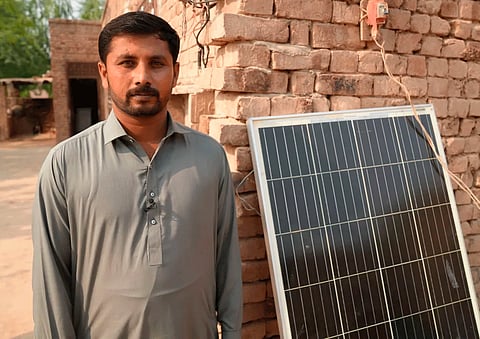
Dubai: Jewellery, silverware, furniture — and now solar panels. In Pakistan, a quiet energy revolution is transforming not only how people power their homes but also what families give as wedding gifts.
Three months after his wedding, Faisal Shahzad, a resident of rural Punjab, treasures one particular gift from his bride’s family: A 340-watt solar panel tucked beneath his bed.
During summer, the panel powered an air cooler throughout the day, helping his family avoid drawing electricity from the national grid.
“Now they give a solar panel and an air cooler. It has almost become a must,” Shahzad told the BBC, describing how solar equipment is increasingly replacing traditional wedding gifts.
Seven million households embrace solar
Pakistan is experiencing an extraordinary solar boom, driven largely by ordinary households desperate to escape soaring electricity bills.
Between 2018 and 2025, solar power’s share of the country’s electricity generation jumped from just 1 per cent to 28 per cent, according to the think tank Renewables First.
Around seven million households now own solar panels.
The transformation has been accelerated by a dramatic fall in the price of Chinese solar panels, which have become 93 per cent cheaper, while electricity tariffs have more than doubled in recent years.
For families earning an average monthly wage of less than Rs40,000 ($145), electricity bills of Rs15,000 to Rs18,000 can consume a substantial portion of their income.
Pakistan’s Energy Minister Awais Ahmad Leghari told the BBC that people had found an economically viable way to cope with rising energy costs.
Solar boom threatens national grid
But the rapid transition is creating an unexpected problem for Pakistan’s electricity system.
As more households generate their own power, fewer consumers remain to share the fixed costs of maintaining the national grid.
This can trigger what energy experts call a “utility death spiral”: Declining electricity sales force tariffs higher, encouraging even more customers to switch to solar.
Leghari said the shift away from grid electricity had already imposed additional costs exceeding $500 million annually on remaining consumers over the past two years.
Experts warn that poorer households unable to afford solar installations could ultimately bear the heaviest burden.
How much does it cost to power a small home with solar panels in Pakistan?
Pakistan enjoys approximately 250 to 300 sunny days annually, making it particularly suitable for rooftop solar installations and helping households reduce dependence on expensive grid electricity.
For a modest two-bedroom house, a 3-kilowatt solar system can provide enough daytime electricity for fans, lights, a refrigerator, television and other basic appliances.
What would it cost?
One 585-watt solar panel: Rs23,000–25,500
Basic 3kW system without batteries: Approximately Rs200,000–400,000
3kW system with battery backup: Approximately Rs400,000–600,000
Panels required: Around five to six modern panels
Electricity generated: Roughly 350–400 units a month, depending on location and weather
Can it run an air conditioner?
A 3kW system may power an energy-efficient one-tonne air conditioner during sunny hours, provided other electricity consumption is limited. Running air conditioning at night generally requires battery storage or grid electricity.
Can families disconnect from the grid?
Not necessarily. Homes without batteries still depend on the national grid after sunset. Becoming fully self-sufficient requires sufficient solar capacity and battery storage, substantially increasing installation costs.
Is solar power worth the investment?
For many Pakistani families, the upfront cost remains a major obstacle. Even a basic system can cost the equivalent of several months’ earnings, putting it beyond the reach of poorer households.
But for those who can afford it, solar power can be a valuable long-term investment, cutting electricity bills and reducing dependence on the national grid.
Source: Indicative Pakistan solar market estimates, September–November 2026. Prices vary by equipment, battery capacity, location and installation requirements.
Factories join the revolution
The solar transformation is also reshaping Pakistan’s industrial sector.
At Kohinoor Textile Mills in Islamabad, hundreds of machines operate entirely on solar power during sunny periods, replacing heavy-furnace-oil generators.
The company is preparing to install industrial batteries to store excess electricity, although it will continue using the national grid when solar generation is insufficient.
Businesses, however, have criticised changes to government rules that reduced payments for surplus solar electricity supplied to the grid.
Officials argue that the previous system unfairly shifted costs onto other consumers.
Pakistan faces an energy crossroads
The government aims to generate up to 90 per cent of its electricity from clean sources, including nuclear power, by the end of 2036, while sharply reducing dependence on imported energy.
But experts say Pakistan must balance its solar expansion with reforms that keep the national grid financially sustainable.
For Shahzad, the ambition is more personal.
He plans to install another 10 to 15 panels, along with batteries, to make his family’s home entirely self-sufficient.
“The plan is to be fully self-sufficient,” he told the BBC.


