Putin’s Delhi visit puts spotlight on Hyderabad House — Inside Nizam’s palace turned diplomatic hub
Once built for world’s richest ruler, Hyderabad House now hosts most vital summits
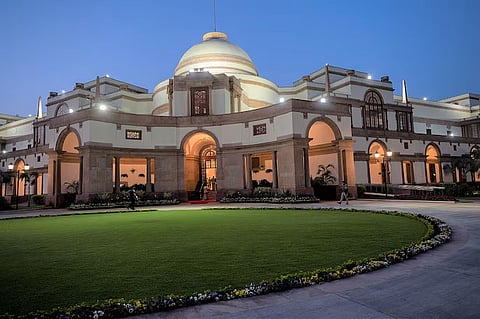
Dubai: As Russian President Vladimir Putin arrives in New Delhi for high-level talks, Prime Minister Narendra Modi will receive him at Hyderabad House — a landmark building that has transformed from a princely residence into India’s prime stage for diplomacy.
Situated at 1, Ashok Road near India Gate, the palace has become synonymous with state banquets, joint press conferences and meetings with visiting global leaders.
Long before it became a diplomatic hub, Hyderabad House was built as the Delhi home of Mir Osman Ali Khan, the seventh Nizam of Hyderabad — a ruler so wealthy that TIME magazine named him the richest man in the world in 1937. Stories of his pearls filling swimming pools and the legendary Jacob Diamond kept in his paperweight drawer remain part of Indian historical folklore.
A capital shaped for princes
When British India shifted the capital from Calcutta to Delhi in 1911, the princely states were encouraged to establish a presence in the new imperial enclave.
The Viceroy allocated prime land to five rulers — Hyderabad, Baroda, Patiala, Jaipur and Bikaner — signalling their loyalty to the Crown. These palaces were positioned near the new government axis, close to the Viceroy’s House (now Rashtrapati Bhavan), to visually integrate royalty into the British-designed capital.
According to NDTV, the Nizam wanted a residence worthy of Hyderabad’s 21-gun-salute status. He commissioned Edwin Lutyens — the principal architect of New Delhi — to design a building that would match his stature. The Nizam reportedly demanded something as grand as the Viceroy’s House, but colonial regulations required official approval on designs and prohibited duplication. Ultimately, Lutyens granted only one shared visual reference: a central dome.
Hyderabad House — fast facts
Built: 1920s
Architect: Edwin Lutyens
Commissioned by: Mir Osman Ali Khan, last Nizam of Hyderabad
Cost: £200,000 in 1920s (≈ £1.4 million / ₹170 crore today)
Plot size: 8.2 acres
Rooms: 36
Style: Butterfly plan, central dome, Indo-European design
Current use: Venue for PM-level state visits, banquets, joint statements and diplomatic engagements
The Butterfly Palace
Completed in the 1920s at a cost of around £200,000 (over £1.4 million in today’s value), Hyderabad House stood out among Delhi’s princely residences. Lutyens designed it using his distinctive “butterfly plan,” two symmetrical wings spreading out from a circular central hall. The layout was adapted from his earlier Papillon Hall design in England.
The palace contains 36 rooms, courtyards, archways, staircases, fireplaces, fountains and formal reception rooms. Interiors combine European aesthetics with Mughal touches, balancing classical symmetry with ornamental detail. Lutyens incorporated influences from the Pantheon in Rome, Florence’s Uffizi galleries and other European inspirations, blending these with Indo-Saracenic elements.
One notable feature was the zenana, or women’s quarters, a circular court with small rooms around it. Lord Hardinge, who visited the house, famously described the rooms as “the size of a horsebox” with taps for hot and cold water but no baths, reflecting a collision between traditional arrangements and modern plumbing.
Hyderabad House became the largest princely palace designed by Lutyens in Delhi, surpassed only by the Viceroy’s House. It was intentionally striking — designed to command attention, evoke prestige and assert Hyderabad’s identity within the imperial capital.
After independence — princely opulence to public diplomacy
With India’s Independence in 1947, the purpose of Hyderabad House changed dramatically. Hyderabad resisted joining the Indian Union, prompting Operation Polo in 1948, which resulted in the state’s accession. The Nizam rarely used the Delhi property afterwards, and it was eventually transferred to the Government of India, though exact records of compensation remain unclear.
By 1974, Hyderabad House was placed under the Ministry of External Affairs and designated for state visits, banquets and diplomatic ceremonies. The India Tourism Development Corporation (ITDC) managed its catering, upkeep and VVIP services.
Since then, the palace has hosted some of the most consequential bilateral meetings of independent India. Former US Presidents Bill Clinton and George W. Bush, Russian President Vladimir Putin, British Prime Minister Gordon Brown, Chinese President Xi Jinping, Japanese Prime Minister Shinzo Abe and multiple ASEAN leaders have been welcomed here.
As Putin returns to Hyderabad House yet again, the palace stands as a physical reminder of India’s journey: From princely wealth and imperial design to strategic diplomacy and global engagement.


