Jaipur's pink elephant death case: Sparks animal welfare debate in India
Postmortem confirms natural death but controversy fuels wider concerns
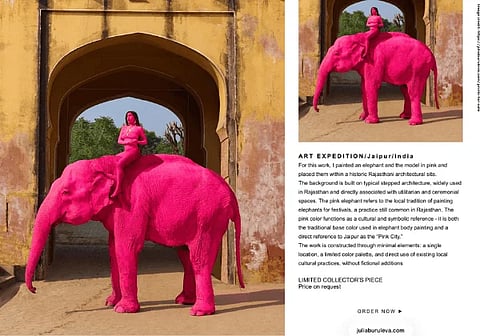
Dubai: A photoshoot that set social media ablaze has taken an even more charged turn following the death of the elephant at its centre.
Chanchal, a 67-year-old female elephant who was painted pink for a shoot by Russian art photographer Julia Buruleva in Jaipur, died in February 2026, triggering an outpouring of outrage from animal welfare activists who blamed the photoshoot for her death. But the postmortem report tells a different story.
What the postmortem found
According to the postmortem report reviewed by NDTV, Chanchal died on 4 February 2026 at 3:30pm. The cause of death was cardiac arrest due to old age. She was 67 years old. Dr Arvind Mathur, who was part of the postmortem panel, confirmed the findings directly. "Her death was entirely natural and unrelated to the gulal painting incident," he told NDTV.
Elephant Village Committee President Ballu Khan also pushed back on the claims circulating online, describing them as baseless. He clarified that the photoshoot had taken place approximately a year before Chanchal's death, and that she had been painted with gulal, the coloured powder traditionally used during Holi celebrations. The colour was washed off after around half an hour.
How the controversy started
The images were shared by Buruleva on social media on 18 February and spread rapidly, drawing immediate and fierce criticism from animal lovers and welfare advocates who called the shoot an act of cruelty. Among those who spoke out was actress Rupali Ganguly, who is associated with PETA. She went as far as writing a letter to the Prime Minister demanding a ban on elephant rides in the country.
The news of Chanchal's death, which emerged shortly after the images went viral, intensified the backlash considerably, with activists linking the two events and holding the elephant's owner, the photographer and the forest department responsible.
The photographer's response
Following the controversy, Buruleva posted a clarification on Instagram alongside a behind-the-scenes video of the shoot. In her post, she addressed concerns about Chanchal's welfare directly. "For anyone worried about the elephant, we used organic, locally-made paint, the same kind locals use for festivals, so it was absolutely safe for the animal," she wrote.
Her post also described the inspiration behind the project and the process of finding a suitable location and subject for the shoot, though the clarification did little to quieten the debate online.
Update: PETA India demands artist pull the print or donate all proceeds
The controversy has now taken a further step, with PETA India formally entering the picture. Dr Mini Arivandan, PETA India's Senior Director of Veterinary Affairs, has written a letter to Buruleva urging her to either immediately remove the commercial print of Chanchal from her website or donate all proceeds from its sale toward elephant conservation efforts in India. The print is currently being sold on Buruleva's website for up to over Rs 3 lakh per piece.
The letter suggests the proceeds be directed toward initiatives such as PETA India's mechanical elephant project, or to a genuine elephant sanctuary like Wildlife SOS or the Wildlife Rescue and Rehabilitation Centre, where rescued elephants are kept unchained, never controlled with weapons and have the company of other elephants.
If the latter option is chosen, PETA India asks that the prints carry a clear message discouraging the use of captive elephants for rides or other purposes, and that this be posted publicly on Buruleva's website.
Questions around the paint and Chanchal's age
While the postmortem attributed Chanchal's death to natural causes, PETA India's letter stops short of fully absolving the photoshoot. It notes that the paint was applied near the elephant's eyes, ears, trunk, mouth and genitals, and states that "it is not possible to wholly rule out the health impacts of the paint towards Chanchal's demise."
The letter points out that coating an elephant's skin around sensitive areas can pose risks including irritation, ingestion during grooming or feeding, stress and aggravation of pre-existing conditions, even when products are described as safe.
The letter also notes that some media reports placed Chanchal's age at 70, and references Ministry of Environment guidelines which recommend that captive elephants be retired at 65 years of age.
A wider pattern of concern
PETA India's letter does not stop at the photoshoot. It raises broader concerns about the treatment of elephants used for rides at Amer Fort, describing how they are chained and kept on concrete when not working, and controlled with weapons often hidden beneath costumes and decorations.
The letter also flags that Chanchal's owner, Saddik Khan, appears to be the same person who previously owned an elephant named Malti, who was rescued following a PETA India campaign after being documented as severely beaten on multiple occasions, including once by eight men wielding sticks.
It further warns that the situation at Jaipur poses risks not only to the animals but to humans as well. In 2024, a Russian tourist was hospitalised after an elephant named Gouri, used for rides, slammed her to the ground and broke her leg.
Get updated faster and for FREE: Download the Gulf News app now - simply click here.





![India government urges citizens to avoid unregistered agents and misleading recruitment pitches. [Illustrative image]](http://media.assettype.com/gulfnews%2F2026-10-01%2F9ga9fyu9%2F202607313886105.jpg?w=320&auto=format%2Ccompress&fit=max)