A huge electricity bill led police to 300 pythons hidden inside a flat
Escaped snake triggered an investigation that led officers to a reptile-filled China flat
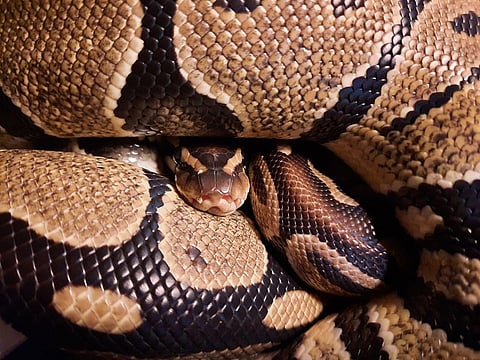
The mystery began with a snake that wasn't supposed to be there.
In March last year, residents near a mountain in Taizhou, eastern China, spotted a large python moving through the area and alerted authorities.
The sighting immediately raised questions.
Get updated faster and for FREE: Download the Gulf News app now - simply click here.
Not because the snake was large — although witnesses described it as unusually thick — but because of the timing. It was still early spring, when wild snakes in the region are typically inactive.
So where had it come from?
Investigators suspected the animal had escaped from captivity, but finding its source would prove far more complicated.
The breakthrough came from an unexpected place: electricity records.
Experts told police that keeping pythons alive in large numbers requires a carefully controlled environment: heat, humidity and constant regulation. All of it consumes power.
If someone were breeding snakes, their electricity bill would probably show it.
Authorities began looking.
Among the homes that caught their attention was an apartment with unusually high power consumption. When officers entered the property, they found what police described as an illegal breeding operation hidden behind an ordinary residential door.
The apartment had effectively stopped functioning as a home.
Two bedrooms and the living room had been converted into reptile enclosures. Plastic containers filled the rooms. Inside them were pythons — hundreds of them. Furniture had reportedly been pushed into the remaining small space, while the rest of the flat was used for the animals.
By the end of the search, police had counted 309 pythons.
That was only the beginning of the investigation.
As investigators dug deeper, they traced shipments, financial transactions and online activity. Police allege the apartment was part of a wider network involving several people engaged in breeding and selling protected snakes.
One suspect was accused of regularly sourcing white mice to feed the reptiles. Another allegedly supplied some of the pythons. Social media posts and transaction records helped investigators piece together what authorities say was a profitable underground trade.
The numbers kept growing as investigators dug deeper.
What started with one escaped snake eventually led police to 436 pythons, according to Chinese media reports. Authorities estimated their value at more than 30 million yuan, about $4.2 million.
The animals were later transferred to a local zoo.
The case has attracted widespread attention across China, where exotic pet ownership has expanded rapidly in recent years. Industry estimates cited by the South China Morning Post put the number of people keeping exotic animals, including reptiles and amphibians, at roughly 17 million.
But pythons are subject to strict protections.
Chinese authorities classify them as Grade Two protected wildlife, making it illegal to breed, transport or sell them without official approval.
The men involved were later sentenced to prison.
For investigators, however, the case remains notable for a different reason.
It was not solved through a tip-off, a raid or a lengthy undercover operation.
It started with a single snake. And a power bill that did not make sense.


