Why the Supreme Court ruled Trump’s sweeping tariffs illegal: Key points explained
Ruling ends broad import duties on key partners; sector tariffs unaffected
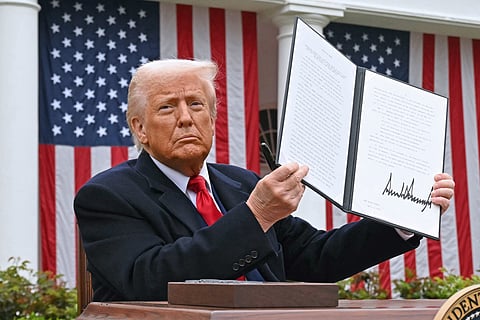
The US Supreme Court ruled Friday that President Donald Trump exceeded his authority by imposing a broad set of tariffs that disrupted global trade. The six-three conservative-majority decision blocked a key economic tool Trump used to pursue his agenda.
The court found that the International Emergency Economic Powers Act (IEEPA) “does not authorise the President to impose tariffs.”
Trump had relied on emergency economic powers last year to levy duties on nearly all US trading partners, including “reciprocal” tariffs over trade practices deemed unfair and separate duties targeting Mexico, Canada, and China over drug flows and immigration.
“Had Congress intended to convey the distinct and extraordinary power to impose tariffs through IEEPA, it would have done so expressly, as it consistently has in other tariff statutes,” the court noted.
Sector-specific tariffs remain
The ruling does not affect Trump’s sector-specific tariffs on steel, aluminium, and other goods. Formal investigations that could lead to further sectoral duties are ongoing.
Lower courts had previously blocked most of the across-the-board tariffs, ruling they were illegal, but enforcement was paused pending appeals. Friday’s Supreme Court decision affirms those earlier findings.
Deeply disappointing: Trump
Trump said that the Supreme Court decision declaring his sweeping global tariffs illegal was "deeply disappointing."
Trump also told reporters he was "absolutely ashamed" of "certain members" of the conservative-dominated court who ruled against him.
Global reaction
EU analysing impact
The European Union said it is carefully studying the Supreme Court ruling. EU trade spokesman Olof Gill said, “We remain in close contact with the US Administration as we seek clarity on the steps they intend to take in response to this ruling. Businesses on both sides of the Atlantic depend on stability and predictability in the trading relationship.”
Canada calls tariffs ‘unjustified’
Canada’s International Trade Minister Dominic LeBlanc said the ruling “affirms that the levies were unjustified,” while noting that sector-specific tariffs affecting steel, aluminium, and autos remain in force. Ottawa plans to work with Washington to “create growth and opportunities on both sides of the border.”
UK to coordinate with US
A UK government spokesperson said Britain will work with the US to understand the ruling’s impact on the bilateral trade deal. The UK expects its “privileged trading position with the US to continue.”
Market and economic response
Wall Street rebounds
US stocks rose Friday after initial losses, as the Supreme Court ruling could improve global company earnings. However, cautious sentiment remained due to weak US economic growth and tensions with Iran over its nuclear programme.
The US economy grew 1.4% in Q4 2025, below the 2.5% forecast, while December’s price index rose to 2.9%, surpassing expectations. Analysts warned these figures may limit the Federal Reserve’s ability to cut interest rates.
Global markets mixed
In Europe, business activity accelerated in February, with stock indices rising, while Asia saw declines in Hong Kong and Tokyo following Lunar New Year holidays. Oil prices slipped from six-month highs as traders weighed the risks of a US-Iran standoff.
Market analysts describe Trump’s warning to Iran as “pressure and leverage rather than a prelude to invasion,” highlighting ongoing geopolitical uncertainty.
Key points: Supreme Court strikes down Trump’s tariffs under IEEPA
Constitutional authority
Chief Justice John Roberts wrote that the Constitution gives Congress, not the president, authority to levy taxes and tariffs.
IEEPA (International Emergency Economic Powers Act) does not authorise the president to impose tariffs.
The Court emphasised that “regulate … importation” does not equate to taxing authority.
Major questions doctrine
Roberts called this a “classic major questions” case: the government claimed a transformative expansion of presidential power based on ambiguous language.
The Court said clear congressional authorization is required for actions with multi-trillion-dollar economic impact.
Statutory interpretation
“Regulate” = control or direct, not tax.
Other trade statutes explicitly mention tariffs, duties, caps, or triggers; IEEPA is silent on tariffs.
Any presidential authority to impose tariffs must be explicitly granted by Congress.
Tariffs in practice
The US collected ~$30 billion in tariffs per month, four times pre-Trump levels.
Despite high rates, import taxes were just over 5% of overall government revenue in January 2026.
Exemptions (e.g., coffee, bananas) and supply-chain shifts reduced total collections.
IEEPA tariffs make up about half of total import taxes; other tariffs issued under different statutes are not part of this case.
Who pays?
Studies show US importers and their customers bear nearly all tariff costs, not foreign suppliers.
Companies either absorb costs or pass them onto consumers via higher prices.
Refunds and administration response
If IEEPA tariffs are illegal, refunds are possible but may be complex.
Customs has systems to track payments and waive deadlines for eligible refunds.
The administration can impose tariffs under other statutes:
* Section 122 (Trade Act 1974) – limited to 15% for 150 days.
*Section 301 or Section 232 – requires official findings by USTR or Commerce Dept.
Alternative tariffs are more limited than Trump’s IEEPA-based measures.
Political and economic context
Some tariffs were rolled back or delayed due to high cost of living concerns.
Trump continues to view tariffs as a negotiation tool, despite economic and political pressures.
Tariffs have not revived domestic manufacturing; factories shed 108,000 jobs in 2025.
Many manufacturers report higher costs, lower morale, and disrupted supply chains.
IEEPA tariffs vs sector-specific duties
Trump had used emergency economic powers last year to impose broad “reciprocal” tariffs targeting trade practices and separate duties linked to drug flows and immigration.
The Court noted that Congress would have explicitly authorized tariffs if such sweeping powers were intended. Lower court rulings declaring the IEEPA-based tariffs illegal were affirmed.
Economic impact
Average tariffs are expected to fall from 16.8% to 9.5%.
Government revenue could drop by $100–120 billion.
The ruling does not affect sector-specific tariffs, and formal probes could still trigger new targeted duties.
Constitutional authority & major questions doctrine
Chief Justice Roberts: Congress, not the president, has taxing authority.
“Regulate … importation” in IEEPA does not equate to taxing authority.
Major questions doctrine: extraordinary presidential powers require clear congressional authorization when economic stakes are high.
Tariffs in practice
US collected ~$30 billion per month in tariffs, four times pre-Trump levels.
Tariffs are only ~5% of total government revenue.
Exemptions and supply-chain shifts reduced the total bill.
IEEPA tariffs account for about half of total import taxes; other tariffs remain under separate statutes.
Who bears the cost?
US importers and consumers carry nearly all costs.
Businesses either absorb higher costs or pass them to customers.
Refunds and alternative tariffs
Refunds for illegal IEEPA tariffs are possible but complex, with customs able to waive deadlines.
Alternative statutes exist:
*Section 122 (Trade Act 1974) – limited to 15% for 150 days.
* Section 301/232 – requires official findings by USTR or Commerce Dept.
These alternatives are more limited than Trump’s broad IEEPA tariffs.
International reactions
EU: studying the ruling carefully, emphasizing trade stability with the US.
Canada: tariffs were “unjustified,” though sector-specific duties remain.
UK: will work with US to understand impacts on bilateral trade.
Market and economic context
Wall Street rose on tariff ruling, but US growth and inflation data remain weak.
European and UK businesses show stable output, while Asian markets showed mixed performance.
Oil prices eased amid Middle East tensions and uncertainty over US-Iran nuclear talks.
Political and industrial context
Some tariffs were rolled back to ease cost-of-living pressures.
Tariffs have not revived US manufacturing; 108,000 jobs lost in 2025.
Manufacturers report higher costs, lower morale, and supply disruptions.
Trump continues to view tariffs as a negotiation tool despite economic pressures.


