Trump tariffs ruled illegal — why new 15% tax keeps UAE investors watching
Top court blocks tariffs, but Trump pushes new 15% levy on world imports, up from 10%
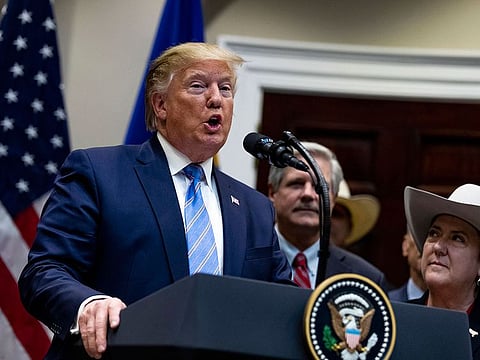
Dubai: The US Supreme Court struck down a major part of President Donald Trump’s global tariff programme, ruling that he exceeded his authority by imposing sweeping duties without congressional approval. The conservative-majority decision blocks one of the central tools Trump used to pursue his economic agenda.
The court ruled that the International Emergency Economic Powers Act “does not authorise the President to impose tariffs.” Chief Justice John Roberts wrote that the Constitution gives Congress, not the president, the authority to levy taxes and tariffs.
Why shut it down
The justices said Congress would have explicitly authorised tariffs if it intended to grant such sweeping powers. “Had Congress intended to convey the distinct and extraordinary power to impose tariffs through IEEPA, it would have done so expressly,” the ruling stated.
Roberts described the case as a “classic major questions” dispute, stressing that actions with multi-trillion-dollar economic consequences require clear congressional approval. The court also clarified that the power to “regulate … importation” does not equate to taxing authority.
Lower courts had already ruled most of the across-the-board tariffs illegal, though enforcement was paused pending appeals. Friday’s ruling affirmed those earlier findings and brought the issue to a close.
Trump escalates
He said duties would rise to the “fully allowed, and legally tested, 15% level,” while also saying he was “absolutely ashamed” of “certain members” of the conservative-dominated court. The new levy is temporary under US law and capped at 150 days.
The White House confirmed exemptions remain for sectors under separate probes, including pharma, and goods entering under the US-Mexico-Canada agreement. Sector-specific tariffs on steel, aluminium, and other goods were not affected by the ruling.
Cautious reaction
The European Union said it is carefully studying the decision. Trade spokesman Olof Gill said: “Businesses on both sides of the Atlantic depend on stability and predictability in the trading relationship.”
Canada’s trade minister Dominic LeBlanc said the ruling “affirms that the levies were unjustified,” while noting that tariffs on steel, aluminium, and autos remain. The UK said it would work with Washington to understand the ruling’s impact and expects its “privileged trading position” to continue.
EU–US trade in goods and services totalled €1.7 trillion in 2024, averaging €4.6 billion a day. European officials warned that unpredictable tariffs undermine confidence and global supply chains.
Shock absorbed
US stocks rose on Friday after early losses, as investors weighed the potential for improved global earnings. The reaction was muted rather than volatile, even as economic data remained soft.
US growth slowed to 1.4% in the fourth quarter of 2025, below forecasts, while inflation rose to 2.9%. Analysts said those figures could limit the Federal Reserve’s ability to cut interest rates.
In Europe, business activity picked up in February and stock indices rose. Asian markets were mixed, while oil prices eased from six-month highs amid uncertainty over US-Iran tensions.
Why no panic
Nigel Green, CEO of Dubai-based deVere Group, says the ruling hits the foundation of Trump’s approach. “This ruling strikes at the core of the administration’s economic doctrine,” he said.
He noted that tariffs “have functioned as a tax on importers,” with companies either absorbing costs or passing them on to consumers. Studies show US importers and their customers bear nearly all tariff costs, not foreign suppliers.
Despite record collections of about $30 billion a month — four times pre-Trump levels — tariffs account for just over 5% of total government revenue. Exemptions and supply-chain shifts have reduced the overall take.
What changes
IEEPA-based tariffs account for roughly half of all US import taxes, meaning the ruling could push average tariffs down from 16.8% to about 9.5%. Government revenue could fall by $100–120 billion.
Refunds for illegally collected tariffs are possible, though the court noted the process could be complex. Customs systems can track payments and waive deadlines, but litigation may take years.
The administration still has other legal routes, including Section 122 of the Trade Act, which allows tariffs of up to 15% for 150 days, and Sections 301 or 232, which require formal investigations.
Investor takeaway?
For UAE residents with exposure to US equities, funds, or global trade, this is less about shock and more about recalibration. Markets are balancing the prospect of lower trade friction against weak growth, sticky inflation, and geopolitical risk.
Green summed it up this way: “Financial markets are pragmatic.” If the outcome brings greater clarity and continued investment in AI and advanced computing, “equities can advance even as the political narrative fractures.”