Trump vows 10% global tariff after stinging Supreme Court rebuke
Trump says US Supreme Court tariff ruling leaves him 'more powerful'
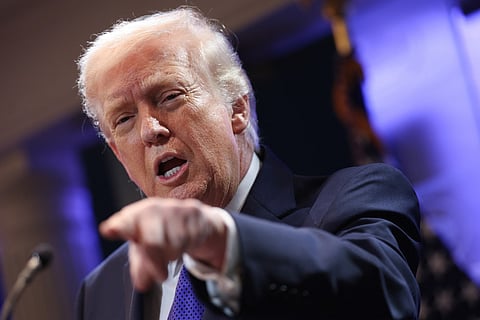
Washington: President Donald Trump vowed Friday to impose a 10 percent tariff on all imports into the United States after the Supreme Court handed him a stinging rebuke by striking down his signature economic policy.
The conservative-majority top court ruled six-three that a 1977 law known as the International Emergency Economic Powers Act (IEEPA) Trump has relied on "does not authorize the president to impose tariffs."
Trump, who had nominated two of the justices who repudiated him, responded furiously, alleging without any evidence that the court was influenced by foreign interests.
"I'm ashamed of certain members of the court, absolutely ashamed, for not having the courage to do what's right for our country," Trump told reporters.
Trump said he would use a separate authority to impose a uniform tariff of 10 percent - after he spent the past year imposing various rates spontaneously to cajole and punish other countries.
"In order to protect our country, a president can actually charge more tariffs than I was charging in the past," Trump said, insisting that the ruling left him "more powerful."
'Much-needed certainty'
Business groups largely cheered the ruling, with the National Retail Federation saying this "provides much-needed certainty" for American firms and manufacturers.
"We urge the lower court to ensure a seamless process to refund the tariffs to US importers," the federation said.
But the justices did not address the degree to which importers can receive refunds. This will likely be litigated.
Kavanaugh warned that this process - as acknowledged during oral arguments - could be a "mess."
EY-Parthenon chief economist Gregory Daco told AFP the loss of IEEPA tariff revenues for the US government could amount to around $140 billion.
Delighted Democratic leaders pounced on the ruling, with Senate Minority Leader Chuck Schumer lauding the outcome as a "win for the wallets" of US consumers.
But top Democrat on the Senate Banking Committee Elizabeth Warren cautioned there remains "no legal mechanism for consumers and many small businesses to recoup the money they have already paid."
The Budget Lab at Yale University estimates consumers face an average effective tariff rate of 9.1 percent with Friday's decision, down from 16.9 percent.
But it said this "remains the highest since 1946," excluding 2025.
Constrained ambition
The European Union said it was studying the court ruling and will remain in close contact with the Trump administration.
Britain plans to work with the United States on how the decision affects a trade deal between both countries, while Canada said the decision affirms that Trump's tariffs were "unjustified."
California Governor Gavin Newsom, who is widely expected to seek the Democratic presidential nomination to succeed Trump, called for refunds to Americans over the "illegal cash grab."
"Every dollar unlawfully taken must be refunded immediately - with interest. Cough up!"


