What is Golden Dome? America’s first $17 billion space missile defence explained
It will include ground-based and space-based components that can track, intercept missiles
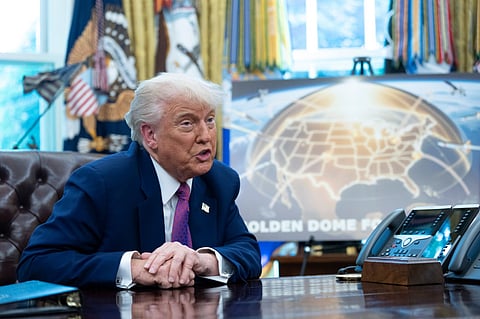
Dubai: In a move that could redefine global defence dynamics, President Donald Trump has officially selected the concept for a new, ambitious US missile defence programme — Golden Dome.
Costing an estimated $175 billion, this first-of-its-kind system would mark the United States’ debut of deploying weapons in space, with Trump stating it could be operational by the end of his term in 2029.
Designed to counter evolving threats from adversaries, Golden Dome is being billed as the most advanced defence shield in US history — capable of intercepting missiles even if launched from space.
Here’s a closer look at what this programme entails:
What is the Golden Dome system?
Golden Dome is a multi-layered missile defence system. Unlike previous systems, it will include both ground-based and space-based components that can detect, track and intercept missiles at all major phases of flight: Pre-launch, boost, midcourse and terminal (descent).
Its name is inspired by Israel’s successful Iron Dome, but while Iron Dome handles short-range rockets, Golden Dome is designed to stop intercontinental ballistic missiles (ICBMs), hypersonic weapons, cruise missiles, and even space-launched threats.
How is it different from Iron Dome?
Iron Dome is focused on short-range projectiles in a small geographical area, like Israel. Golden Dome, on the other hand, is designed to protect the entire continental United States — a landmass more than 400 times larger.
It also targets long-range, high-speed and highly advanced threats from nuclear powers like Russia and China, rather than the low-altitude rockets typically used by militant groups.
How does it work?
Golden Dome will rely heavily on satellite technology. Hundreds of satellites will monitor missile activity across the globe, with a planned constellation of armed satellites capable of launching interceptors or lasers to neutralise enemy threats.
The goal is to shoot down missiles early in their flight — potentially even before they fully launch. The system will also integrate existing US missile defence infrastructure like Patriot batteries and space surveillance networks.
How much will Golden Dome cost?
Trump has proposed an initial $25 billion to launch the project. The Congressional Budget Office estimates that just the space-based components could cost over half a trillion dollars across two decades. Trump has pegged the system’s overall cost at $175 billion, though experts suggest the long-term expenses could be significantly higher.
Who will lead the project?
General Michael Guetlein, Vice-Chief of Space Operations and a senior figure in the US Space Force, has been tapped to lead the effort. He is a four-star general with extensive experience in both space systems and missile defence.
Who will build it?
SpaceX is a top contender to take the lead, in partnership with companies like Palantir and Anduril. More than 180 companies have expressed interest in being involved, according to the Pentagon. SpaceX is expected to provide launch infrastructure but will not weaponise the satellites directly.
When will it be completed?
Trump has said the system will be operational by 2029, though military officials consider that timeline optimistic. Some early capabilities may be demonstrated before then, but full deployment will likely take years beyond his term.
Which countries are covered?
The primary mission is to defend the US homeland. However, Trump has said that Canada has expressed interest in joining, which could expand coverage to include all of North America.
What’s the strategic rationale behind Golden Dome?
Golden Dome is a response to growing concerns over space-based offensive weapons and hypersonic missiles being developed by countries like China and Russia.
In 2023, the US issued a warning that Russia was working on a space-based nuclear weapon. Golden Dome is designed to intercept threats early — possibly even before they leave enemy territory — to provide an added layer of homeland defence.
How have other countries reacted?
Russia and China have condemned the proposal. In a joint statement, they described Golden Dome as “deeply destabilizing” and accused the United States of weaponizing space, turning it into a new domain for military confrontation.
What’s next?
The system remains in the planning phase. The Pentagon and US Northern Command are finalising the initial capabilities document that will outline the system’s technical and operational requirements. Congress must still approve funding, and roles will be assigned to specific defense contractors as the project progresses.
Why is it so important?
Golden Dome represents a fundamental shift in how the United States defends itself — not just from traditional missile threats but from emerging dangers in space. It aims to neutralize attacks before they even launch, combining ground-based systems with armed satel-lites.
In an era where Russia and China are developing hypersonic and space-based weapons, the system could give the US a decisive defensive edge. But it also risks escalating a global arms race in space.
Its success or failure could shape the future of both national security and international stability.


