Trump and Greenland: Why it matters now
How a revived Trump-era focus has exposed fault lines in NATO and the global order
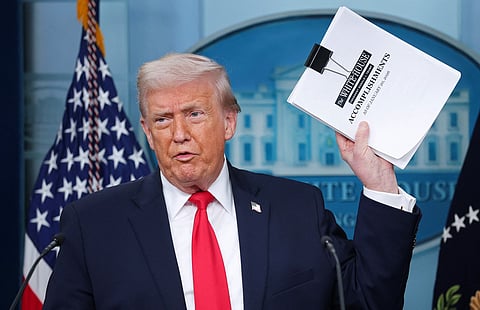
When US President Donald Trump first floated the idea of acquiring Greenland in 2019, the proposal was widely dismissed as an eccentric aside — diplomatically awkward, legally implausible and politically unserious. Yet six years later, Greenland has returned to the centre of transatlantic tension, with Trump again declaring the vast Arctic territory “imperative” to US security and hinting at economic pressure to achieve his aims.
The renewed rhetoric, sharpened during the World Economic Forum in Davos, has triggered an unusually firm response from Europe, tested the cohesion of NATO, and forced a broader reckoning over why Greenland — sparsely populated, ice-covered and geographically remote — has become such a consequential strategic prize. What began as a provocative Trump-era remark now sits at the intersection of Arctic security, critical minerals, alliance politics and international law.
Why is Greenland suddenly back in the spotlight?
Greenland’s re-emergence is driven by a convergence of strategic trends rather than a single political moment. The Arctic is becoming more central to global security planning as new shipping routes, resource access and military considerations reshape how major powers view the region. Against that backdrop, Trump’s renewed insistence that the United States must control Greenland has turned a long-simmering issue into an open diplomatic crisis.
Trump’s comments have also coincided with wider strains in transatlantic relations, including trade disputes and disagreements over burden-sharing within NATO. By linking Greenland explicitly to tariffs and alliance loyalty, Trump has elevated the issue from a speculative idea to a test of political resolve among allies.
What exactly did Donald Trump say about Greenland?
Trump first proposed the idea of the US acquiring Greenland in 2019, describing it as a strategic necessity. At the time, Denmark rejected the suggestion outright, calling it “absurd,” and Greenland’s leaders stated clearly that the territory was not for sale.
Since returning to office, Trump has revived the idea with greater force. He has repeatedly said US control of Greenland is “imperative” for security, suggested that economic pressure could be applied to countries opposing his stance, and implied that existing arrangements are insufficient. While he has stopped short of outlining a specific mechanism, his language has been deliberately open-ended, keeping allies guessing about how far he is prepared to go.
Why does Greenland matter strategically to the United States?
Greenland’s strategic value lies primarily in geography. It sits between North America and Europe, straddling key Arctic and North Atlantic approaches. For decades, the US has viewed Greenland as a critical early-warning and defence node, particularly during the Cold War.
The United States already maintains a military presence at Pituffik Space Base (formerly Thule Air Base), which plays a role in missile warning, space surveillance and Arctic operations. From Washington’s perspective, Greenland is less about territorial expansion and more about ensuring uninterrupted strategic access in a region that is gaining importance.
What is special about Greenland’s location?
Greenland occupies a unique position at the crossroads of emerging Arctic shipping lanes and traditional transatlantic routes. As seasonal ice patterns shift, parts of the Arctic are becoming more navigable for longer periods, increasing the region’s relevance for both commercial and military transit.
Its proximity to North America also makes Greenland a natural buffer zone in strategic planning. Control or influence over Greenland affects how easily military assets can move between continents and how early potential threats can be detected.
Does Greenland really have valuable minerals?
Yes — but with important caveats. Greenland is known to possess deposits of rare earth elements, uranium and other critical minerals used in clean energy technologies, electronics and defence systems. These resources have drawn interest from governments and companies seeking to diversify supply chains away from dominant producers.
However, extraction remains limited. Harsh conditions, environmental concerns, infrastructure challenges and political resistance within Greenland itself have slowed large-scale development. The presence of minerals alone does not automatically translate into strategic control or economic windfall.
How does climate change factor into Greenland’s importance?
Climate change is reshaping access rather than transforming Greenland overnight. Reduced ice cover has made exploration, shipping and infrastructure planning more feasible in certain areas, increasing long-term strategic calculations.
That said, Greenland’s leaders and European partners are careful to frame climate change in pragmatic terms, focusing on adaptation and managed development rather than catastrophe narratives. The geopolitical significance lies in gradual accessibility, not sudden transformation.
Who controls Greenland today?
Greenland is an autonomous territory within the Kingdom of Denmark. It has its own parliament and government and controls most domestic affairs, including natural resources. Denmark retains authority over foreign policy, defence and monetary matters.
This arrangement gives Greenland significant self-governance while anchoring it firmly within the Danish state — a structure recognised under international law and supported by NATO allies.
What does Greenland itself want?
Greenland’s leaders have been clear that they seek respect, partnership and the ability to shape their own future. While there is an ongoing debate about eventual independence, there is no appetite for being transferred from one sovereign authority to another.
Greenland has expressed willingness to deepen cooperation with the United States on security and economic development, but only on the basis of consent and mutual respect. Its leaders have explicitly rejected any suggestion that Greenland is a passive object of great power competition.
What is Denmark’s position?
Denmark has categorically rejected the idea of selling or transferring Greenland. Copenhagen has emphasised that Greenland is not a commodity and that any changes to its status would require the consent of the Greenlandic people.
At the same time, Denmark has signalled openness to enhanced security cooperation in the Arctic, including increased defence investment and coordination with allies — undercutting arguments that existing arrangements are inadequate.
What is NATO saying — and why does this matter?
NATO has found itself in an unusually delicate position. Greenland is part of NATO territory through Denmark, meaning any coercive move against it would raise fundamental alliance questions.
Former and current NATO officials have warned that attempts to pressure or undermine a member state over Greenland risk destabilising the alliance itself. While NATO acknowledges the Arctic’s growing importance, it operates on the principle of collective defence and sovereignty, not territorial bargaining.
Where do Russia and China fit into this?
Russia has expanded its Arctic military infrastructure, and China has expressed interest in Arctic shipping and research, but their roles in Greenland are often overstated. China has pursued limited commercial projects in the past, many of which stalled or were blocked.
Western analysts generally agree that while Russia and China factor into long-term planning, Greenland is not currently a theatre of imminent great-power confrontation. Existing US and NATO presence already provides a substantial security framework.
Can the United States legally buy or take over Greenland?
No. Under modern international law, territory cannot be transferred without the consent of the people who live there. Greenland’s autonomous status, Denmark’s sovereignty and NATO membership make any unilateral takeover legally impossible.
Historical precedents for territorial purchases predate contemporary international norms and do not apply in this case. Any change in Greenland’s status would require democratic approval and international recognition.
Has anything like this happened before?
Greenland has long been strategically significant. During the Second World War, the US established a presence to prevent Nazi Germany from gaining a foothold. During the Cold War, Greenland was central to early-warning systems against Soviet missiles.
What is new is not interest in Greenland itself, but the public framing of that interest as a territorial question rather than a security partnership.
Why does this debate keep resurfacing?
Greenland sits at the intersection of three enduring forces: geography, resources and great-power competition. As the Arctic becomes more accessible and strategically relevant, questions about control, influence and responsibility naturally resurface.
Trump’s approach differs from that of previous US administrations in style rather than substance — turning strategic concern into blunt political rhetoric. That shift has forced allies to confront issues they might otherwise have managed quietly.
What happens next?
Greenland will remain central to Arctic strategy. Expect deeper security cooperation, greater European investment in Arctic defence and continued diplomatic sensitivity around sovereignty.
Trump’s statements have not altered Greenland’s legal status, but they have ensured that the Arctic — and Greenland in particular — will no longer be treated as a geopolitical afterthought.
- with inputs from AP and AFP


