Why Trump is after Greenland — and what it means for the world
After the Venezuela raid, Trump’s push on Greenland alarms Europe and raises Nato fears
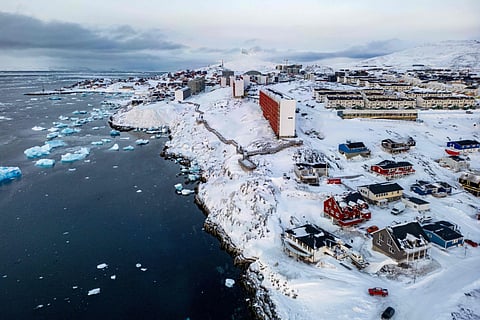
Dubai: Greenland, the world’s largest island, has suddenly become a geopolitical flashpoint after US President Donald Trump revived his push to bring the vast Arctic territory under American control.
His remarks, coming soon after a dramatic US military operation in Venezuela, have alarmed European allies and raised an uncomfortable question: is Washington prepared to defy the global order to secure Greenland?
European leaders have publicly reaffirmed Greenland’s sovereignty and Denmark’s authority over the self-governing territory, signalling that Trump’s rhetoric is no longer being dismissed as mere provocation.
As CNN noted in an analysis, the tone in European capitals has shifted from disbelief to genuine concern.
At a glance
Who controls Greenland? An autonomous territory of Denmark
Why it matters: Missile defence, Arctic shipping routes, rare earth minerals
US presence: Pituffik Space Base (formerly Thule Air Base)
Europe’s fear: A US takeover would shatter Nato unity
Key question: Does Washington need control — or just cooperation?
Why does Trump want Greenland?
Trump argues that Greenland is essential to US national security. Strategically located between North America and Europe, the island sits astride key Atlantic and Arctic routes and plays a role in early-warning missile defence.
CNBC has reported that the White House sees Greenland as increasingly critical as Arctic ice melts, opening new shipping lanes and intensifying competition with Russia and China. Greenland also lies near the shortest flight path for Russian ballistic missiles heading toward the continental United States.
Beyond security, Greenland holds vast untapped reserves of oil, gas and rare earth minerals — resources vital for electric vehicles, renewable energy technologies and advanced weapons systems.
What military role does Greenland already play for the US?
The United States already operates the Pituffik Space Base in northwestern Greenland, a legacy Cold War installation now central to missile warning and space surveillance.
According to CNBC, around 150 US service members are stationed there today, down from thousands during the Cold War, but analysts say the base’s strategic value is rising again as Arctic tensions grow.
Greenland also anchors the GIUK gap — the naval choke point between Greenland, Iceland and the United Kingdom — long used to monitor Russian submarine movements from the Arctic into the Atlantic.
If Greenland is so vital, why doesn’t the US just reinforce it?
This is where Trump’s argument begins to fray. Greenland is an autonomous territory of a Nato ally, and existing agreements already give Washington broad rights to expand its military presence if required.
CNN analysis pointed out that there is nothing preventing the US from building additional bases, deploying more troops or installing new missile defence systems with Danish consent. Ownership is not a prerequisite for security.
Both Danish and Greenlandic officials have also indicated openness to partnership agreements, including on defence and mining, undercutting the case for outright control.
How has Europe responded?
With alarm. Leaders from France, Germany, Italy, Poland, Spain and the United Kingdom have publicly backed Denmark, declaring that “Greenland belongs to its people.”
Danish Prime Minister Mette Frederiksen has warned that any attempt to seize Greenland by force would effectively destroy NATO, since it would involve one alliance member acting against another.
CNN reported that European officials now see Trump’s remarks not as trolling, but as part of a broader shift toward raw power politics.
Could Trump actually take Greenland by force?
In military terms, the United States could overwhelm Danish forces in Greenland. Politically, however, the costs would be staggering.
Any such move would likely require congressional approval, provoke legal challenges, and trigger a rupture with Europe. Retired NATO commanders have warned that it could spell the end of the alliance’s collective defence guarantee.
The prospect of American troops confronting Nato allies is almost unthinkable — yet no longer unimaginable, according to CNN.
What do Greenlanders themselves want?
Opinion polls consistently show Greenlanders oppose US control. While many support eventual independence from Denmark, there is little appetite for becoming American territory.
Greenland’s leaders have drawn a clear distinction between cooperation and conquest — welcoming investment and security partnerships, but rejecting annexation.
Is Trump serious, or is this brinkmanship?
During Trump’s first term, talk of buying Greenland was widely dismissed as a stunt. This time, the context is different.
CNBC noted that the administration has openly discussed “a range of options,” including military force, to secure US interests on the island. Coupled with Trump’s recent assertion that the US is “running” Venezuela, allies fear rhetoric is hardening into doctrine.
Still, there is no public evidence of imminent military planning.
Can Trump defy the world and get away with it?
Trump holds significant leverage. Europe remains heavily dependent on US military power, and few believe European forces could resist American pressure over Greenland.
But power carries consequences. Any attempt to seize Greenland would deepen global mistrust, accelerate European efforts to reduce reliance on Washington, and further erode the rules-based order the US helped create.
Bottom line
Greenland’s strategic importance is real — and growing. But Trump’s push for control rather than cooperation has transformed a security discussion into a geopolitical crisis.
For now, Greenland remains Danish and autonomous. Whether it stays that way may depend less on treaties or international law — and more on how far Trump is willing to test the limits of American power.


