Minerals and a strategic location: Why Greenland is coveted
Senior Danish and Greenlandic diplomats visiting the White House for high-stakes talks
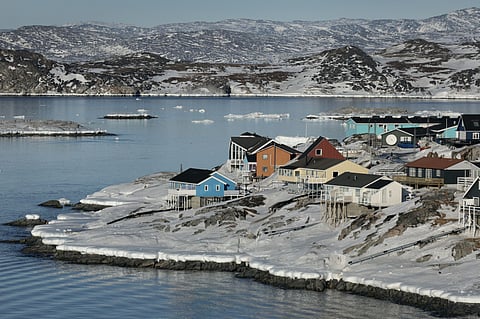
Copenhagen: Greenland, which US President Donald Trump has vowed to seize for national security reasons, is an ice-covered self-governing Danish territory in the Arctic.
On Wednesday, senior Danish and Greenlandic diplomats are visiting the White House for high-stakes talks with US Vice President JD Vance and Secretary of State Marco Rubio on the future of the island.
Potential mining sector
Since 2009, Greenlanders have been in charge of deciding how their natural resources are used.
Access to Greenland’s resources is considered crucial by the United States, which signed a cooperation memorandum for the sector in 2019. The EU followed four years later with its own agreement.
Greenland’s soil is well-explored, which has enabled a detailed map of resources to be drawn up.
The EU has identified 25 of the 34 minerals on its official list of critical raw materials in Greenland, including rare earths.
“As the demand for minerals is rising, there is a need to go and look for untapped resources,” said Ditte Brasso Sorensen, an analyst at Think Tank Europa.
“Actors are more and more aware they need to diversify their sources, especially when it comes to the dependence to China on rare earth elements.”
Adding to this is the fear that China will get its hands on the mineral resources, she explained.
However, mining in Greenland is largely non-existent at the moment.
There are only two mines on the island - one for rubies, which is looking for new investors, and the other for anorthosite, a rock containing titanium.
In southern Greenland, the rare earth metals Tanbreez project, led by Critical Metals Corp plans to open a mine near Quaqortoq this year, with operations expected to begin next year.
Closer to New York
Greenland, which has a population of about 57,000 people, is an autonomous territory but Copenhagen controls its law enforcement, monetary policy, foreign affairs, defence and security policy.
However, with its capital closer to New York than Copenhagen, Greenland is in the United States’ “zone of interest”, historian Astrid Andersen, of the Danish Institute of International Studies, told AFP.
During World War II, when Denmark was occupied by Germany “the US took over Greenland. In a sense they have never left,” she explained.
The United States has one active military base there. The Pituffik space base was used during the Cold War as a warning post for possible Soviet attacks and is still an essential part of the US missile defence infrastructure.
Strategic location
An Arctic island close to the United States, Canada and Russia, Greenland’s location makes it strategically important.
It sits on the shortest route for missiles between Russia and the United States.
Trump’s administration has accused Denmark of falling short when it comes to investing in Greenland’s security and not protecting it from Russia and China.
Denmark, a founding member of NATO, rejects the claims and stresses that it has allocated nearly 90 billion kroner ($14 billion) to beef up its military presence in the Arctic.
Hours before the White House meeting Wednesday, Danish Defence Minister Troels Lund Poulsen sought to ease US concerns and said Denmark was boosting its military presence in Greenland and that it was in talks with allies on “an increased NATO presence in the Arctic.”
As new shipping lanes open up in the Arctic due to melting ice, Greenland will also gain economic importance.


