NASA finds 84 mysterious objects unlike anything seen before
Scientists uncover previously unknown class of cosmic sources hiding across six galaxies
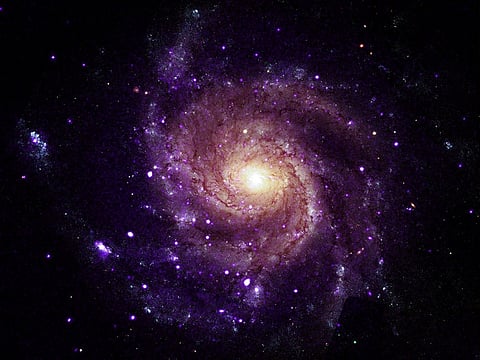
Astronomers reviewing old observations from NASA's Chandra X-ray Observatory discovered something they weren't expecting.
Not one mysterious object, but 84.
Spread across six galaxies, the objects behave differently from any previously known class of cosmic source, NASA says.
Get updated faster and for FREE: Download the Gulf News app now - simply click here.
Scientists have named them “hypersoft X-ray sources” because they emit unusually low-energy X-rays while apparently producing enormous amounts of energetic ultraviolet radiation.
“We've never encountered a group of objects that act like this,” study leader Mustafa Muhibullah of the University of Alabama said.
The discovery was published on September 9 in the peer-reviewed journal Nature Astronomy.
Hiding in a cosmic blind spot
The objects weren't discovered because a new telescope suddenly spotted them.
Instead, researchers found them by digging through the enormous archive of observations Chandra collected over the years.
They searched six galaxies, including the famous Andromeda Galaxy and the Pinwheel Galaxy, and identified objects visible at Chandra's lowest X-ray energies that essentially disappeared at higher energies.
That unusual signature revealed a population astronomers had largely been missing.
The reason is partly technological.
Their X-rays are extremely difficult for telescopes to detect, while much of their radiation appears in the extreme-ultraviolet part of the spectrum. Hydrogen and helium gas between stars readily absorbs that radiation, making it extremely difficult to observe.
“By combing through the Chandra archive, we were able to eliminate what used to be a blind spot for telescopes,” study co-author Rosanne Di Stefano of the Centre for Astrophysics | Harvard & Smithsonian said.
So what are they?
Scientists don't know for certain yet — which is what makes the discovery particularly intriguing.
The leading explanation is that the sources involve some of the Universe's most extreme objects: black holes, neutron stars or white dwarfs.
In such systems, one of these compact objects may be pulling material away from a companion star.
As that material falls towards the black hole, neutron star or white dwarf, it heats up and produces radiation.
But astronomers have studied many such binary systems before. These 84 objects behave differently enough for researchers to consider them a previously unidentified class.
Some could involve white dwarfs that may eventually explode as Type Ia supernovae, according to the study.
Two cosmic mysteries
Finding out what the objects actually are isn't the only reason astronomers are interested.
Researchers say hypersoft X-ray sources could help answer two long-standing questions in astrophysics.
One concerns what happens before certain white dwarfs explode as Type Ia supernovae. Scientists use these explosions extensively to measure cosmic distances, but important questions remain about exactly which systems lead to them.
The second involves the gas between stars.
Something strips electrons from gas in galaxies, a process known as ionisation. Hot, massive stars account for some of it, but apparently not all.
The intense ultraviolet radiation produced by the newly discovered sources could provide part of the missing explanation.
For now, though, the mystery remains.
Astronomers know there are at least 84 of the unusual sources in the six galaxies they examined.
The next question is how many more have been hiding in astronomical archives all along.


