Sustaining growth
As football fever grips the world, the World Cup hosts get set to meet some financial goals
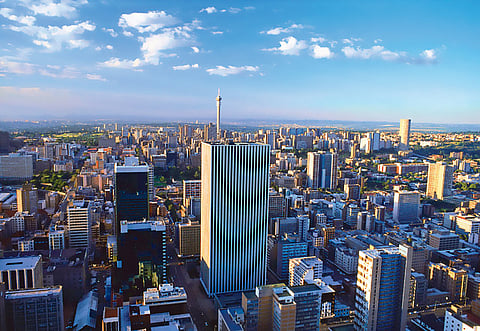
In the ball game that is economics, South Africa has been scoring well enough through the global crisis. Partly owing to good fortune, partly to the management, the country has fared better than many more developed countries. The economy contracted by only 1.8 per cent in 2009, while trading partners such as the United Kingdom, Germany and Japan suffered falls closer to 5 per cent.
Two key characteristics go some way to explaining the cushioned impact. Similar to Germany's, the South African economy is heavily dependent on exports. But whereas Germany offers mainly manufactured goods, the market for which fell sharply during the downturn, South Africa's exports, consisting largely of mineral resources, found a thriving market still, especially in China.
In 2009 China's imports from South Africa increased by 36 per cent from the previous year, and they have risen a staggering four to five times in five years, making China South Africa's leading market for the first time, ahead of its more established product destinations of the United States, Japan, Germany and the UK.
The other determining factor in relative outperformance has been the banking system, which in South Africa's case has "felt little of the direct impact of the global financial crisis, due to a prudent regulatory environment," according to rating agency Moody's. Not so exposed to toxic instruments as in the West, it hasn't needed bailing out. A record of comparative prudence and low accumulated debt levels has in fact meant that the budget deficit has stayed within acceptable bounds. Although over the past 18 months it has turned from a surplus of 1 per cent of GDP in 2007-08 to a projected deficit of 6.2 per cent for the current year, new finance minister Pravin Gordhan has held the fort in maintaining the policies set by his well-regarded predecessor Trevor Manuel.
Thus, the Medium Term Budget Policy Statement projects that debt/GDP will rise from 24 per cent in 2009 to 41 per cent in 2013 — plenty safe enough by international standards.
Since coming to power in 1994 through the first all-race elections, the African National Congress's (ANC) economic policies have adopted the hybrid aim of promoting a favourable business climate while at the same time seeking to favour a growth and employment strategy. Progress, it has to be said, has been steady rather than spectacular.
South Africa was motoring along, growing at about 5 per cent per annum, between 2004 and 2007, though weaker global demand and severe electricity shortages triggered a moderationin growth to 3.1 per cent in 2008.
The current recovery has exceeded market expectations. GDP growth of 3.2 per cent in the fourth quarter of 2009 (from 0.9 per cent in the third quarter) signalled that the economy was out of recession. This strong bounce back was driven largely by a rebound in global demand, while the construction industry remainednotably resilient throughout, driven by the government's heavy infrastructure projects related to the 2010 football World Cup.
Development constraints
The government's own forecast is for GDP growth of 2.3 per cent for the current year. There are estimates that the summer's sporting extravaganza World Cup could add 0.7 percentage points to that.
But the longer-term future will be decided by the structures underlying those data. The need to build additional energy generation is an example of ongoing constraints to development. Indeed, it is often noted that, economically, � South Africa is a land of contrasts. On theone hand it has an advanced financial sector; likewise telecoms. On the other, it still has poverty and health issues, and unemploymentat around 25 per cent.
Not so much a game of two halves as a country, like many rapidly developing nations,of ‘haves' and ‘have nots', a situation about which the government is acutely aware and concerned.
Literally lying beneath those perennial conditions is an abundance of natural resources, with the world's largest reserves of platinum, gold, chromium and diamonds.
Bridging the gap between social and economic expectations and reality remainsan enduring challenge.
Increasing productivity
The government's idea of growth picking up to 3.6 per cent by 2012 falls well short of the necessary pace (often said to be 6 per cent) to make serious inroads on joblessness. President Jacob Zuma has in fact pledged four million jobs to be created by the end of 2014.
In his State of the Nation address in February he highlighted the government's new industrial policy action plan for building stronger and more labour-absorbing industries, as well as a rural development programme to lift productivityand living standards.
A youth wage subsidy is being considered, against the backdrop of an unemploymentrate among South Africa's 18 to 24-year-oldsof more than 45 per cent.
Zuma said South Africa's capital investment programme would see 846 billion rand ($116.07 billion or about Dh426.38 billion) spent on public infrastructure over the next three years, adding that further reduction of communication costs would also boost growth prospects.
Meanwhile, ways are being sought to promote the country as an attractive gateway for businesses looking to extend operations into Africa.
Amid tightening economic conditions, overseas investment activity in South Africa has remained strong, driven in part by higher public spending on infrastructure and preparations for the World Cup. The institutionalised macro-economic policy framework has much to do with that, with, for instance, an inflation bandof 3-6 per cent still targeted.
The government continues to argue the orthodox case that a lower and stable rate of inflation reduces the long-term cost of borrowing and provides confidence about the future, as well as help guard the living standards of the poor. This in turn stimulates investment, employment and competitiveness, particularly among exporters and those industries relying on imports.
Consumer price inflation (CPI) easedto 5.7 per cent in February, having declined from a peak of 13.6 per cent in August 2008. According to Nedbank, it might fall towards5 per cent, given that recovery has been"driven more by demand from abroad than domestic conditions". Interest rates were dropped late last month to 6.5 per cent.
But economics is nothing if not unpredictable, as the volatility of the rand, which concerns the authorities enough to contemplate exchange control reform, regularly testifies.
Old Mutual economist Rian Le Roux says that experience tells us that there are always unexpected shocks from some source, and "this year will probably be no different." Presumably he wasn't referring to the winner of the World Cup, which, in a broader sense at least, hasa good chance of being South Africa.


![The incident occurred in the early hours of Tuesday in Kampani Zurak community, located in the Wase area of Plateau state. [Illustrative image]](http://media.assettype.com/gulfnews%2Fimport%2F2022%2F12%2F13%2FSTOCK-ambulance_1850a298a2c_large.jpg?w=320&auto=format%2Ccompress&fit=max)
