Workers in Dubai are now more aware of their rights, top official says
Maj Gen Obaid bin Suroor, who chairs labour affairs committee, says efforts have paid off
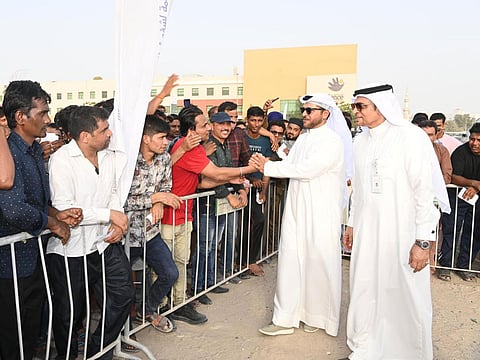
Dubai: Workers’ awareness of labour laws has risen significantly, contributing to protecting their rights, a top official in Dubai has said.
In an interview with Gulf News, Major General Obaid Muhair bin Suroor, who chairs the Permanent Committee for Labour Affairs in Dubai, said the results of surveys conducted among workers participating in the Committee’s programmes also showed a significant increase in their knowledge of UAE’s social norms.
Maj Gen Bin Suroor is also the Deputy Director-General of the General Directorate of Residency and Foreigners Affairs in Dubai (GDRFA Dubai).
The Committee’s members include representatives from key government entities in Dubai, such as Dubai Police, General Department of State Security, Labour Cases Section of Dubai Courts, Labour Inspection Department at the Ministry of Human Resources and Emiratisation, Human Rights Department at the Community Development Authority, Dubai Municipality, and Jebel Ali Free Zone Authority.
What is the impact of the committee’s awareness sessions?
The results of surveys conducted among delivery workers, for example, participating in the programme showed a significant increase in their knowledge of UAE societal norms and acceptable behaviours, rising from 21.19% before attending training sessions to 80.98% after the sessions.
The improvement was measured based on the number of correct answers provided by workers before and after attending the training sessions. For example, correct answers related to residency and labour laws increased from 20.74% to 80.68%. Similarly, awareness of available government support channels rose from 18.43% to 79.20%, while the percentage of correct answers regarding road safety standards increased from 19.41% to 80.71%.
Additionally, opinion polls conducted among construction workers, supervisors, and managers at work sites and labour or accommodations revealed that participants’ understanding of UAE culture and acceptable behaviours rose from 11.36% before attending the training to 90.64% afterward.
The accuracy of answers related to residency and labour laws increased from 18.71% to 83.29%. Awareness of government support channels grew from 16.42% to 85.58%. Similarly, awareness of health and road safety issues saw significant improvement.
How many inspection campaigns are conducted monthly or annually, and who are the partnering entities in these efforts?
The committee conducts regular inspection campaigns across private sector establishments, though exact monthly or annual figures were not disclosed.
Partner entities:
• Ministry of Human Resources and Emiratisation: Supports inspections and monitors corporate compliance.
• Dubai Municipality: Ensures workplace and housing safety standards.
• Dubai Police: Provides security during inspections.
• Community Development Authority: Advocates for human rights and raises labour awareness.
What were the committee’s major achievements in 2024?
Our awareness programmes reached over 88,500 workers through educational initiatives, with awareness videos garnering more than 10 million views.
We also saw success in:
• International participation: Represented Dubai at the Global Forum on Migration and Development in Geneva in 2024, showcasing the emirate’s commitment to labour issues on an international platform.
• Sports events: Organised the 6th Labour Sports Tournament in collaboration with Dubai Sports Council, involving 46,000 workers from 270 companies to promote health and camaraderie.
• Outreach: Delivered programmes via on-site workshops, digital content, and multilingual materials to ensure inclusivity.
• Impact: Made tangible progress in enhancing workplace conditions, raising awareness about rights and responsibilities, and achieving the committee’s founding goals.
Additionally, the committee developed tailored training content for construction workers, translated into four languages—English, Arabic, Urdu, and Hindi. This initiative addresses workplace culture, social norms, labour laws, and safety practices. A separate program was designed for managers and supervisors, focusing on oversight and housing standards.
When did the idea of establishing the Committee emerge? What are its main roles?
The Committee was initially established under Executive Council Resolution No. 2 of 2005 to protect the rights of expatriate workers, prevent exploitation, and improve their conditions. The committee was restructured by Executive Council Resolution No. 22 of 2006 and further formalised by Executive Council Resolution No. 3 of 2011.
According to the resolution, the committee’s core responsibilities include:
1. Designing, implementing, and evaluating inspection programmes for private sector establishments to ensure compliance with health and environmental standards, labour laws, employment contracts, and workplace safety.
2. Coordinating with local government entities to review labour legislation to foster fair working conditions and stable labour relations.
3. Addressing workers’ complaints and taking necessary actions.
4. Overseeing measures taken by government authorities against non-compliant establishments.
5. Promoting awareness programs to educate workers and employers on labour legislation, rights, and obligations.
6. Establishing mechanisms to execute its mandates.
7. Forming subcommittees and task forces to support its work.


