Dubai rains: Municipality pumps out 12 million cubic metres of rainwater, clears 159 fallen trees
How 3,500-strong team responded to 15,150 calls during 'Azm' low-pressure weather system
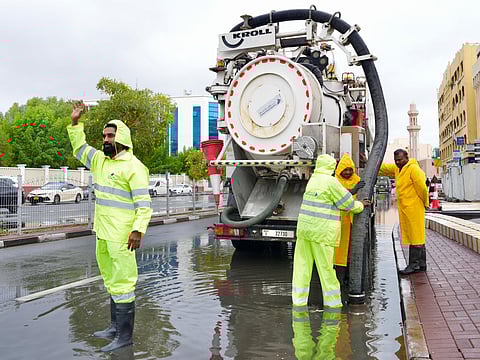
Dubai: When the "Azm" low-pressure weather system hit Dubai recently, Dubai Municipality fielded 15,150 calls and handled 8,466 interactions through its "Fares" virtual assistant on WhatsApp, while resolving 4,325 reports spanning 249 areas: from water accumulations and fallen trees to drainage blockages and road cleaning.
In all, 12.195 million cubic metres of rainwater were pumped out into water bodies, 159 fallen trees were removed, and beaches and parks were reopened within six and 24 hours respectively, the civic body revealed on Tuesday.
Recovery operations included the clearance of 1,130 cubic metres of water, and disposal of 12,250 kilograms of waste, ensuring the safe restoration of public spaces.
The municipality said the response reflects Dubai's advanced capabilities in crisis and emergency management, reinforcing its position among the world's most prepared and resilient cities in addressing climate-related challenges.
The teamwork
Dubai Municipality activated a unified operational system supported by approximately 3,500 personnel, including supervisors, engineers, field workers, and specialised rescue teams.
Operations were reinforced by a comprehensive logistics fleet of more than 1,210 machines and vehicles, including tankers, fixed and mobile pumps, heavy vehicles, field support units, and cranes, ensuring rapid and coordinated response across affected areas.
World-class infrastructure
Dubai's stormwater drainage infrastructure demonstrated strong performance, managing a total of 12.195 million cubic metres of rainwater. Of this, 7.362 million cubic metres were handled by pumping stations, 4.833 million cubic metres through deep drainage tunnels, and 631,000 cubic metres transported via mobile tankers across 22,250 trips.
The network comprises more than 124,000 drainage inlets connected to over 47,000 inspection chambers and an extensive pipeline system spanning 4.9 million linear metres, collectively enabling the drainage of more than 94% of rainwater.
These capabilities reflect Dubai Municipality's continued investment in advanced, resilient infrastructure designed to ensure safety, operational continuity, and long-term sustainability, the civic body pointed out.
Proactive approach
Dubai Municipality implemented a phased operational plan to manage the weather event. The first phase focused on pre-emptive readiness, including the mobilisation of field teams, deployment of equipment, and verification of infrastructure performance such as drainage networks, retention lakes, and pumping systems.
The second phase involved the activation of emergency response protocols, ensuring immediate handling of water accumulations and maintaining uninterrupted municipal services through coordination with strategic partners via a joint operations framework. This was followed by a structured recovery phase to complete drainage operations and restore normal conditions across the Emirate.
Eng. Adel Mohammed Al Marzouqi, CEO of the Waste and Sewerage Agency at Dubai Municipality and Head of the Stormwater Drainage Team, said: "Dubai's response to the recent weather conditions demonstrates the strength of an integrated operational model built on preparedness, coordination, and advanced infrastructure. Our priority remains the safety, wellbeing, and quality of life of the community, supported by proactive planning and rapid response capabilities that enable us to manage challenges efficiently under all conditions."
He added: "We remain committed to continuously advancing stormwater and wastewater infrastructure to ensure it meets the highest standards of resilience, sustainability, and future readiness."
Parks and beaches
Dubai Municipality said it maintained high levels of operational readiness across public parks, beaches, and recreational facilities, prioritising safety through proactive inspections, temporary closures where required, and the deployment of approximately 1,000 personnel across key locations.
Advanced technologies supported operations, including beach response vehicles, electric mobility units, drones, a marine rescue robot, remote sensing systems, and automated monitoring solutions, enhancing response speed and situational awareness.
Following the weather event, Dubai Municipality implemented rapid recovery measures, enabling the reopening of beaches within six hours and public parks within 24 hours.
Dubai Municipality also ensured uninterrupted operation of wastewater and stormwater stations, managing drainage flows, clearing blockages, and removing debris to maintain road safety and traffic flow across the Emirate.
These efforts underscore Dubai Municipality’s commitment to delivering safe, resilient, and world-class urban environments, even under challenging conditions, it added.


