UAE’s MBZ SAT set to launch into space from California tonight
MBRSC to livestream launch of region’s most advanced satellite along with HCT-SAT 1
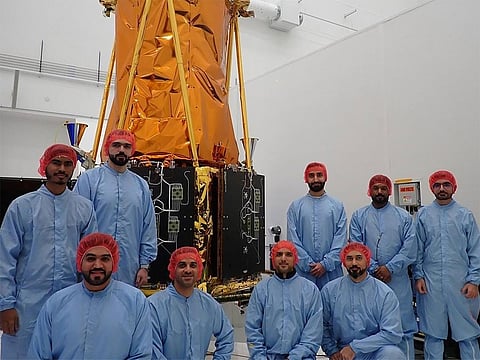
Dubai: UAE-made MBZ-SAT, the most advanced Earth observation satellite in the region, will launch to space aboard a Falcon 9 rocket of Elon Musk’s SpaceX company tonight.
The Mohammed Bin Rashid Space Centre (MBRSC), the agency that built the satellite, issued a confirmation this morning.
Last week, MBRSC had announced that MBZ-SAT will be accompanied by HCT-SAT 1, an Earth observation CubeSat developed with participation of students of Higher Colleges of Technology (HCT), during SpaceX’s Transporter-12 Rideshare mission this month.
“MBZ-SAT is scheduled to launch later tonight with a 27-minute window opening at 10.49 PM (UAE time) from Space Launch Complex 4E (SLC-4E) at the Vandenberg Space Force Base in California, USA aboard SpaceX’s Falcon 9 rocket,” MBRSC said in a media statement on Tuesday morning.
The centre will livestream the mission beginning at 9.30 pm (UAE time) on the MBRSC website at live.mbrsc.ae.
“Take part in this historic moment using the hashtag #MBZSAT,” the centre said in an SMS sent out to UAE residents.
“The date and time are subject to change depending on weather and other operational conditions. If required, there is a backup opportunity on Wednesday, 15 January at the same time,” MBRSC said.
The Centre had earlier announced that the MBZ-SAT team had completed final tests at the SpaceX facilities, USA, with the satellite integrated on to the Falcon 9 rocket.
The satellite, named in honour of the President His Highness Sheikh Mohamed bin Zayed Al Nahyan was announced by His Highness Sheikh Mohammed bin Rashid Al Maktoum, Vice President and Prime Minister of the UAE and Ruler of Dubai in 2020 and was officially approved for launch by Sheikh Hamdan bin Mohammed bin Rashid Al Maktoum, Crown Prince of Dubai, Deputy Prime Minister, Minister of Defence, and President of MBRSC, earlier last year.
Better capabilities
MBZ-SAT, fully developed by Emirati engineers at MBRSC, represents a milestone in the UAE’s space exploration journey, showcasing cutting-edge Earth observation capabilities.
With a total mass of 750 kg, and dimensions of 3m x 5m, that satellite has twice the imaging accuracy of its predecessors, ten times more imagery, and rapid data delivery within two hours. Equipped with advanced electric propulsion, precise navigation, and a high-resolution camera, it can deliver precision in imaging locations, which supports applications like environmental monitoring, infrastructure management, and disaster relief.
The satellite’s development, in collaboration with UAE-based companies has also driven economic growth and knowledge transfer, strengthening the nation’s aerospace ecosystem and global competitiveness in space technology.
Beyond the launch
Once operational in low Earth orbit, MBZ-SAT will be managed from the Mission Control Centre at MBRSC, with teams monitoring its operations and analysing data transmitted back to Earth.
Beyond the launch, HCT will take full control of the operation of the HCT-SAT 1 developed by 34 students and nine faculty members under the mentorship of experts from MBRSC, marking a historic milestone in space education in the UAE.
The nanosatellite measuring only10x10x11.35 cm and weighing just around 1kg carries a payload camera with 5 mega pixels’ resolution.
What is Transporter-12?
Originally slated for launch in October, 2024, the launch of MBZ-SAT on SpaceX’s Transporter-12 Rideshare mission was pushed back due to technical reasons that grounded the rocket.
Transporter-12 is a dedicated smallsat rideshare mission with 131 payloads, including CubeSats, MicroSats, and orbital transfer vehicles carrying 30 of those payloads, 14 of which will be deployed at a later time, according to SpaceX.
Following stage separation, Falcon 9 will land on Landing Zone 4 (LZ-4) at Vandenberg Space Force Base, the company said on its website.


