How do children fare in emergencies?
Are children and parents living in the UAE prepared to handle emergencies?
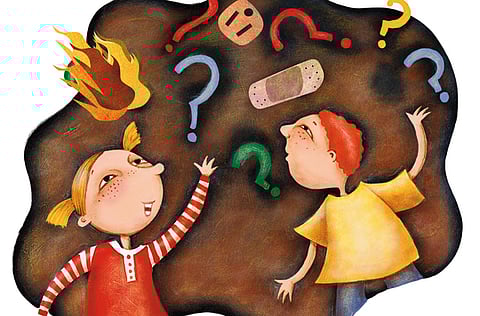
A recent international study showed that children are not well prepared when it comes to emergency situations, be it a fire, an earthquake, a gas leak or getting lost. As tougher economic times mean more families, in which both parents are working, it becomes a bigger concern. The probability of youngsters finding themselves in a crisis situation increases. Gulf News community journalists spoke to children and their parents from a cross-section of society in the UAE to find out how they cope on their own. Are children prepared to handle emergencies? Read on to find out.
Meet the families
Son: Samer Al Jaafar, a six-year-old
Emirate: Sharjah
Son: Jack Evans, a nine-year-old
Emirate: Dubai
FILIPINO FAMILY
Son: Diego Vargas, a nine-year-old
Emirate:
Daughter: Kehkashan Basu, 10-year-old
Emirate: Dubai
Son: Easa Saif, an eight-year-old
Emirate: Dubai
- Dr Lalit Taori, a doctor, who works in the accident and emergency department of Welcare Ambulatory Care Centre, Dubai
- Arvind T. Dhumale, a fire supervisor in Abu Dhabi
- Dr.Gabriel Ionescu, senior consultant and head of Paediatric Surgery division at Tawam Hospital in Al Ain
Scenario 1: Cuts and bruises
IRAQI FAMILY
Scenario 2: Electric shock
IRAQI FAMILY
Scenario 3: Allergic reactions/insect bites
IRAQI FAMILY
Scenario 4: House on fire
- First, do not panic.
- If it’s a minor fire, raise the alarm. If it’s a full-blown one and can’t be tackled, close the door of the room/source and get out quickly.
- Worst-case scenario: Smoke rises so wet a towel and put it over your mouth, lower yourself to the ground and crawl to get to the exit.
- Children must be trained beforehand about escape routes, how to use the fire alarm and which emergency number to call.
Scenario 5: Gas leak
- Kids must be taught to identify the smell of leaking gas.
- Do not switch on any electric equipment, do not light a match.
- Exit the house at the earliest and ask for assistance.
- Opening windows should be left to adults — ventilation is only advisable when the source of the leak or fire is isolated, otherwise, when exposed to oxygen, even the smallest fire can spread within seconds.
Scenario 6: Witnessing someone choking
Scenario 7: Lost in a public place
IRAQI FAMILY
- Take a deep breath and try not to cry.
- Contact any information centre or a security personnel.
Scenario 8: Left in a car for more than 5 minutes
- The child should open the car window if it is manual.
- He or she should try to honk the horn or hit the door or window to get public attention.
- Loosen clothes and drink water or juice if kept inside the car.
Scenario 9: Earthquake
- Crouch with your head between your knees and covered with your hands.
- Choose a safe place like under the table or a couch.
- Try to stay near a wall or a pillar.
When disaster strikes, are your children prepared?
According to Dr Gabriel Ionescu, head of Paediatric Surgery at Tawam Hospital in Al Ain, children’s responses in emergency situations can be “unpredictable, especially during situations involving trauma”. He compared them to another species that is quick to react, but often reckless in its response — chickens.
“Usually, children flee the scene or run straight into trouble, not realising the consequences of their choices. It’s up to their parents to prepare their children and teach them what to do beforehand.”
A recent US Census report found that 19 per cent of the nation’s children, between the ages 5 and 14, were left at home alone regularly. So are they able to cope when they’re on their own?
It is not a far-fetched idea, according to Dr Ionescu. With the spread of literacy and greater exposure to media, children have become more clued in — all they need is a little guidance and communication. As someone who works in the accident and emergency department of Welcare Ambulatory Care Centre, in Dubai, Dr Lalit Taori knows this to be true.
In his experience, he said he often finds that culture has a role to play in children’s behaviour during traumatic moments. Dr Taori said those from the West are often more responsible and informed than those who hail from the East.
“When a small child requires stitches, I have seen parents gently explaining the process — these children tend to be calm and cooperative. But then there are other children who scream and cry because they do not know what to expect and have no assistance from their emotional parents.
"According to Dr Taori, children in the modern age are not being given enough room to become independent. He said: “Parents are often over-indulgent and pamper kids. It’s important for children to learn and experience things for themselves so they can grow. Parents can help by preparing them.”
Have your say
Does your child know what to do in an emergency situation? Have you made an attempt to talk to your child about what to do? What more can be done to ensure children know how to react in these kinds of situations? Tell us by posting a comment below.
Sign up for the Daily Briefing
Get the latest news and updates straight to your inbox


