Dubai Filipina expat's warning after ignoring brain tumour symptoms thinking it was stress
Mother of two dismissed headaches and fatigue for years; saved after complex surgery
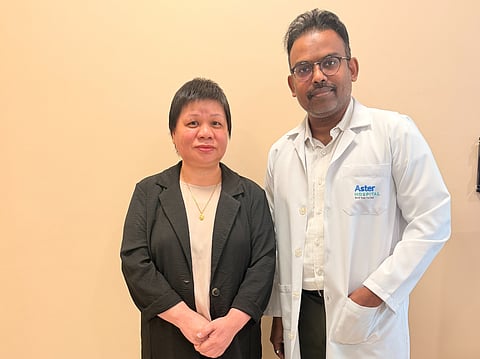
Dubai: For years, Eliza had an explanation for everything her body was telling her. The headaches were from work. The fatigue would pass. The double vision, the numbness, the loss of balance: all of it, she told herself, was just stress.
She was wrong. And that assumption, the 48-year-old Filipino mother of two now says, was the biggest mistake of her life.
"For a long time, I ignored these symptoms, thinking it was just stress or that it would go away on its own. That delay was my biggest mistake,” she told Gulf News ahead of the World Health Day on April 7.
It was only on the night of December 13, 2025, when Eliza suffered seizures in the middle of the night and was rushed to Aster Hospital Al Qusais as an emergency, that the full picture finally emerged. An MRI scan confirmed what no one had suspected: a brain tumour that had most likely been growing for years while Eliza carried on with her life, unaware.
"If there is one thing I have learned and want to share, it is this: be kind to yourself, listen to your body, and if something doesn't feel right, do not ignore it. Don't be afraid. Seek help immediately,” she said.
Ahead of World Health Day, doctors in Dubai are echoing her warning, urging residents never to dismiss persistent or recurring symptoms as stress or simple headache. Early diagnosis and specialist treatment, they say, can make the difference between full recovery and lasting neurological damage.
Years of missed signs
Eliza's initial symptoms were headaches, fatigue, double vision, numbness, and loss of balance. She said they had been present for years before that December night. Multiple check-ups had led to a diagnosis of sinusitis, and prescribed medication offered only short-term relief before the symptoms returned. Over time, she had simply learnt to live with them, attributing everything to the pressures of daily life.
It was after further evaluation and imaging at Aster Hospital Al Qusais that the real cause was revealed: a parafalcine supratentorial meningioma. It is a deep-seated brain tumour measuring approximately 3 cm and pressing dangerously on surrounding brain tissue.
Although meningiomas are among the most common primary brain tumours, parafalcine supratentorial meningiomas account for only 5–11% of cases. Their location deep within the brain makes surgery particularly challenging. In Eliza's case, the tumour was compressing the superior sagittal sinus, one of the major veins responsible for draining blood from the brain.
Doctors recommended emergency life-saving surgery without delay.
Skull from bone
The procedure lasted seven hours. Dr Chelladurai Pandian Hariharan, Specialist Neurosurgeon, and Dr Manish Srinivasa Murthy, Head of Department and Specialist in Anesthesiology and Medical Director at Aster Hospital Al Qusais, led the team using advanced techniques including intraoperative monitoring, microscope-assisted surgery, and ultrasound guidance.
Surgeons opened the skull at the back of Eliza's head, partially removed the tumour, repaired the covering of the brain, and reconstructed her skull using her own bone.
"This case was particularly complex because the tumour was located deep within the brain and involved the superior sagittal sinus, one of the major veins responsible for draining blood from the brain," said Dr Chelladurai.
"Any surgical manipulation in this area carries risks such as significant bleeding, stroke, or brain swelling. With advanced neurosurgical techniques and continuous intraoperative monitoring, we were able to carefully remove the tumour while protecting critical brain structures. Early diagnosis and timely surgical intervention are crucial to preventing serious neurological complications."
Road to recovery
Following surgery, Eliza spent three days in the Intensive Care Unit, where repeated CT scans confirmed satisfactory progress. She was then moved to the ward and discharged in stable condition, with no residual neurological weakness or deficits.
Dr Manish described the case as a demonstration of what coordinated, multidisciplinary care can achieve. "Managing tumours located near major venous structures requires meticulous planning and a multidisciplinary approach. The use of modern surgical technologies such as neuromonitoring and microscope-assisted precision allowed us to perform the surgery safely while minimising risks. This case demonstrates how coordinated care — from diagnosis through surgery and post-operative recovery — can significantly improve outcomes for patients with complex neurological conditions."
Eliza went on to complete radiation therapy, which resulted in complete resolution of the tumour. She has since made a full recovery and returned to both her career and her family life in the UAE, where she lives with her husband and two children.
How right diagnosis can save life
"For months, I believed my headaches were just migraines, but Dr Chelladurai was the first to identify the real problem," Eliza said.
"I am deeply grateful to him, Dr Manish, and the entire medical team at Aster Hospital Al Qusais for saving my life. The care, reassurance, and professionalism I received throughout my treatment — from diagnosis to surgery and recovery — were truly exceptional. Today I am healthy, back at work, and able to spend time with my family because of their dedication."
Her message to others is simple and urgent: "Early detection truly changes everything. A routine check-up can be sometimes life-changing or even lifesaving. Please prioritise your health, trust your instincts, and act early."
Doctors say Eliza's case highlights the importance of seeking timely medical evaluation for persistent symptoms.


