Awareness, financing, and more liquidity needed for people to go solar
Challenges still there for people to willingly tap into solar energy
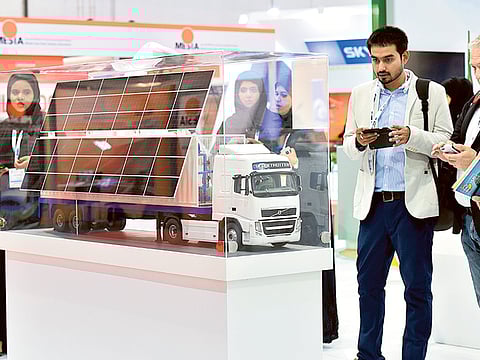
Dubai: More support systems that encourage households to go solar are needed in Dubai, industry players said.
Increasing public awareness, introducing various bank financing schemes and making the secondary market more liquid are needed for solar energy to appeal more to the greater majority in Dubai.
Key players in the solar industry from the Middle East and North Africa region met on Monday at the Global Solar Leaders Summit 2015 to discuss the growth opportunities and challenges in the solar energy industry in the region.
Dr Mattar Al Neyadi, Undersecretary, Ministry of Energy, said that in the UAE solar energy has made a remarkable progression and is on track to make a crucial contribution to the energy sector in a few years. He said the UAE is prioritising the improvement of the investment climate for solar power projects to provide solar energy systems both for utilities scale as well as for small-scale distribution.
In the UAE, both Abu Dhabi and Dubai are frontrunners in the solar energy industry. But it is only Dubai that allows homeowners and institutions to install rooftop solar panels as an independent venture.
When Dubai Electricity and Water Authority (Dewa) launched Shams Dubai in March that allows households to tap solar energy using solar systems on their rooftops, 11 establishments and households signed up. Altogether, they can produce 8.5MW of power, Dewa figures show. But demand has picked up, albeit conservatively.
Saeed Mohammad Al Tayer, managing director and CEO of Dewa, said applications have increased reaching a total output of 15MW from mixed-use facilities such as residential and commercial establishments.
Abdullah Rafia, assistant director-general for Engineering and Planning at Dubai Municipality, said to encourage more households to go solar, proponents should let the numbers speak but they have to be backed by facilities such as lending institutions tied with a government programme on this initiative.
“What we need here is a programme that brings together the owner, Dewa, manufacturers or interest group, the regulatory body, and some banks. If they get together, I think they can come up with a good project that [appeals to the public],” Rafia told Gulf News.
Apart from the relatively cheaper electricity in the UAE, the transient nature of the UAE’s population is also a factor in why solar energy is not yet a priority for residents.
“One of the reasons why Dubai is not able to install a lot of solar systems is because of the temporary nature of residency. Most of the businesses here are renting property. They are unsure if they can stay for a long period. For solar, you need to have an investment horizon of 18 to 20 years,” Amin Lakhani, general manager of DuSol, the first solar manufacturing company in Dubai, told Gulf News.
Another problem, he said, is the lack of market liquidity. Lakhani said a system should be in place that would allow property owners and developers to put more premium on homes with solar systems making it easy to liquidate them should the owners desire to.


