The passion keeping Abu Dhabi's old souk alive: "This is where I can tell my story"
In Abu Dhabi’s old souk, heritage, dreams and handmade stories endure
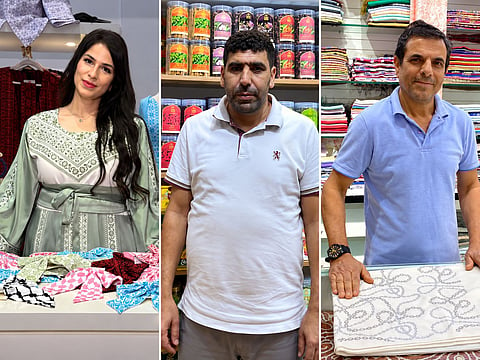
Abu Dhabi: "This is where I can tell my story," Iman ElHajj, founder of the clothing line, Darazean, says, about a place many would write off as an outdated market.
To her it is where her dream was born.
Not in her bedroom or on the school bench, but on the Fridays of her childhood, when her father took her and her sister to the old souk of Abu Dhabi after prayers.
"It was full of life," she remembered. "Short, simple stores with things all over the street. We would buy toys, spices, even street food."
Years later, she herself opened a shop there, at the old souk of the Abu Dhabi World Trade Centre.
As Abu Dhabi is modernising fast and shopping has moved to malls and screens, an old souk only survives if someone chooses, every day, to open a shop in it. Iman ElHajjj, Palestinian, born and raised in Abu Dhabi, is one of the people keeping it alive.
A dream comes true
Iman’s parents came to the UAE in the early 1980s, joining the growing community of families who came to the country in search of new opportunities. They built their lives in Abu Dhabi, where Iman was born and raised. She attended government schools before going on to university, where she studied computer engineering. But alongside her career, she has always carried a deep passion for Arabic heritage and fashion.
"I have always had a passion for Arabic heritage and Arabic fashion," she said.
When she began to think about turning that into a brand, she did not have to look for a place, because she has always known.
"The old souk is the dearest place to my heart. It is full of heritage, full of old stories, so this is where I can tell my own. I have never doubted that." Iman said.
In 2018 she made that dream come true and opened her first shop in the souk. Her clothing line, Darazean, now has three branches and a workshop close to the souk, where her own tailors make every piece by hand.
A dress is a language
She sells tatreez, Palestinian embroidery, which she learned from her grandmother and mother. Being able to bring it to life is a thing she carries with pride.
"A dress is a language," she said, "My grandmother and my mother taught me about different patterns."
"The Palestinian woman used to be very creative, and still is," she added. "We look at the nature around us, trees, mountains, even small birds. We express our thoughts, sometimes our status, in the dress itself. From looking at a woman's dress, we can tell whether she is single, married, whether she is happy or sad. There is a certain colour to wear, and certain patterns."
Some of the embroidery in her workshop is around 100 years old, cut from dresses once owned by Palestinian women and worked into new designs.
"Palestinian embroidery is like gold," she said. "Whenever it is older, it has more value."
She tells her customers the same thing: "If we make a handmade piece for you, it is like lifetime gold, because even if the dress becomes older, after ten years you can redesign it and use the same tatreez in a different outfit."
The UAE encourages women
Asked what it means to be a Palestinian woman building this business in the UAE, she talks about will, not obstacles.
"I believe women have the power to start anything they want, from a small business to everything," she said and added; "If we have something in our mind, we will do it."
Iman also expresses that Abu Dhabi gave her the room to do it.
"Abu Dhabi is my city. It is where I belong. Being able to express my Palestinian culture in Abu Dhabi makes me proud. The UAE has really encouraged this creativity and women. It gives us the space to express ourselves, and we can dream even bigger," she said.
The old souk is alive
Is a shop like hers under pressure from a mordernising city and online shopping? She said the opposite is true.
"I feel more privileged to operate in the old souk, because it really helped me market my line," she said.
"We have tourists from all over the world, and it gives us the chance to show our very rich Arabic heritage. Seeing them appreciate our Arab culture and our Palestinian embroidery really motivates me. Whenever the souk becomes older, it gives me more exposure," she also credits the souk's management for supporting her.
Her worry is perception, especially among the young.
"Sometimes they feel it is very old stuff, and they might not find what they are looking for, so we show them that you can wear the heritages in a modern way," she said and stresses the importance of teaching the younger generations to know the value of rich heritage
Her message to the public is short; "Support the art, support the artists."
Working from the heart
Iman is not the only one who made this choice. Across the souk, others made it for different reasons.
45-year-old Irshad Ahmad Shah arrived in the UAE 20 years ago from Kashmir in India, after finishing his bachelor in political science, to carry on his family's handicraft business in the country. He worked alongside his cousins, and today he sells shawls, carpets, wall hangings and cushion covers all from Kashmir. He started his journey in Dubai and opened his shop in the old souk around 10 years ago.
"Our business is based on tourists," he said.
He opens at 10 in the morning and closes 10 at night, and what he likes the most is the people he deals with every day.
Rachid Kharbouche, who is 41 years old came from Morocco and opened his shop at the old souk in 2016, where he sells Moroccan honey and herbs.
What makes him wake up every day and open his shop at the old souk is his love for honey, which he has inherited from his parents, who has been working with honey their whole life.
"If your work comes from the heart, you will succeed with it. And it will make working feel like a blink of an eye. This is what makes me open my shop every day without hesitation," he said.
Kharbouche described how his love for honey has grown even bigger in the UAE.
"Abu Dhabi has welcomed our products and passion for honey with warm arms. It has made selling honey feel like a service of love. This has underscored how Morrocco and the UAE is a brotherhood." he said.


