A handsome craft
Abu Dhabi's dhow-building tradition employs basic tools to create timeless masterpieces
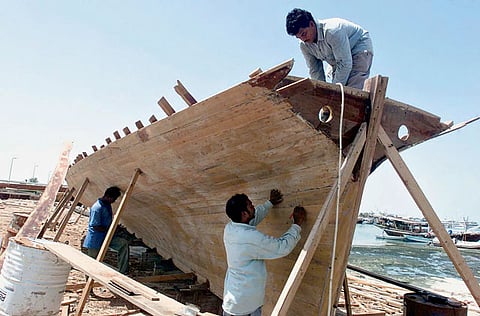
The harsh sounds of a construction site were a sharp contrast to the silence of the seashore at Al Bateen district but as I stood there early one morning it seemed to be the best place to appreciate Abu Dhabi’s almost-impossible geography of great sand expanses — restrained on the one hand by gentle waters and framed on the other by concrete, steel and glass.
At Al Bateen dhow yard it was business as usual as workers got ready for another hard day of exacting work. Construction hemmed the site and previously accessible areas were cut off by mortar and excavation. And although much of the ship-building activity has moved to Musaffah and other areas, a friendly security guard was quick to point out that it continues to draw visitors who remain undeterred by the dust.
Traditional dhows, an iconic symbol of the UAE’s very foundations, are still built by hand. One builder took a little breather while recounting some of the old techniques that continue to be in use today. Craftsmen use basic tools such as a hammer, saw, and chisel. Planks of imported timber are piled up, and the entire frame is put together by master craftsmen, who take between six months and two years to complete a dhow — the lifespan of which is said to be about 75 years.
Techniques are passed down from generation to generation through apprenticeship and experience, without charts or drawings. Once the vessel is complete, the master craftsman draws a waterline on one side of the dhow, the accuracy of which is always indisputable and proved once the craft is in water. In ancient times when dhows sailed the trade routes connecting Arabia to East Africa and the Indian subcontinent, they carried cargoes of dates and fish, returning laden with timber, spices and sometimes even the basic necessities of life. Also used also by the pearl divers who harvested the rich waters of the Arabian Gulf, these boats were an invaluable asset before oil became the chief source of income. And while I could see no evidence of those times, there was no denying the beauty of the vessel’s lines and the artistry of the craftsmen behind it.
Visible symbols of progress have threatened to submerge older districts, but the Abu Dhabi Urban Planning Commission (UPC) has taken a systemic approach to optimise the city’s development through a 25-year programme of urban evolution. Code-named Plan Capital 2030, the project aims to lay down the foundations for a socially cohesive and economically sustainable community that preserves the emirate’s unique cultural heritage. As the capital’s original dhow harbour and ship-building area, Al Bateen has a special place in its history and development. The Tourism Development and Investment Company’s idea is to build on the ancient tradition and make the wharf and marina a natural gateway to the capital. Soon, visitors will be able to watch dhow building in action once again.
For me, it was an interesting morning, more so when I think that a tradition that thrived a century ago continues to draw people.


