A bunk bed, Dh500, and a mother's prayers: How the UAE helped this expat bring Philippine craftsmanship to the world
The daughter of a roadside vendor now champions Filipino craftsmanship globally from Dubai
Dubai: In her early days in Dubai, Marilou Lorenzo-Joson slept on the top bunk of a room she shared with seven other women and wondered what came next.
She has arrived in the UAE in 2005 with borrowed money, a visit visa, and just Dh500 in her pocket. Back home in the Philippines, a mother battling asthma and a family struggling to make ends meet were counting on her. Failure was not an option.
Her story is not just about business success. It is about what can happen when sacrifice meets opportunity in a country that rewards perseverance.
“The UAE gave me the platform. My mother gave me the purpose. And together, they gave me the courage to finally build something of my own,” Joson told Gulf News.
Get updated faster and for FREE: Download the Gulf News app now - simply click here.
A childhood shaped by sacrifice
Long before Dubai has entered the picture, Joson's education in resilience had already begun. She grew up as the only daughter among four children. Her father worked as a security guard while her mother sold barbecue and halo-halo, a popular Filipino shaved ice dessert, by the roadside to support the family.
Money has been scarce, but her parents ensured their children understood the value of hard work.
“My mother never finished school, yet she gave me the most valuable education: faith, hard work, and unshakeable character,” recalled Joson.
Determined to build a better future, she has earned a scholarship at one of the Philippines’ leading state universities. She has graduated with honours and was recognised among the top 10 most outstanding marketing students in the country.
But academic success could not erase the financial realities facing her family. Her mother's recurring asthma-related hospitalisations and rising household expenses have pushed her to seek greater opportunities abroad. When a college friend invited her to Dubai in November 2005, she took a leap of faith.
Eight women in one room
The reality of expatriate life has been far from glamorous. Joson has shared accommodation with 24 women. Eight have occupied a single room, where she slept on the upper bunk.
Her bathroom schedule was at 5am every day, which has meant waking before dawn. Every dirham has to be carefully budgeted. Meals have been cooked to last several days, and taxis were a luxury she could not afford.
Instead, she has travelled across Dubai by bus, often walking long distances to interviews and appointments when she became lost in unfamiliar neighbourhoods. Yet she has never seen those circumstances as obstacles.
“Growing up without privilege is not a disadvantage, it is an education. It teaches you discipline, resourcefulness, and an unshakeable understanding of what truly matters,” shared Joson.
Within three weeks of arriving, she has secured employment. On December 2005, she has joined a company that would become her professional home for nearly two decades.
The UAE opened a window to the world
Over the years, Joson has built expertise across every aspect of the furniture business, from supplier relations and logistics to sales, marketing, and after-sales service.
Much of the furniture she worked with has been handcrafted by skilled Filipino artisans and weavers, particularly from the province of Cebu.
She has watched as these products were admired by international buyers and sold around the world. The experience has sparked a question that would eventually change the course of her career.
“One question kept coming back to me, why shouldn't these products carry the Filipino name proudly?” said Joson.
Working in the UAE has given her something few places could offer, and that is direct access to global markets. She has interacted with international buyers, corporate clients, architects, and designers from around the world.
Moreover, she has learned how products moved across borders, how brands were built, and how relationships created business opportunities.
“The UAE sharpened me professionally in ways I could not have found anywhere else.”
Building a bridge between the Philippines and the UAE
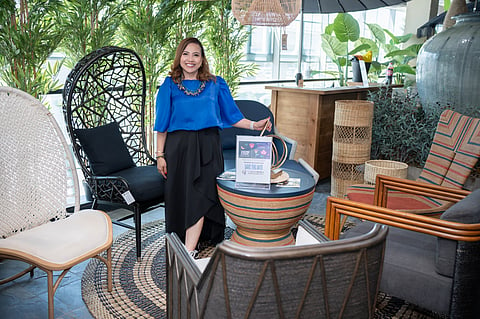
After years of industry experience, Joson has founded Casa Filipina. The company has been born out of a desire to showcase Filipino craftsmanship on the global stage while creating meaningful opportunities for artisans and small businesses back home.
Today, it serves as a platform connecting Filipino micro, small, and medium-sized enterprises and skilled artisans with international markets through the UAE.
Notably, Joson has also been nominated by the Philippine Trade and Investment Centre as a bridge between stakeholders in the UAE and Filipino entrepreneurs, helping strengthen exports and trade between the two countries. For her, the mission goes beyond business.
“The experiences, the relationships, the communities, and the love for my mother and her tireless hard work have reminded me every day why purpose matters more than profit,” explained Joson.
Each product represents not only craftsmanship but also the livelihoods, traditions, and stories of the communities behind them.
A second home for her family
The UAE's impact on Joson's life has extended beyond her professional achievements. Her parents have lived with her family in the Emirates since 2008. Over the years, they have faced challenges that tested them in ways no business ever could.
One of her brothers has underwent a kidney transplant in 2013. Another has battled severe Covid-19 pneumonia and spent 45 days in intensive care in 2021. Her father has also survived Covid-19 at the age of 65.
Joson has credited the UAE’s healthcare system and quality of life with helping her family through some of its most difficult moments.
“The UAE has given my family a second home and in many ways, a second life,” exclaimed Joson.
Those experiences have deepened her commitment to giving back through charity works, community initiatives, and financial literacy advocacy through the registered financial planners network.
Message to every expat
For nearly two decades in the UAE, Joson believes the country's greatest strength lies in its ability to reward effort, regardless of where a person comes from.
“The UAE is truly one of the greatest gifts to every expat who comes here with a dream. This country does not judge you by where you came from. It values what you are willing to contribute. It keeps you safe, it gives you opportunity, and it genuinely celebrates your success. Not every country does that,” remarked Joson.
Her advice to fellow expatriates is simply to know your purpose. “Know your why. Don't just come for a salary, come with a purpose. Find your deeper reason and hold onto it tightly.”
In addition, she has encouraged newcomers to remain humble, respect the country's culture and laws, and focus on building character as much as career success.
“The UAE rewards people who show up with integrity and stay committed. Be a responsible and grateful resident because the UAE has given us so much and we owe it our very best.”
From surviving to creating opportunities
Today, Joson spends her days doing something she once only dreamed about, creating opportunities not just for herself, but for others.
Through Casa Filipina, she is helping Filipino artisans, weavers, and small businesses gain access to international markets. Through her community work, she advocates financial literacy and entrepreneurship. Through her own story, she offers proof that humble beginnings do not determine a person's future.
Yet for all she has achieved, the image that remains strongest is not the business she built or the milestones she reached. It is her mother.
The woman who sold by the roadside. The woman who never finished school but taught her the values that would carry her across countries. The woman whose prayers travelled with her long before success did.
Looking back, Joson does not measure her journey by the company she owns today. She measures it by how far that young woman with Dh500 has come. The bunk bed is gone. The borrowed money has long been repaid. But the faith that brought her to Dubai remains unchanged.
And every handcrafted piece she now helps bring to the world carries a reminder of the lesson that shaped her life, that sometimes the greatest investment is not the money in your pocket, but the purpose in your heart.
Because in a city powered by ambition, Joson's story proves that dreams do not always begin with wealth or privilege. Sometimes, they begin with Dh500, a mother's prayers, and the courage to board a plane.