From ancient amulets to social media: The enduring mystery of the Evil Eye
Artist Zahed Sultan explores how a centuries-old belief continues to influence culture
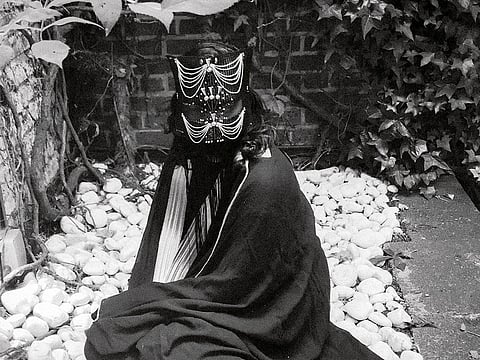
Rooted in ancient beliefs and social rituals, Al Ayn—also known as the ‘Evil Eye’—is a cultural artefact that emanates from the notion that an envious gaze can bring down illness, misfortune or harm upon another person, corrupting an achievement or souring good fortune. The methods to avert this are many and varied, ranging from protective symbols to social rituals.
For Kuwaiti-Indian multimedia artist Zahed Sultan, the concept of Al Ayn has become something of a fascination, both for its complex history and its myriad aesthetics. The constant evolution of Al Ayn offers much to explore as—in his eyes—it speaks to a fundamental aspect of human nature.
Get updated faster and for FREE: Download the Gulf News app now - simply click here.
“When faced with sudden misfortune, people naturally ask why it happened to them,” Sultan tells The Kurator. “Whether through ancient amulets, or modern wellness concepts like avoiding negative energy, the practices that have grown up around Al Ayn offer accessible, comforting methods to maintain a sense of protection and control over the unknown.
“I’m drawn to Al Ayn because it represents a cultural memory where everyday traditions become carriers of stories and create tension between preservation and erasure,” he continues. “I’m intrigued by these layers of memory and how they continue to live through our shared landscape, structures and daily rituals, while also seeing culture as a practice that is continually evolving, reshaping and being carried forward.”
The concept of Al Ayn is old, dating back 5000 years, although its precise origins are difficult to pin down. The Evil Eye and similar talismanic symbols permeate cultures ranging from ancient Mesopotamia, Egypt, the Levant and Greece, through to the Ottoman Empire and even Indian and Urdu traditions of South Asia. Most notably, Al Ayn has become firmly entrenched in Islamic culture, despite its pagan origins, even today.
“Islamic tradition explicitly acknowledges the reality of Al Ayn,” Sultan explains. “Prophetic traditions state that the Evil Eye is real and can exert a tangible influence. This is why expressions like ‘Mashallah’ are so common in the Arab world, invoking God’s name shifts the focus of praise to the divine, neutralising potential envy or evil eye curses”.
“In Islam and Eastern traditions, religion still deeply permeates culture and society,” he goes on. “Belief in Al Ayn comes from a worldview that accepts that the physical world is influenced by spiritual forces. This concept is so culturally embedded that phrases like ‘Inshallah’ or ‘Mashallah’ are part of the fabric of daily life.”
As such, Al Ayn takes on many different guises. The iconic blue glass ornaments depicting the Evil Eye—also known as a ‘Göz Boncuğu’ or ‘Eye Bead’—are most associated with the Ottomans, crafted to act as a mirror, gazing directly back at the observer to deflect envy. Another well-known form is the ‘Khamsa’ which combines the Evil Eye with an open palm, and primarily protects women from ill will, common in the Levant.
There are also practices that do not incorporate the Evil Eye itself, but still serve the same purpose. Traditional garments
—especially children’s clothes—often feature metal decorations embroidered around the chest and collar, creating a dazzling glimmer that breaks an observer’s focus and thus deflects jealousy, while Bedouin ‘Sadu’ weaving embraces repeating geometric patterns like triangles, diamonds and chevrons, which symbolically act as arrows to pierce the Evil Eye. Al Ayn even finds purchase in the architecture of the Middle East in the form of ‘Mashrabiya’, intricate lattice wood screens on windows and doors that break lines of sight to prevent jealous looks from passersby.
Al Ayn is also highly prominent in traditional celebrations, especially weddings, which gather together many subtle protective rituals. Bridal attire featuring heavy gold headpieces and other metal adornments creates continuous sound and light reflections, serving as sensory distractions that prevent an observer from holding a direct gaze, while henna designs block the entry of negative energies.
“Traditionally, a bride observed a period of seclusion before the wedding, to minimise exposure to envious gazes,” says Sultan. “During the festivities, heavy curtains and screens shield the bride, diverting ill-intentioned admiration. The bridal entrance procession also features loud drums, singing, clapping, and the burning of incense, which act as a ritualistic exorcism of the space.”
In more recent times, the iconography of Al Ayn has also translated into the world of fashion and popular culture. Today, airports and tourist destinations are thronged with keepsakes, keychains and postcards decorated with the Evil Eye. All of this attests to Al Ayn’s striking visual flair, but it also raises the question: if a symbol has become so recognisable, and even desirable, does that not run counter to its original purpose as a ward against the jealous gaze of others?
“Because Al Ayn has drawn so much interest over the years, centuries of thought have gone into what is considered the final symbol,” Sultan remarks. “There is a decorative, almost souvenir-like aspect that has been very much honed, and it has permeated culture to the point where it has become a form of self--expression. I do wonder how many people wear it today simply because they like the aesthetic, versus how many actually believe in it fully. If the intention is to ward off the envious gaze, but you purchase something that obviously commands high value and draws attention towards you, that is a powerful contradiction.”
At the same time, it cannot be denied that our current era is one of high exposure to potentially harmful attention. The explosion of social media across the globe has catapulted many to unexpected stardom or sudden -infamy, making threats like online scams, doxing and cancel culture feel very much like -contemporary manifestations of the menaces Al Ayn is supposed to ward against. In an attention economy unlike anything before it, the protection against the Evil Eye may well be more sought after than ever.
In many ways, Al Ayn is firmly anchored in the universal human experience of wanting to protect one’s own joy and prosperity from the envy or judgement of others, navigating a precarious social balance between the celebratory and ostentatious.
“The modern concept of ‘vibes’ might just be a very watered-down term for Al Ayn,” muses Sultan. “We all try to give form to the unexplainable within ourselves. Striving to make sense of what is within and around us cements the foundation for concepts like Al Ayn in our collective consciousness, especially when people are trying to navigate beyond a rigid, black-and-white view of the world.”


