Exclusive: Reema Al Banna turns her memory box into a collection
At The JamJar, a Dubai designer turns intimate memories into immersive fashion
“For me, it’s much more important to create a fashion presentation that makes people feel something than one that’s simply big or elaborate.”
It is an unexpectedly understated way to begin talking about a fashion show. At a moment when presentations are becoming increasingly ambitious in scale, Reema Al Banna has little interest in hunting for excess. The founder of Dubai-based label REEMAMI isn't trying to construct an illusion as much as invite people into a world that already exists.
“A meaningful presentation is more than just creating something beautiful,” she tells The Kurator. “It has to have a genuine connection to the story, the designer, and the brand.”
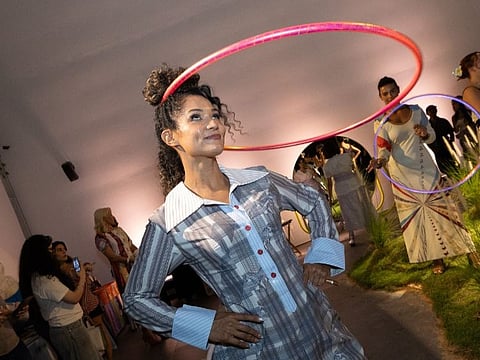
That idea shaped every part of REEMAMI's latest presentation at The JamJar, where the gallery became less a runway than an extension of Al Banna's imagination. Guests wandered through rolling grass installations, hand-drawn interventions and objects gathered from years inside her atelier, pausing to paint, explore and interact with the space rather than simply observe it. The atmosphere felt very domestic, almost as though visitors had been welcomed into someone's creative process instead of arriving for a fashion show - it felt real.
“When every print, silhouette, fabric, movement, sound, and detail serves the same narrative,” she says, “people aren't just watching a show; they're experiencing an idea, a culture, and an emotion. That's what stays with them long after it's over.”
That emotional thread runs through the collection itself.
Rather than beginning with one reference or seasonal mood, Al Banna looked inward, drawing together fragments collected across different stages of her life. Childhood memories sit alongside recent sketches. Prints first developed in 2015 reappear beside entirely new designs created for 2026. The result refuses chronology, allowing different moments to coexist without hierarchy.
“It feels like opening an old memory box and finding everything mixed together,” she says. “A childhood photograph sitting beside a sketch from yesterday. A print from ten years ago speaking to a new idea. A beach toy becoming a fashion detail. I wanted to create a world where nothing needed to be separated or organised - where memories, dreams and different versions of ourselves could all coexist.”
Those references are unexpectedly ordinary. A beach ball. Inflatable rubber floaties. Family photographs. Even images of Al Banna modelling in brochures for her father's dental clinic during the 1990s become part of the collection's visual vocabulary. Objects that might otherwise remain tucked away in family albums are transformed into garments that feel less designed than assembled from memory itself.
Across the collection, zebra prints drift alongside cross-stitched checks. Love birds appear between florals and planets. Scarf motifs resurface beside references drawn from earlier REEMAMI collections, while stripes travel in opposing directions without ever demanding perfect symmetry. Lace interrupts satin. Cotton meets appliqué. Ropes weave through silhouettes. Every look embraces contradiction, yet nothing feels accidental.
The collection also marks something of a conversation between REEMAMI's past and present. Rather than treating the archive as something fixed, Al Banna revisits earlier ideas with fresh perspective, allowing older prints to acquire new meaning through unfamiliar combinations. It reflects a designer increasingly comfortable returning to her own work instead of feeling compelled to leave it behind.
That same sense of familiarity extended beyond the clothes.
As a small independent label, Al Banna wanted the presentation to feel personal rather than performative. The women wearing the collection weren't selected to disappear into identical looks or choreographed personas. They were people already woven into the life of the brand.
“Every woman in the show is a friend of the brand, and I have a real relationship with each of them,” she says. “It honestly felt like inviting friends over for dinner and to play dress-up together.”
There was no attempt to flatten individuality in service of a uniform aesthetic. Instead, each woman wore the clothes in a way that reflected her own personality.
“They're all incredible women with their own careers, personalities and sense of style,” Al Banna explains. “I wanted them to wear the clothes in a way that felt natural to them, in their own comfort zone, because that's what Reemami has always been about: celebrating individuality rather than making everyone look the same.”
The environment echoed that same thinking. Working alongside artist Farah Tajeddin of The Art Supper, Al Banna created a communal tablescape layered with archival REEMAMI fabrics, recycled textiles and playful objects collected throughout the brand's history. Rather than commissioning an entirely new set, she simply reimagined the one she already had.
“Almost everything came from my atelier - our sofas, mirrors, foosball table, toys, and objects that have lived with the brand over the years,” she says. “Instead of creating a completely new world, we transformed the one we already had into something magical.”
The evening continued beyond fashion. Chef Dalia Dogmoch of Zinn Bistro interpreted Palestinian flavours through contemporary canapés, including tabbouleh dumplings and musakhan rolls, adding another layer to an experience already shaped by memory, identity and storytelling. Al Banna's own heritage was present throughout the presentation, though never announced overtly.
“There were subtle nods to my Palestinian heritage, but always through a fun, playful, and whimsical lens,” she says. “That's how I naturally tell stories through Reemami - celebrating where I come from with optimism, colour and imagination rather than presenting it in an expected way.”
The collection never asks nostalgia to remain fixed. Instead, memory is treated as something fluid - capable of shifting, overlapping and returning in unexpected forms. It is less about looking backwards than recognising that the past continues to shape the present, often in ways that only become visible once the pieces are allowed to sit beside one another.
"Reemami's visual language has always developed very organically," she says. "It comes directly from my world - how I'm feeling, what I'm experiencing, the things I'm interested in, and the hobbies I'm exploring at a certain moment in time. The sketches, drawings, prints, and stories are all connected to my life in different ways, which is what makes the work feel authentic and personal."
For many designers, developing a recognisable identity can become a paradox: the very qualities that establish a brand eventually risk confining it. Al Banna sees the opposite.
"I don't think having a strong signature is restrictive," she says. "I actually think it creates a foundation that gives me more freedom to explore. Once you have a language, you can keep playing with it, stretching it, and discovering new ways to express yourself. The DNA stays the same, but the way it evolves is always changing."
That evolution rarely begins at the drawing board. Instead, she describes a process of stepping away entirely.
"Every collection starts with creating space to feel something new. I usually need to take a break after finishing a collection, to step away from that world and allow myself to be inspired and moved by something else. That emotional connection is what helps a new language emerge naturally."
This season became one of REEMAMI's most expansive to date, eventually growing into 65 looks. Not every piece appeared during the presentation, with a number held back for the forthcoming lookbook, allowing the collection to unfold beyond a single evening. Even at that scale, however, Al Banna found herself returning to familiar ideas - not out of habit, but because they continued to reveal new possibilities.
"What surprises me is that I often find myself returning to familiar shapes, feelings, and ideas, but they never come back the same way. They become more developed, mixed with new prints, new combinations, new techniques, and new stories," she says. "It's like speaking the same language but discovering new words."
It is a revealing analogy. Rather than reinventing herself each season, Al Banna is refining a vocabulary she has spent years building, trusting that depth can be more compelling than perpetual reinvention.
That marks perhaps the biggest shift in her thinking since launching REEMAMI.
"When I first started Reemami, I think I believed that I had to prove myself through constant newness - to always create something completely different, to surprise people, and to keep pushing forward without looking back."
It is a pressure familiar to many independent designers, particularly in an industry that often equates relevance with non-stop novelty. Looking back, however, Al Banna no longer sees progress in quite those terms.
"Over time, I realised that growth doesn't always mean changing direction. Sometimes it means going deeper into what you already have and understanding your own language better. I used to think that repeating certain elements could become limiting, but now I see that the most authentic brands are the ones that continue to explore their own world from different perspectives.
Reemami has always been about storytelling, colour, playfulness, and personal expression," she says. "Those things haven't changed - they've just become more refined and more intentional. I've learned that evolution is not about abandoning your identity; it's about allowing it to grow with you."
That confidence is perhaps what stays with you most after leaving The JamJar. Beyond the prints, the layered references and the carefully assembled environment was the sense that nothing had been included simply to impress. Every object, every pattern and every memory belonged because it belonged to Al Banna herself.
"Today, I trust the process much more," she says. "I don't feel the need to force something new just for the sake of being different. The most exciting ideas come when they are connected to something real - an experience, an emotion, a memory, or something happening in my own life."


